
The Letterman Podcast · Episode 34
Sue Hum
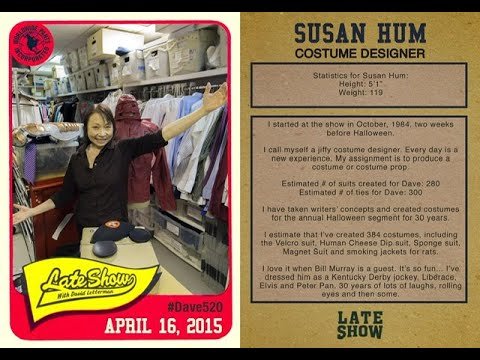
For over 30 years, Sue Hum was the costume designer for Late Night and Late Show with David Letterman. She helmed the crafting and execution of everything we saw on the show from the aesthetic of Dave’s wardrobe, the designing and production of the humorous suits and costumes he and other members of the cast wore, and of course the iconic annual Halloween bit where children would come in wearing hilarious trick or treat costumes. In this first episode Mike explores Sue’s roots of where she came from and how she ended up becoming part of Dave’s company, by way of Broadway and Another World. She also worked on other projects including a Run D MC video before embarking on what would become a legendary career. Sue and Mike barely scratch the surface in this fascinating behind the scenes retrospective tour, leaving so much on the table for future episodes.
As always, The Letterman Podcast is brought to you in part by The Hello Deli. If you are in the New York area and enjoy good food and kindness, visit the Hello Deli, and feel free to tell them Mike sent you; you will be sure to receive extra condiments for your trouble. While there, check out the assortment of Late Show with David Letterman merch as well as very nice merchandise featuring Rupert himself.
Please also feel free to Subscribe to, Like, and Share the Letterman Podcast with all your friends and rivals alike. Heck, even your mom and dad can get in on the fun! We are grateful for all the support! Please feel free to join our group on The FaceBook, where we will be giving away Letterman stuff, once we figure out how to do it.
Episode Transcript
Read full transcript
you're watching The Lettermen podcast with Mike Chisholm endorsed by the hello Deli yeah welcome once again to the Letterman podcast my name is Mike Chisholm I am stoked to be here I am stoked to have the conversations that I have with all of the folks who have something to do with the David Letterman Mythos uh the again uh the unprecedented greatest body of broadcasting work in history and uh today's episode is no exception it's almost Halloween and so you know what um there was an ongoing bit that was run on all of David Letterman's uh shows uh up until the end of The Late Show in 2015 that had to do with uh comedy Halloween costumes and so who better of a guest to have on this week's episode of the Letterman podcast then sue hum suhum who had so many on-screen appearances but also was behind the scenes um one of the elves that created the magic that we saw on screen phenomenal body of work in this episode we talk about where she came from uh quite literally actually geographically and and also you know what emotionally where she came from and the journey that she went on in going from a farm girl to an artist to a costume designer of Epic Proportions so excited about this as you can imagine this was a uh one of those dream come true uh episodes for me I had a real kick talking to her and we got all of the um the biographical stuff out of the way so the next time she comes on the show we've got a ton of instances that we can talk about and things uh but we hit the broad Strokes today it was fantastic talking to Sue and I just appreciate her so much this episode of course brought to you by Rupert in May at the hello Deli in New York go to hello deli.com if you're looking for Late Show with David Letterman merchandise or Rupert merchandise or one hell of a sandwich um thank you very much for all of the support so far please like please share Please Subscribe All That Jazz uh without further ado we give you Susan hum okay so you actually started uh art school as a post and you were an art school teacher as opposed to costuming that's where you started I was an art I was artistic what had happened is I grew up on a farm okay my father was a civil engineer we were just outside of Wilmington Delaware uh my father went to a woman a woman a university Delaware he got a civil engineering degree and his uh dream was to buy a farm and so the uh uh man who uh one of his friends uh that was in the office said there was a farm 60 Acre Farm uh for sale right next to his Farm in landerberg Pennsylvania so all I know is we moved from Wilmington Delaware to to this Stone Fieldstone house with an outhouse and pumping water and I went to a ding dong one room school house with a big classes three grades in one class in one room pumping water in an outhouse uh and then my father uh we got pigs cows and chickens then we graduated to Black Angus and then we had Black Angus yeah yeah this is and then moving on up in the farming world in the farmer let me tell you I I delivered so many baby calves you know I wanted to be a veterinarian even though I was artistic wow and okay so I want to start back there to the part where you were artistic in a second but I also want to go back a little bit further for a moment because when when my wife and I were in New York last week uh we had a beautiful dinner with uh Rupert and May and we told them um that that you were going to be coming on the show and they both got excited because you all have a commonality back well before that as well you're from the same region uh historically family wise right I think we all were Southern Chinese ancestry yeah May has peop friends family in Hong Kong I don't know about Rupert you know Rupert never talked about his background but all all of us have a common ground because we're pair children of immigrants well they're under the impression that you all came from like almost the same town um and it can be very very very uh close to each other but um that's what they had told us anyway they got very excited when they heard you were coming on now that being said you're in Delaware you guys are moving up uh in the farm world you deliver calves you're you're you're you're literally a farmer's daughter um now that being said when this artistic Flair came out of you and this desire um how was that viewed by the rest of the family because obviously it's a it's a stark departure from farming well first of all my artistic uh creativity started way before uh first grade teachers started to notice that I was very good and then the next thing you know by high school I was doing the murals uh and and and I was doing the the yearbook I was decorating the prom and uh I got scholarship to Moore College of Art uh the art teacher so I started drawing very very young and and and teachers started to notice that and I think that was my solace to to be on my own and and and be in my own little world to sit there and draw you know and that's what I would this this is fascinating to me um because at the end of the day you look at your skills as a costume designer and and where your career ended up taking you but many times you have artists who will uh attract to Fashion at the same time you know many of the outlets that artists do is is is is uh inventing clothing and lines and and different things like that was that something that you ever did when you were an artist or was it more uh was it other things I'll tell you what when you grow up with Asian parents that have you have a tiger mama in the family you do uh what they said well I always wanted to be in the fashion world but my parents said uh we were not going to send you to school unless you uh become an art teacher you have to have a and make a living out of Art and this is the days where uh of course Asian immigrants they they really uh focus on education and and and and and really tell their kids uh how they have to make a living out of what it goes well it's got to be practical right and I mean I I think that uh all of us can understand the logic behind that because we all want our kids to do well we all want our kids to be able to sustain themselves but when you're an artist that wants to burst out of you many times art and commerce don't necessarily mix do they well you you know and you grow up on the farm and then all you have is your family and pigs chickens and and dogs as your friends you know I lived a pretty isolated uh life and going to uh in a primary school a one-room schoolhouse with three grades and uh a stove pot belly stove in the middle of the classroom you know like uh pioneer days you know so you know you're talking to somebody who who Who's um didn't grow up in the city that's for sure okay so what university did you end up at I went to I got a scholarship yeah College of Art and that was because of my high school teacher at Kennett Square Pennsylvania uh I guess found out about this this school oh uh so I took Saturday classes I would get on the train at Newark Delaware that would go all the way up to Philadelphia and I would take Saturday classes and from there I went to Moore College of Art for four years wow was that mind-blowing to you coming from this small isolated place and then suddenly it's just being exposed to this brand new world was that the thing that you had dreamed of were you excited or was it just scary as hell well nothing was scary the thing is there was just an eye-opener you know by that time everybody was heavily dating and going to fraternity parties I mean I was taking my drawing board and going to the Museum of Philadelphia Museum and drawling because uh I I I you know everybody was you know I didn't date in high school like other High School people did I didn't have a normal uh All-American upbringing if you've got Asian parents you don't have an All-American upbringing unless University you caught up for lost time huh oh boy did I with the push thing speed button uh by the time I got to New York yeah yeah and one thing led to the number yet another and I just thought you know um I was just in the right place in the right time I uh I'm fascinated by this um you get your art degree you actually become an art teacher you actually go through and get the teaching certificate and all of that yeah I I taught for uh I think five years wow uh before and then I got then then I got married to an aspiring uh actor that's how I got into costume design because I knew how to sew and we went to a my husband at that time was in acting in place at a place called um the amateur Comedy Club at sniffen court at 36th Street between Lexington and 3rd it was founded by the Steinway piano Brothers wow yeah so he he was in little there was a gentleman's club that was putting on plays and then one director came and we did Camino Real and three plenty Opera and then I ended up him telling me Oh we're going to the Chelsea Theater over where bam is in Brooklyn and uh all of a sudden I I go there and I I start doing plays I've done like over 25 plays and one Broadway show and and ended up getting a um uh graduate assistance grant uh at Brooklyn College theater Department yeah but then I knew more about theater and by practical methods than just hitting the books and finding out uh when what was uh what came after the tutor period and the Renaissance you know this is all while teaching at the exact same time like this is you basically taking that that farm girl work ethic and and and having a career but then working on a second career blossoming on the side of that at the same time yeah well that was well after I left the farm you know of course but yeah on arm you you have you know that's lurking on a farm is um busy busy I tell you uh you you don't stop you know you gotta turn on the tractor key and and and rake the hay and you you've gotta uh you you've you've got to feed the animals uh you've got to harvest you got to put that hay in the barn stuff like that and then well all of a sudden you know down there um we became friends with Mennonites in Lancaster and they that this family I know uh called the wagamoose I'm still friends with them they're uh the father used to come and talk to my dad how to rotate crops and everything uh so that family's a large family in Lancaster and I'm still and connected with them you know oh that's delightful um so if I have it right you're doing the theater stuff for a while and then you end up did you end up on another world from there oh here's what happened um yeah so like I get a I get a I start I'm still teaching get it to get separated get a divorce yeah not a costume designer yet but want to be a costume designer from my theater experience yeah and through the connection of of of of of the Chelsea Theater and Robert calfinman who was the artistic director who I put on the first play in uh the West Side theater I did um the contractor but we before after that I I noticed I I need to um make a living because now I have a one-year-old child right that's hard yeah so I I go to the network and there you go I ended up in another world and then I started uh substituting for um uh costume desires who would go out on vacation to a couple other soaps and kept getting connected and there was a woman named Gloria who was in the design Department uh uh at NBC and I kept going up to her after I do a couple beauty pageants you know ones that Trump owns you know yeah that owns the universe and miss miss miss teen what would you do there like did the contestants bring their own dresses in and you would help augment or did you like dress a lot of these contestants oh no I would put on a Broadway show all these contestants yeah 50 contestants I would have dressed up in a costume I remember Tommy tune and Twiggy they were the the dancers and the girls were backup dancers and they sing a song and this would be a main main little form of entertainment uh of part of that show okay and that's that's what I would do dress 50 individual contestants you know wow yeah that's huge that that's huge yeah it it was huge yeah so um at the same time another world did another world it didn't shoot in 30 Rock did it no another shot in Brooklyn uh M and East 14th you know your your history that Avenue M and was another world and another soap opera there and did you know at that studio Esther Williams swimming pool was underneath are you kidding me yes that's where they did Esther Williams swimming goodness yes big big wow yes so I was history there too but then after that is that when you went to the even more historic 30 Rock is that when you moved over there like did another world springboard you over to that and 84 I became freelance I went out and did a a TV movie with Jason Robards and even Marie Singh called a Christmas to remember Somewhere Out near Minnesota and then then I did a lot of commercials yeah you know like for Sony TV and and and and all all I guess I did about eight commercials and then just kept my fingers in the fire looking for another job another little job when you are a freelancer just grinding it out um you know and and back you talk about the TV movie I don't know if there's an equivalent today to what the TV movie was back then and um and a lot of a lot of young folks right now don't even understand that all the major networks would have throughout the week or or the month they would have a couple of TV movies of the week it was the network that would create these movies yeah I think the closest thing you'd kind of maybe compare it to now or maybe Hallmark movies or something like that that's kind of the similar kind of production and um and some of these TV movies were were gigantic and they gathered cult followings of them on their own oh yeah yeah I mean for me to work with Eva Marie Saint and Jason Robards yeah these These are are are are the finest uh actors and actors and and you know when you dress even Marie Saint and you you and that's 1930s um time and I give her that I'll try these shoes on and she puts them on and she says you know I have never had anybody give me a pair of shoes that I just fit into just like that it was a lovely lady you know and it sounds like um as you're progressing in your life and you are moving over towards the uh the the costume end of things uh closing the chapter on the on the art part um it sounds like you know duck to water this is what you always wanted and it's as good as you thought it was going to be well you know uh one job led to another and and when you become an artist you you you are always you have this fight in your mental um about where's my bread and butter and how can I do an artistic uh Endeavor that I can contribute to to their ideas you know uh yeah and and and um one of them came closer I did Andreas vollenweiter's uh pearls and tears that that was I don't know if you know Andres Paul invited I'm not familiar with that one new age uh New Age um heart heart a hard play yeah yes yeah and and it seems like you can meditate to more than that it's uh you take you know all the avatars that you you've seen in the fantasies of of the world he he he in his mind uh takes you somewhere take you somewhere yeah yeah but you know in the meantime I I connect myself and I I do the start of getting the music videos and I did run dmc's first music video you're not talking about let's not Walk This Way is it yes with Aerosmith no a Run DMC yeah no no Run DMC did Walk This Way with Aerosmith that was a big video at the time uh or It's Tricky or Tougher Than Leather I'm trying I did it with um Hillary Bud Melman was in it one of the sequences yeah okay and is that your first connection to the Letterman show then no letter Letterman's show was just out of the blue Gloria from NBC calls me and says oh will you get a pair of ice skates that's all I need and I said okay I'll get it anything else next week comes uh okay you're going to be here for a week okay and and and and and I never left oh really now when you got there um now did you know you wanted to stay and then number two in your wildest dreams did you ever think it would last three decades no you know something when I I the reason why I think they put me in so many uh acting little bit Parts is because I'm a serious person and I have a serious face and I laugh Off the Cuffs and now I've learned how to be silly you know but all my Asian upbringing if you ever saw my brother or sisters they they are super serious Academia you know yeah so I I this is where it led me to and I stayed there and I I watched David and BC days walk down walk down the the hallway with Meryl Marco yeah to chatting away and throwing the football and getting to the studio and how Gurney's there and and and the crew all waiting for him and and uh by then you know going gee this is pretty simple But as time went by uh lycha grew and grew and grew and everything was spontaneous everything off the cuff well and I mean I'm gonna I'm gonna get into that in a second here because I've got some stats and we're gonna talk about this um I'm gonna just kind of set the table not just for the viewers and the listeners today but also for you and I now here's the thing um every single time I get one of you on this program here I there's so many questions that I want to ask like we go through the background and how you got there and all that stuff the first time I'm hoping that I can get you back on multiple times because the list of questions that I have for you and topics that we could discuss is massive like massive especially with yusu because um you have so many different um Dimensions as your place within the Lettermen and Company Mythos you certainly do so I'm gonna try and get to all the general stuff today and because we are uh coming out before Halloween and and and um and also to coincide with the fact that uh your staff moments just came out on the day that we're recording this actually with Walter that you shot it just came out today did you know that have you seen it yet no then until I before I I just looked at my my my phone and I and I was with my son because he he has I I go with him twice a week on deliveries with his business uh and I go oh look I I I want to share this first time look with you so well we saw it together that's adorable it's fantastic so um the other thing again setting the table the other thing that I don't want to do is I don't want to just rehash um all the moments that Sue talked about in that in that uh favorite moments go go watch the uh we're gonna we're gonna um obviously uh in our Facebook group and what oh go ahead I I did see it yeah I saw it what they they covered yeah good well well maybe you and I'll talk about that in another episode I don't want to just rehash that people can go and they could watch it on their own it's fantastic I highly recommend it go watch Sue hum's uh favorite moments by the way the music video that uh that you did for Run DMC which I did not have in my notes uh was king of rock and um that is so cool that you worked on a Run DMC video I mean you know Letterman in the sense you know the hippest chain talk show at the time changed late night forever changed uh the definition of a talk show deconstructed it Run DMC did the exact same thing for music I mean they changed an entire genre and created helped create a genre um man so you've worked on some Cutting Edge man holy cow you know I just want one thing to another I mean uh you know and also during my season doing plays I was Forerunner of new plays like I did Leroy Jones's plays and Ed bullins's play When the uh black theater started to emerge in the 80s most creative time for new New Riders to to do I did a Asian plate fractions the Year of the Dragon he's from San Francisco that was an American place and that was on PBS channel 13 as well you know so I I was like there uh in in sort of that Flux Of of artistic uh Performing Arts time you know and what a sensibility to bring to late night I mean my wife and I uh were just in New York as we've mentioned uh Ad nauseam lots of people know that we were just there um but we went and saw a book of Mormon and we went and saw funny girl and when you look at Broadway level costume design or set design boy does it ever open your eyes when you're used to seeing you know and no offense to local Productions and local community theater Productions things like that even the touring shows no offense to any of them but there is nothing like Live Theater in New York and you being a part of that and taking that skill set and that expertise over The Late Night it makes a lot of sense and I think a lot of folks who greatly admire what you did within the Lettermen run it makes sense that that that you are somebody who had worked on Broadway and some of these other things and and we're able to think outside the box you have a you have a quote here you call yourself a jiffy costume designer every day is a new experience your assignment is to produce a costume or costume prop now I I want to talk about this I want to talk about the Halloween costumes because it's the time of year and I want to talk about dressing day wave from NBC to CBS those are the things that if we can if we can tackle those topics today I'm a happy guy um so you get on to late night and you're going from working with Broadway uh caliber you know the the top of the top and then suddenly you're making magnet suits and velcro suits and Rice Krispies suits and things like that um was that always delightful or were there times where you were just like oh boy this is uh what am I doing here today you know you know what it is when I was at The Late Late Show and Dave did all those suits that was the writers coming up with such concepts are they were incredible all those costumes I made by hand I did not take them to a shop because there was no time because it was basically overnight you know you had a lot of the Lettermen things I did them myself uh that were on The Daily Show because a costume shop would have a Broadway show in there do they want to do something that is a less than 24 hour turnaround that that is even not profitable to them yeah not even probably they would have entire departments uh that would be involved in that because they have deadlines with with yeah and my deadline was like I called a jiffy artist so I found uh two shops that would run with me one was uh creative costumes they the those girls Susan and Linda they were I they were my sisters like this is what I got and at that time you know the fax machine we didn't have computer we had a fact we faxed everything and then uh then with the Halloween costumes I I actually was hiring one man who was an artist who who was good at that he was a he was a sculptor uh a a um Furniture uh designer and he he would do that that on his side then I I found another costume shop that that that took me uh along with me for uh a long time I guess three three different costume shops with all these people were small costume shops that uh male made a living uh uh during doing Oddities and they they had a great creative hand you had to write make a sketch for them bring them the materials uh that's how you control your concept by bringing the materials Halloween costumes are all done and made um four children to wear and children about six to ten years old their sense of balance and weight had to be considered to be and So what had to be considered is that once we were through rehearsal all of a sudden after a meeting the child that you did though that was designated for that costume God changed to somebody else so I had to know a universal size in order to change out a child to an another another uh costume that they felt would be carrying that better okay there's a lot to unpack here uh for lack of a better phrase um now now I want to talk about the idea that you had essentially as opposed to a staff you had costume stores that were kind of at your disposal and and um these sketches that were made now would they come out of a writer's meeting and then come to you and say okay well here's what we've come up with and then you would add your Flair to it how specific were the writers in what they wanted and was there any flexibility that you would then add to it did you ever I would imagine that with your creativity you probably could have taken some of those Concepts and actually evolved them a little bit and made them a little better are all right um with the Halloween costumes there came a list okay with all the costumes with the adult Concepts okay okay then I went and I would uh sketch them out then I'd show the raw sketch to the Head writers and we discuss and if they had any mechanisms of movement or Mobility we had to discuss that yeah one was uh give you an example a child in one of those meat Gyros yeah the uh yeah the spinning the spinning well that was a whole mechanism that had to be introduced let alone being light enough for the child also knowing that Letterman's is Parts it's like a Broadway show stage it's lies and uh you have to read the distance and that's which Broadway designers do because between the stage and the audience what is uh readable has to be made in a shape or size to to have that perspective so just like your voice needs to project the costume itself needs to project to say the person and the the the the last row that they would need to understand what was happening yeah yeah and my concept was if you don't see it in three seconds what I'm showing you then it's it's it's all wrong it's God you don't have to be simple too then yes very explicit yep listen it had to read within three seconds and at that you've seen it so between the the writers me asking specific writers who wrote the the Halloween costume plus the final list being run down with the head writers right I would have maybe three weeks be three weeks because that Halloween segment was one segment on one day of uh show yes I I I would have basically two and a half weeks to make 12 costumes and and call the parents and ask them to measure the kids with my my my my list and all that I had I had one assistant and one wardrobe girl who maintained the the Wardrobe stock yeah but it was a small staff yeah um and and Halloween every year was the most creative time for me um and I try very hard for the writers to visualize what their concept was that was satisfactory yeah to to their eye this is like okay so this is outside it's not like the it's not like the show stops it's not like um oh okay for the next month Sue is working on Halloween costumes only for this one night this one bit this is all the show is going on and they may come at you the day of the Jiffy costume designer they may come at you uh with other stuff while this is all happening real time like that so okay and this is a bit that I believe started on the on the on the morning show and it went like this is a refillable this is something that I believe did you do it every single year late night and late show was it a Halloween tradition did you ever miss a year on don't think you did no I started in 84 I never missed a year do you know when I first started it was one two days before Halloween and I had to do all those Halloween costumes I I would you know in some instances I would spend an all-nighter and not go to bed wow um that's fantastic what a tradition though yeah you know the late shows concept you don't you don't say no to their ideas you know you just can't with you know it you have to just go on and do it you know yeah I did one called a Mitsubishi Brain Hat I don't know if you remember Mitsubishi Mitsubishi the company well that was in two and a half hours and I had to run around down to the uh electronic people and say what do you got tubes you got anything that looked like tubes Woody got looks like gadgets and then they ran into my uh wardrobe room and got us a shell outside of a hockey helmet and started building on that and and and and it had to be done by rehearsal if it's not done by a rehearsal it's not going to happen and the Breakneck speed you had to work at um okay and let's go back to the kids for a second many times I know later on for sure but we're um the children that you had involved were they always uh children of Staff members and and people close to the show or were they ever actors or both um they were always actors in the beginning yep by the time we got to uh 1993 CBS was a combination and then latter part of the year it become it became staff staffers crew members children yeah you know Alters Alan coulter's little granddaughters and and and and and uh you know there there were stagehands and and and and and Stage managers who had children their children now was that easier or harder like did you did you have a preference for either one or was it all just the same give me a body you know well I can tell you this um you know as a watching The Late Show when it would ever come out that uh or or you'd put two and two together as a viewer where they would show a staff member's child and you'd recognize the fact that they were in the Halloween sketch um it always brought a certain delight and and it showed just how much the family grew um as the production grew and as it changed um I I we could stay on this this whole time um but at the end of the day you you created over 280 suits for Dave um you know and then also 300 ties for Dave and this is where I wanna I gotta ask you this before you know more than that it's okay more than that grew up you know wow I gotta ask um this question this is one this is one for me uh because obviously um The Late Show sensibility changed significantly um basically that the presentation you guys put on was the presentation that you would have put on if you got the Tonight Show you just took it across the street to CBS and and it would it became bigger it became uh you know the the changes that needed to happen that NBC wasn't sure you guys could do not only did you show them that you could do it but you did it and in my opinion did it better than anybody else ever um the only person uh being able to hold a candle of course to what you did at The Late Show um at that highest level is of course Johnny Carson and and um when you upped the ante I'm I've always wanted to talk to you about Dave suits I've always wanted to talk to you about Dave's attire uh moving from uh late night to The Late Show um because it was one of the things that was obviously the most noticeable people were like oh is he still going to come out in the tennis shoes and the and all of that um did you enjoy that part when you guys moved over from late night uh late night to uh to late show did you enjoy upping the ante of Dave's personal presentation you know um it came the message that I got is that Dave is going to wear Suits now yeah PBS he where he wore I took the jacket from a suit and then I took a casual pants from gerbo and then he wore wrestling shoes yeah that's what he wanted Dave uh gave me an uh an idea how he wanted to to dress okay yeah so we got to um 1993 CBS Dave would only feel good in double-breasted suits and that was because he's a man of habit and we had double-breasted over at uh NBC so it was almost like a lioness blanket to cover him up more a Linus blanket is such an interesting way of it was you certainly as a viewer we would watch him and he would play with the double-breasted um portion of it and we would see that and you know his his uh his mannerisms would certainly certainly um enjoy that but at the same time you couldn't read a rolling stone article or one of these other uh even in Bill Carter's books they talk about it these were high-end suits though right like was there a certain brand or a certain um that you gravitated to or is it just a double breasted itself they were all custom made by a tailor every single one custom made yeah wow because Dave didn't spit in two a over the rack as I called suits he like wear his trousers up and belt it at his navel yeah you know a lot of stuff was hung at the hip okay he didn't like his pants being uh a certain with so those were cut to his desired stature he had a perfect model uh figure who was but he had broader shoulders than usual and every designer cuts to a style Dave was one suit to make him feel comfortable it's not about style but yet I had to go with style with fabric and and the silhouette of the width of the lapel or the shape of the lapel that was in this or that Year's uh fashion right and then he was particular of his desired length of what he wanted you know and then Davidson has an actor mentality you know us clothing is their armor of protection yeah absolutely um there is a feeling that you get when you're wearing you know it's funny I've become a collector of uh of of the jackets of the production jackets that you guys have I've got a few of them and oh yeah it's it's funny when I and I'm going to ask you about that too so that's one other thing I want to ask you about but I want to stay on the suits for a minute here um even when I put one of those on and I go out um it's funny how when you wear a certain piece of clothing how much attitude or or confidence which I guess is type of a type of attitude but um how much it can affect your emotional state it's almost like armor but it's not armor for the body because you think arrows are gonna appear see what's armor for for the mind about how you feel when you walk out and um it's if I'm hearing you correctly uh that was certainly um he got a little bit of juice out of the suit that he wore when he walked out it's basically like I say it it has to make them feel secure that that's the least that's the most I can do for a performer is to make them feel comfortable in what they're wearing can you imagine something tugging at your armpit that that's going to be for an hour and Dave has one hour to give his all to the audience and that's what I keep in mind you know uh I'm there to assist him uh to get on Showtime when it's time you know yeah it's it and all of us all of us on the staff were we knew when all offices all come to 5 30 taping that's it all the time you got you got to solve those problems even if you're running down the stairs to the backstage you've got to do that you've just got to put that nine yards in I everybody did that everybody did that I uh I appreciate that so much and this is the sentiments that you have just said um have been echoed from everybody from writers to production to different people who have been on the show here everybody just kind of rallied around that and Dave was was the vessel for all of that effort and and all of that effort was there so he could put on the best uh presentation that he possibly possibly could um it certainly was was seen I want to go back to the Taylor for a second was it a Taylor who has uh you know local someone that you knew was it somebody who who they dressed other uh celebrities that sort of a thing or was it uh can I ask about that was it the same tailor the entire time no no it was it was two two tailors in each one weren't recommendations from um someone at Bergdorf Goodman that was a buyer at burgerf Goodman he had given me uh two two people and he knew his Fabric and and everything and and the last Taylor um you know he is in a documentary of of the dying art of built building a suit and making a suit you know this this is a craft uh uh that he came from Italy that they were trained how how to make a suit and he he would make we would we would buy have I would look through Bible of fabric to get the right suiting and and the lining and this man all the lining we heard a lot about the lining over the years didn't we yeah we we had to have this this last um uh uh Taylor you know after I chose the clothes and we took measurements with days Dave Dave is a or somebody who who's very impatient you know and and and so there's one or two fittings and then the tailor I would tell him if something look like it was uncomfortable today he had to look at it at monologue point because Dave is not going to see a tailor anymore after the first two fittings most people have four fittings with their tailor yeah to get the pattern for them especially made to their body yeah so the pattern was especially made for his stature how many suits do you think he had over the years oh gosh I I would say every year I would get about it's hard it's hard to say uh every year I would get about uh I would do uh spring summer and fall winter um suits and of that I would say uh probably um 20 20 anything from 20 to 2 to 24 suits depending a year a year yeah wow so okay yeah that's uh I mean but then at the same time you're taping four sometimes five shows a week I mean you're you know you're going through stuff I'm gonna have to rotate the the the the suits because um if it's Christmas or a special occasion with the president or something uh I take into account uh what would look best for Dave at for that that that particular show with was there a Best suit was there a this is this is the top this is the the the best one that's in the entire roster was it dark blue was it uh pinstripe what was it I I I know that Dave looks best in navy blue dark navy blue because on camera with the lights you got to be careful because they dead white lights yeah and then they have then they have uh lights that are are about a little blue in it and it it'll it'll it'll pop it it'll look like he's got a Cobalt suit while blue suit if you don't uh if you don't get the fabric right you have to know the absorption yep of light on the fabric I uh I appreciate this so much and I mean I could go down the rabbit hole and just ask you more and more moral questions about this I'm I don't know how many of members of our audience are fascinated by this I certainly am thank you so much for for letting me pick your brain about this how many times over the years did people comment to you what is up with Dave's socks how many times have you heard that because I know he's certainly heard it a lot and I know they were gray not white um how many times did you hear that over over your career I heard all the time they they were custom-made socks what they're not Hunter they were custom-made okay let me tell you Dave had a little particular nuances and those are custom-made socks I went and got a sports sock at Saks and that was just above the angle okay that's so now Dave wants them to be knee-highs you try to find knee highs in July no they don't come that way but this special Sports Talk ad had terry cloth inside oh off padding in the heel and the soul so I had Gold Toe I'm talking to a designer a a a a a a toe a sock designer a go to Gold Toe does it eyes and I send them specifically to the sock the color shade of black uh gray it cannot be deviate light gray dark gray it's got to be the right one so they did it for him they especially dyed those socks and knitted those socks and gave him umpting dozen socks that that he used and he wanted the gray socks yep well you know what Dave started out with Wigwam sauce what's a wigwam sock I don't know what that is and so that's a wool sweat sock you sport it's a sporty sock Dave is sporty you know Davis athletic yep you know a person who is athletic socks mean a lot but with the shoe you're wearing so that's how that all came about I uh man we're talking about David Letterman's socks and I could not be more excited about it um this is great thank you thank you for this I want to go to the jackets for a second here every year a new worldwide pants jacket came out did you ever have any involvement in the designers of those jackets I had nothing to do with it was Dave and Mary and that was all Dave and Mary yeah okay do you still have any of your jackets have you kept anything uh from the show as souvenirs well you know when we we had to leave you know I had to clean out um clean up the entire wardrobe room and my office I I have kept um this Sarah Jessica Parker was going to this lottie-da thing in in London and she wore this peacock feathered flowered with butterfly hats yep it got cut I have it I tell you I had the best milliner ever in New York make that wow Eleanor this milliner used to do all of Radio City Rockets hats oh yeah there's a history of of who is the best Jeweler who is the has best Miller in New York on all of Broadway and that's the reason things like that yeah so I took one of those that's cool that's a very very cool souvenir to have yeah anything else that's off the top of your head let's see um a couple of Dave's ties yeah what else Dave famously gave a bunch of his ties to Jimmy Kimmel um I don't know if you knew about that or not apparently when he was done he sent Jimmy Kimmel a box of ties um I talked to Steve O'Donnell he has a couple of Dave's ties too so I'm gonna try and for the studio where we we're uh we're redoing the studio here we've got one of your old bridges and things like that that we're putting up um I'm gonna try and find one of his one of his ties somewhere apparently they've been distributed all over the place um when this wardrobe room had to be given away yep I asked the writers to come down and pick what they wanted awesome you know so writers took retired suits and and ties you know and and for that matter all of the staff was pretty to come shopping and take that's fantastic like what a cool souvenir um from from a from a legacy of of what you have I have so many other questions I can ask you like so many we haven't gotten into staff members like Steve O'Donnell again I I bring him up like a broken record we just admire him so much at this show so like he's just incredible um you talk about how you used to dress him up as a cop all the time whenever they needed a cop for a segment oh yeah bring Steven you know the big Irish guy and he said you actually gave him the police uniform or he he ended up keeping his police uniform that you made for him yeah it was it was a long time ago um um I can't remember some of it but I do have a picture of him where they were resting in a hot dog uh somebody in a hot dog costume and it's it's in Polaroid it was Joe Tomlin and and and Steve O'Donnell as cop yeah there's one with him in kellison as a as as police officers there's one where in particular that we like to talk about on the show where uh uh where where Dave had unpaid parking tickets and so a forklift came in to tow the desk away uh and I think Steve might have been the cop for that as well but but I again like the celebrities who have come on again everybody who's a viewer and a listener this please watch uh on the on the on the late show or the Lettermen I should say YouTube Channel please watch Sue hum's um you know retrospective and and all of that and you'll get a flavor of how many we haven't even gotten to the celebrity she's dressed up you know uh Bruce Willis came out with a meat to pay once I don't know you know he came out with um all sorts of different costumes whenever he would come on the show and and and other celebrities as well you've done so many things and and I I don't know if you kept a diary or not but my gosh sue you must have forgotten more than you could remember of the things that you've done on that show because so many of the things were okay we did it there's the 30 seconds on screen now we're on to another thing um what Breakneck speed you guys worked at 30 seconds three seconds are you kidding me yeah for the Halloween show was uh that segment was what was that I haven't taken a look at that segment was no more than eight eight to ten eight minutes I don't think it was even 10 minutes and the weeks of prep just to do that the weeks perhaps to do that that's why we love the show so much you could tell you know I talk about my wife when she cooks she cooks with love everybody in that show seemed to do their job with with with with for lack of a better term love you put you put emotion into it and it was very very obvious uh for a little payoff I'm really grateful that um you know there are so many like this show but but there are so many places right now um who are looking back with a lot of this stuff as with with a nostalgic eye and we're re-looking at these things over and over again um I I hate that this is gone you know we're we're getting close to the end here and I hate it because I I could do this all day and I'm so happy doing this with you um are you willing to come back has it been okay are you willing to come back at some point I'm glad to um come back um yes um there are other things there behind the scenes you know things that happen you know we did anyone ever talk to you about the double tapes were two two shows in one one day let's talk about those right now let's absolutely talk about those we we had two shows in one day and a lot of the remote would would have to go upstairs in the balcony but there were sets behind in the balcony that we do do uh some post tapes they call yeah that's where the Super Bowl commercial was filmed the Super Bowl commercial and things like that Oprah Winfrey come up there and Jay Leno and yep you know all of us climb up the stairs in the dark and watch your step you know were you there for that particular day oh yeah what would what okay okay thank you for saying that because like what was your reaction when you saw Lena walking up there well you know at after you do two shows and you go do a post tape yeah right and and and and we know it's not gonna take more than half an hour yeah you know we judge everything by a length of time and uh prep of time you know I I was just impressed about them coming to to sit down with Dave and do this little bit commercial in in between the Super Bowl yeah and just impressed about the professionalism of people let's get this rolling you know yeah the director you know stage managers calling calling time all of that everything worked like clockwork everybody says oh that's just a talk show do you know we had it down there's a TV well we've said this before too and the thing that I love about uh what you guys did versus what many of the shows today do is you made it feel like it was live it was like the bad energy was up the entire time they didn't just play out a bumper then silence and play back in again they played the whole time it was real time two minute commercials you tried to get the show done in an hour and to me that creates an energy that just doesn't exist if you continually start and stop and and and things like that it was um it was very exciting you know it's the momentum you know Dave will go out and do monologue point and and and you know I'd be backstage sending them off and waving to him as he goes across to the other side of the stage to come on and and and and and uh you know Beth is there everybody's there makeup is there um uh stage matters there the energy and and then as waving to Dave and let's go let's go all of us have had that energy this is what we worked for yeah all day long this one hour Dave's gonna now do his part and and and I know by after hours that if I go upstairs to the 14th floor after um after the uh the the show and all the producers and executive producers they're there with Dave talking in it and and I know they're talking about uh you know Dave was not satisfied for what happened the post-mortem the famous post-mortem oh yeah he wasn't happy for for what had happened and you know they they got they they just put it out on the table every night the standard that you set was so high and it's and you know what if that's frustrating to me as a viewer like it's like I wish that I wish that they could see it or he could see it through my eyes because of how awesome it was but I also recognized that because his standard was so high and he looked at it that way that's what made what you guys did so special and and I do appreciate that I just do wish though that he could uh take in the joy that folks like me took in as a as a viewer and and how much we loved it and how much we adored it and I think later on like you know these days it seems like I don't know have you if you've kept up with my next guest and some of the other projects that Dave's doing now but it seems like he's kind of mellowed out when it comes to that stuff over the years it seems like he's uh he's he's a little bit happier than he was in those days you know he's not he's not with a network I guess that's what it is and you know age H has something to do you you don't have to uh answer to anybody but yourself now and Dave Dave is God he's he's accomplished uh he's you know he's the icon of of the talk show that spurred so many other talk shows and talk shows really changed so much in the way of their formats and are Zeus that particular Dave's twist yeah you know what we're known for so um have you watched his Netflix show at all Sue uh actually no I I think I uh caught into some of them uh yeah he's the ones I called he's more relaxed about that you know I uh he's doing the long form now kind of like the Tom Snyder thing where he'll interview somebody for a full hour and maybe cut in a couple little videos here and there but it's a long form interview um is there anybody that you would be interested in seeing Dave interview that way um as an Entertainer or a political figure no anybody you want anybody you want if there's anybody you'd love to see David Letterman talk to you for 45 minutes to an hour uh anybody on your list well I I I I I I I I would like him to talk to people for uh such our world is so topsy-turvy uh you know uh okay talk to uh uh Don Lemon you know uh you know I mean I admire that guy so much talk to Don Lemon that's a great answer another broadcaster uh who's you know at the top of his game these days that's an interesting one he's top of this game and and you could you can see uh how he has has um put a new twist you know his whole presence on on on on television when he wants to make a point yeah you know make a point he is looking straight at you as though you're in his living room and he has this presence you know yeah people like that um people you know I felt that our show is was so topical you know half the people didn't know what was going on unless they just turned on to Dave and he talked about it yeah yeah well and I I hey you know I mean the the top example I think would be would have been um you know obviously 911 and and when Dave you know everybody was waiting to hear what Dave would say and I think that's probably the the biggest example of of of what you're talking about here but it wasn't just those big massive moments it was the smaller moments as well and and I I I um I've said this on the podcast before me as somebody who watched the entire Evolution and appreciated the entire Evolution I'll tell you this sue my favorite segment of the entire run that you guys did ended up being the first segment after the commercial break uh for probably 2006 2007 on it was when Dave would just sit down after the monologue and he would sit down and just talk to the camera and sometimes he would just ignore a piece of Comedy that was sitting there on a blue card and he would just talk maybe he'd be talking about and event in the country an event that happened to him yes an event that happened on the staff like it just I just I just always wanted to see what David Letterman wanted to say that day you know what you see on screen and what you and you see behind the scenes you know he is such a sensitive man and and and you know for the most part what I know he he's a a um an environmentalist you know yeah uh he is a big environmentalist you know um and a lot of people don't know uh how how he has reached out and donate his time and and uh charity to very formidable issues of Life yeah and I appreciate that about him as well and and since since retiring from The Late Show seeing him uh some of the people he's talked to on his show on my next guest what he did on the National Geographic uh he he lent his uh time and efforts uh to that as well going to India and things and I actually thought about him too very very much yeah yeah oh you know oh go ahead I was gonna say uh in all the years that I've been there the one thing that I I came away with is you know those Comedians and life are the most how do I say it they're their most they their minds are far-reaching in the in a humanitarian way whether you're laughing or crying with them over or over something it is to the point well they observe differently than I think a lot of us other humans do yeah yeah I couldn't agree more um I hate that we have to close this up but we're going to close it up uh you've even we're going to do this again another day and I'm going to come up with a list of things the number one thing by the way here's where we're going to lead off the next time we're going to lead off with Gerard Mulligan dressed as a cicada we're going to lead off with that the next time you come on um but uh I do want to finish off by saying now when you finished with the Late Show in 2015 was that okay time it's been 30 years it's time to retire or what are you doing right now and let's just take it home with what you're doing right now other than living in the uh apartment renovation that will never end other than that what do you do in these days okay all right you know quite frankly I think what stopped me from doing any freelance I did a little freelance with Brian Reagan for a while oh wow and uh is I had um two broken legs and two accidents oh my gosh needed to be recovered plus an autoimmune situation okay so stop me in my tracks for about four years of recovery oh my gosh how are you doing now I'm all right you know I'm I'm I I'm I'm I'm I'm I'm I'm fine but uh I I um you know recovering from three leg operations during the pandemic and being myself and being in a wheelchair for six weeks and a non-weight-bearing from an automobile that hit me like that to recovery you know I'm I'm good I'm good now because Mike I I I I chalk it up to my strong Constitution from being a single parent and having a tiger mom and dad you know you may have become an artist you may have become a costume designer but that tough farm girl Still Remains and I just can't thank you enough Sue um this has been a real treat for me I think you can probably feel that through the through the ones and zeros here as we connected I can't thank you enough um I'll do a quick outro here and then we can say our goodbye privately okay that is it everybody that is another uh episode of the Letterman podcast I'm going to keep on saying this until I don't have to say it anymore please subscribe please share uh please leave a positive comment um even if you don't feel like it we'll take we'll take uh you know uh positive comments that you don't mean no no problem at all please keep doing that for us we appreciate this so much we just want to um keep these stories of of everything that happened with David Letterman company alive we are so grateful for the reception that we've received so far and you ain't seen nothing yet we got a lot of very cool guests coming up uh we hope you have a fantastic safe half uh happy and safe Halloween um my name is Mike Chisholm I am the host of the uh the Lettermen podcast coincidentally with Mike Chisholm thank you and good night