The Letterman Podcast · Episode 185
Zoe Friedman Is Comedy Royalty. And Her First Job Was At Letterman.
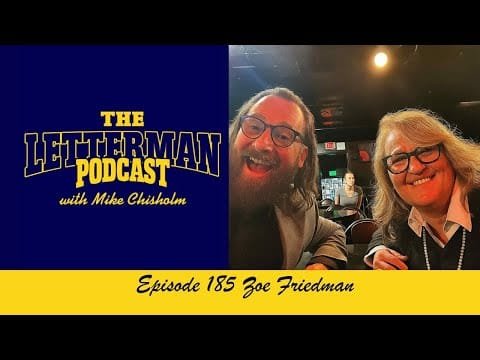
Episode 185 – Zoe Friedman: Comedy Royalty on The Letterman PodcastThis episode features genuine comedy royalty: Zoe Friedman.If her name sounds familiar, it should — her parents, Bud and Silver Friedman, didn’t just open comedy clubs… they invented the modern American comedy club as we know it. The Improv, the clubs, the alt rooms, the entire stand-up ecosystem? That’s the world Zoe grew up in.Her first job in show business? Working at the thrilling circus known as Late Night with David Letterman, where she spent over a decade absorbing the craft, the chaos, and the comedy magic from the inside.From there she became an executive at Comedy Central and Warner Bros., and today Zoe stands as one of the world’s most knowledgeable and passionate experts on stand-up comedy — its history, its future, and the people who make it matter.She is also the co-founder of Comedy Gives Back, a nonprofit supporting comedians with mental-health resources, crisis assistance, and financial aid. Zoe and her partners built an organization that looks after the very people who spend their lives trying to make the rest of us feel better. It’s vital work with a huge heart.Zoe and Mike have a rich, thoughtful, and deeply entertaining conversation about her life, her years with Dave, the evolution of the comedy world she was raised in, and the mission she continues to champion today.⸻Before the episode rolls, stop by Hello-Deli.com — the only place on Earth to score official Late Show with David Letterman merchandise, kept alive by the legendary Rupert Jee, who remains undefeated in the field of being Rupert Jee.And please: like, share, subscribe, and leave a positive comment. Every little click helps keep this quirky Letterman-loving corner of the internet alive — and it keeps Mike from stress-eating a family-sized bag of Skittles.
Episode Transcript
Read full transcript
You're watching the Letman podcast with Mike Chisen, endorsed by the Hello Delhi.
Yeah.
Welcome once again to the Letterman Podcast. My name is Mike Chisum. Uh, this could be an intro, the intro to this episode could be an entire episode. I could go on and on and on because of the admiration that I feel for this gal. Um, I I think I've talked about this on the show before where I had a list when when when Chucky and I started talking about this thing. I had a list of people that I would love to talk to uh just because of their unique people in the world of either Letterman or beyond uh the world of late night, the world of comedy, that kind of a thing. You know, Bill, as an example, Bill Carter was on that list. Um, you know, with Morty and all the other people. Some of those people I've talked to and become friends with, you know, some people I I have yet to. Um, but this gal was on that list and it's Zoe Freriedman. And Zoe's parents started the improv um and and and and in New York, moved it out to LA.
And I mean, we're talking about uh they started basically the first comedy club. And I mean, that's what she grew that was the backdrop of her growing up is is being around all of these standup comics. Andy Kaufman used to babysit her. I mean, holy smokes. We talk about that. Of course we do. Um, and there's a whole bunch of other stuff, too. Her backdrop is just amazing. And then she goes off and starts to grow up. And her first job is working for David Letterman. Like, she cut her teeth um working for David Letterman. And that's an amazing thing when you think about it. Uh, receptionist. It was an intern, receptionist, uh, but then became the comedy booker. We've had Eddie Brill on here a couple of times. Um she was the predecessor for for for Eddie and and I mean the laundry list of names that she helped shepherd their careers and used um you know late night Late Show as the uh backdrop for them to come out to the world. Jim Gaffigan national te is his network television debut was Mitch Hedber. Uh that's one we talk about.
That's a that's that's it's that's a pleasure for me because I love Mitch so much, but and many many many other uh standups. She tells me all sorts of stories from behind the scenes, but but also I look at her as she moved on from the Letterman world, went to work for Comedy Central, went to work for Warner. Um she has seen comedy through a very specific lens that only one person, only her, only Zoe could could see that. um but then goes to to her to her real project, the Lifetime Project, and that's Comedy Gives Back. Hopefully, you've heard of Comedy Gives Back. Uh if you're if if you're hearing Comedy Gives Back and it it's familiar, that's awesome. If you know exactly what they do, that's even better. But if you haven't, you will. You will. um this organization that she co-founded um and is currently the executive director of is is is changing lives and saving lives and improving lives and uh and that's the lives of of of standups and uh we talk a lot about comedy gives back in its infancy to what it is now. It's just a really really phenomenal conversation. It's a dream come true conversation for me. It just is. and and hopefully um those of you who love this stuff um will enjoy this conversation just as I did uh having it.
Um I'm happy to present uh my conversation with Zoe Freriedman. Zoe, I am um thrilled, beyond thrilled to have you here on camera. Uh a couple years ago, I saw I met you in LA. um crazy circumstances and you com it combined a whole bunch of my favorite things in the world. Uh comedy of course and the comedy store, the revered comedy store. Um meditation and then of course meeting you and uh it was a it was a incredible honor. Then I'm f I'm glad we got finally got to do this. Now we met at the comedy store. Before we get into anything here, growing up, uh, the improv versus the comedy store rivalry, did you have to take sides or were you, uh, were you somebody who had a chance to, you know, be neutral ground?
I There were always sides to be chosen. There were always sides. And improv, you know, was my family's club. Like, I was never allowed to go to other comedy clubs until I got to Letterman, right? And then we worked really hard when I was booking the comedians to be a fair equal player probably to to a fault.
Yep.
I do have a funny story about the comedy store um and the improv when I was booking comedians for the for Letterman. Is it okay to jump in? Is this
Oh, let's go. Let's go all over. Let's do it.
And um you know, I really wanted to be fair. I didn't want to just go to the improv. I had two nights available. we were shooting a week of shows. Um, and so I asked the clubs out here to send the bookers, you know, the talent people at their clubs to send me tapes because that's how we did it back then. Uh, of the comedians they would love to present to us like who are their people, right? Who are those people I should see? And then so they would send or have their comics send the tapes. I called the comedy store. Uh, I didn't want to, but you know, that's where Letterman started. I mean, I couldn't ignore that, you know, and again, I tried to be fair. I'm a fair I like justice. I like fairness. You know, I should be Libra. I'm not. Um, and I, the comedy store sent me no tapes. They sent me no names. They did were not industry friendly. So, I ended up spending one night of my showcases at the improv, seeing 17 people, and that 17th person was Jimmy Fallon. Great story. remind me to tell you about failure and all of that. Yeah.
How failure kind of can help you at once? Well, help someone. And then I did at the Laugh Factory.
So, those were my two nights. And then Mitsy reached out to Dave at some point and said, you know, Zoe Freriedman, Bud Freeman's daughter, um, you know, she came to town and didn't even come to us and thank goodness that I was able to like my side of the street was so clean, you know, I was like, Dave, I this is how I did it. It was really like fair and equal and they sent me nobody. And so he was fine. He I will say he in any and every case where it was me versus somebody else, he always took my side and he always supported and took my word. And there were there were a couple of great Letterman stories that we can get into later where one involved Duran Duran, one involved Jeff Alman. And
oh my boy Jeff Alman. I love him. Okay. And I love Duran Durant, too. And um anyway, so um I I there was a lot of rivalry and there was a lot of rivalry in New York and I never went to other clubs. Like it was real taboo. So for me now to Go ahead. Yeah.
No, no, no. I was going to say that experience that you just talked about, how old were you when that happened?
Um I
You were young. You were young when that would have happened, right?
It You mean in the when I was doing the showcases?
Well, right. It was like when I was doing the the the comics for Letterman and that was so I started the show in '92 as an employee and then I was a receptionist for two years and then assisted and by the time I got to booking comics was like 95 96
so yeah I was I was I was a young so that's my thing like
I was 28. You grew up where you grew up, the improv, you're on team improv, of course you are by coastal, the whole nine yards, right?
And now you're working for Letterman and then you've got to go and deal with these other these other people. And you're young. Like this is like kind of your first real job
other than, you know, being the the uh uh the the the comedy club kid. Um, and and and I mean it's just it seems like it's such a cool thing that you know Bud and Silver's daughter went to work for Letterman as her first job to kind of cut her teeth on that side of the business. Is that accurate? That's how I've always romanticized you within this industry. Is that kind of it?
I think that that is accurate and there's more to it, right? Like with everything. So for sure and I used to say so I mean I had worked at the improv in New York in every capacity. So, customer service, talent, relations, right? Like I saw my parents kiss up comics, you know, for my entire life. They loved comics. I mean, honestly, they were they made money off of comics, but they love comics, right? They So, that kind of serviceing and being like talent friendly and I knew how to answer phones because I would answer phones at the improv. I, you know, hosted, I was a coach person. So, I became a receptionist. I knew how to answer phones. And I also thought like they're so lucky at Letterman because I knew half the people. I knew Tim C, you know, I knew the managers through the improv. So I felt like I came in and you know they sort of got the sort of like a really like somebody who was prepared for well to be a receptionist, college educated receptionist for two years as we as one does in the business.
I know you asked the question about I was also an unpaid intern you know and how do you
do that? That's because my mom lived in New York. That's the only way. And I ate baked potatoes and cup of soup. Sometimes cup of soup on the baked potatoes. That was my lunch from the kitchen. I mean, my friends go, "You had baked potatoes in your corporate work kitchen." I go, "Yeah, I don't know why, but that's what they were there." And anyway, so but yeah, I did cut. So, yeah, I cut my teeth at Letterman. I grew up. I did every job there in the talent department. Yeah,
I did cut my teeth and then I had to so I knew how to like talk to people, answer phones and deal with talent.
Yep. But I did have to like use all those skills and go out of my comfort zone like in terms of you know at that age if you remember right I think we were so much more black and white in things you know and and as a child force which I hate that it's such an imprint on me in some ways like you know it was a public in the in a small circle comedy a public divorce and it wasn't a very amicable rep divorce and you know I moved back to New York with my mom and my dad stayed here and there it was really not great in the in the sense of this kind of team whatever. So I had to kind of break that and kind of reach out to the comedy store and reach out and do showcases everywhere. I mean and that was great because you know I they were the same comics. I just got to see more of it. And you know, when I started working with comics at Letterman, the process, which you might have heard about from other bookers, but my process after they were booked is they would be in New York for if they weren't New York Comics, come in for a couple of days before. And I mean, we would do five sets a night. I mean, we would be round about town and, you know, trying it and getting it tighter and suggesting maybe open with that. You don't need that bit.
You know, my let me Oh my god. The best like you know to
Yeah. like like those of us who who who who who uh love this stuff and don't necessarily aspire to do this stuff but want to be around it. I mean, okay, how many people who work a day job bust their butts to be able to go and see some of these shows as much as they possibly can and work it around their life? you actually your life became getting to go comedy club hopping and sch smoozing and and then not just that you were given um incredible incredible uh uh latitude in showing these comics how to steer their sets so they could be part of what is you know arguably but I personally think clean comedy is the hardest form of comedy
and never mind the the the actual um dialect that that Letterman show had.
That's right. The specificity of what his clean comedy meant was in addition. So, you know, no sex, no drugs, no bodily functions, like very ve very, you know, a manologist, the Jake Johansson's, you know, and great people, but very specific
under the umbrella of clean comedy. I mean, clean comedy can be a lot of things. You could talk about, you know, postcoidal something and still be clean. But that Dave didn't want He's very Midwestern. And that was fine, too. I could wear that hat and and and what I could what I tried to do for comedians because truth be told, they are some stubborn, willful mfers. I don't know if we can curse, but they,
you know, they they're on stage alone for a reason, you know. Um, and um, my conversations were harder with some than others.
Yeah.
And I was young and I was a woman
and I was dealing with older males um, giving notes, telling them this joke might not work and whatever. And you know, I would get into some stuff with with the comedians. And what I would try to say is and I understood this like I would never be as I can't walk in their shoes and I don't know their set as well as they'll know. I just never will.
Yeah.
But I do know what Dave likes. And so, you know, they you know, they might have a closer and I was like, gosh, I don't I don't think you should close with that. But that's my closer. That's what that's that's what I do. And I said, I get it and I want you to have a great set, but you also want to come back, right? Like you want to and you know, some listened, some didn't. Some didn't listen and still came back. Some didn't listen, didn't come back. And you know, I get some reflection like from like a Greg Fitz Simmons who said, "You told me that and my closer was a hack thing and you didn't that I didn't need it." and he, you know, I rarely hear and you were so right cuz he he was going to say far and few between people, you know, um but uh yeah, so that was my the process and we would go around club to club and yeah, what a I mean I think my predecessor did it as well. I probably did it more just because it really was my life. It was in my life before like I loved comedy.
Being in a comedy club was literally my second home. Yeah.
So, even though Daniel Kellison did it before me and Mary Connley,
they were they I you know, I really I I think I also like loved rolling up my sleeves and I loved working with comedians, right? I feel like that was just like now that I'm a comic whisperer we joke but you know like kind of working on on on jokes and sets and to be around and and not you know I mean I've I've read even though I've worked in the industry and I I've done good work but I always felt like being the owner's daughter at the improv I got to ride on the coattails and hang out with the funniest and not be a comedian that doesn't really you know happen a lot and um I was grateful because it's my it's you know a happy place for me for sure. You know,
you you brought up Kellison and and and and Connelly too, uh, as far as I'm concerned too of, you know, just legendary legendary people behind, you know, behind the scenes um that made Late Night and Late Show so damn good. Um, you know, and you talk about segment producers and how a segment producer sometimes can can create magic. Um, you kind of got to have fun with that, but you got to be the segment producer for the comics themselves. and and and and like you think about um you know on your um
uh on your staff favorite moments on the on the on the pants channel, you know, you talk about the that that week where it was network television debut week
and you look at the the the list of people who were on that week that you got to kind of put in front of the camera and showcase and literally sometimes made a career
based on um
one of four
how you produced that segment. One of four. But you know,
one of four.
One of four. I was sweating on a couple of the other nights.
As on a tangent, when I started at Warner Brothers, before I started Warner Brothers, I had interviewed Peter Roth
and he's the head of he was the head of we cut this out everyone, but he is the head of Warner Brothers television and he shared a story with me about coming over from Fox and um and soon after he got from Fox to Warner Brothers, he wanted to bring Chuck Lori in. Chuck Lori didn't have the success yet,
right? But he had some Fox success and he made a big to-do and he kind of broke, you know, had lawyers break the deal at Fox, bring him over. I mean, a big like hefty deal and he had I think it was like four three or four failed pilots and then Two and a Half Men happened and the success was so out of control. The the three or four pilots were forgotten, right? Yep.
And all I wanted to really ask him is but how was your stomach through that whole thing like like while there was these failures like were you like so in the in the smaller very micro example of this network debut weeks where very funny comedians comedians who blew up but might not have been Dave's cup of tea and that's the whole thing right somebody could have a great set even come back and maybe not be totally Dave's cup of tea whereas I got it 100% right with Jim Gaffan and then they developed with him and you know off to the races and then I don't think anybody remember.
Yeah, he he had he actually had a pants deal like some of the some of the comics who came in ended up with pants deals. He was one of them.
They did that show Welcome to New York.
Yeah.
Which was Christine Baransky about him coming from the moment Mike I can tell you when I was called up to Rob Bernett's office at the time after the Jim Gaffkin thing and again I was sweating the week. It wasn't it wasn't like the audience wasn't laughing but I was sweating like oh and uh Jim set you know was great and um Zoe we want to see you up in Rob's office and um Jim's manager who was a close you know colleague of mine at the time we all you know you spend the time in the clubs with all this your generation and Moren Taran and I got called up and I you know she was the manager I felt I was in trouble I didn't get called up unless and they're like that was great we want to do a deal with Jim And I mean, I felt like I was in show business. Like that was like that was so exciting for Jim to give that opportunity like that Dave liked it so much. It meant so much to me. I worked so hard. It was he didn't care so much about the talent department. Really, you know, he couldn't care less about half the guests we booked and I came up through the talent department. So, you know, on the writers, it's a whole different relationship. So, but he cared about comics and so it meant the world for me to get it right, you know. I wanted to get it right all the time, you know, for him and for the show. So, that was a big moment that was just like, oh my god, this is this is this is show.
Okay. So, at this point here, um, you know, before Okay, we're going to get to before that because I do want to talk about your life at 30 Rock a little bit before before we get there because because this is a big moment obviously, um, you know, working for Pants at that point uh, in Late Show. They've got their own autonomy and stuff and then you're going to be stretched a little bit more soon because they're going to bring Joanna in and all that sort of stuff. But I'm I'm I'm I I want to go back to to to to 30 Rock for a second here because the reception part tickles me to no end because I assume and I I perhaps I'm wrong on this, but I assume you would have known like Morty and some of these other people from the club side of things. Like did you know very many Letterman people just being the kid at the club?
I knew Morty for sure.
Isn't he the greatest by the way? I'm just going to throw that out there. I mean, our relation
So, by the way, like I've worked with him, you know, at Letterman for him.
I was with him at his Italian villa after he got let go, which was like being with the Nixons after the impeachment. That's a whole another story. I was
Can I say one thing about that villa just because I've never said it on the show?
Yeah.
The We know what that was the inspiration for. His villa was the inspiration for, right? one of the one of the craziest silliest aides in a Seinfeld episode ever where they talk about Tuskanyany
and they're talking about Tus Oh, don't go to Tuscany. Oh, no, no, no. Don't go to It's exclusive. That's apparently based on Mort's Villa. Uh I I don't know.
That's so funny. Well, I made it there once with my friend Anna. We were traveling and I had no idea. There was no social media. I had I was so proud I hadn't like checked into work and he was fire. Whole another story. So that and then when I was at Comedy Central, I was his executive in charge of production. not his boss, but certainly like I would have to turn what Morty taught me on him and we would fight sometimes because I saw him fight for things he believed in and I remember it was Carlos Mia's show that he was the executive producer and I was the executive and we'd get into it but I it was done with love and with respect and I remember Carlos kind of getting worried at some point like maybe we should have a different executive and Robert was like no there's no other executive like you know like no no this is what we do, you know, this is
you fight it out. You you you got to massage it through and Yeah.
Right. So, he taught me, you know, you kind of get it. So, um I, you know, had such and now we're and now we're friends. He lives in Venice near me. I see him at I see him at a lot of memorials of late. That's that's a bummer, but um it happens. So,
yeah. So, okay. Back in the day then. So, you knew Morty?
I knew Morty and I don't think I'm trying to think if there were anybody else on the show. Peter Lasali wasn't there yet. I think I had met him like through the years. Um, I didn't, you know, that was probably it. I mean, I, you know, because I was,
I, so I was an intern. So that's, so I was an intern. That's how I knew people on the staff.
So I knew a lot, but I was an intern like in 86, right? So I after my freshman year, it was during the summer and I was in the talent department and and so I knew the that's how I mean it was so I've spanned the years, right? And then I went away and went finished college then traveled for a couple years then started my employment there. So I knew so I knew you know I knew Rob Bernett when he was the talent assistant. I know Lori Leonard she was a talent assistant. Kathy Vasipoli Paul Shaver's wife when she was you know and
Maline did you work with Matt?
Maline and I so my story with Matteline is I walked her into her job interview and as an intern. So I was working the phones up front and she was there and I remember seeing her resume on the desk and I had studied in Italy and she worked at RAI like the Italian you know she worked on a crazy variety show in Italy and so I saw her and I at that point I was like maybe I'm going to work in in Italy. I speak Italian. I went and studied and you know I was so I was so excited when I met her and I walked her into her interview and that was that. And then when I came back in '92 I overlapped with her for about three months maybe. Oh yeah. She would have still been there at that time.
Yeah. Like just for a like maybe even two months. And I said to her
I was like, "Matteline, how are you going to leave? You get eight weeks of paid vacation. Great healthy." I mean, this was my first, you know, job out of like real job out of college in a career I wanted. And although I got paid $18,000 in 1992, I
it was right in New York. Uh yeah, right. I was like, "How could you leave this job, Maline? You have all these perks." She goes, "Zoe, sometimes the perks just don't matter. It's time to go." Right. So for her, she was done. And you know, you get to that place eventually. You know, I mean, cuz she had been there then. If I was 86 and I started Yeah, that was like six years she was there, right? So I think at that time like if
Did you interact when you were with Kilbornne because I imagine there would have been sort of because there was a little dose I know that happened there, right? And so
Well, yes, but not directly.
Yeah. Oh, I know. Not directly, but you two knew each other. I thought maybe there might be a
No, I guess not. I mean, apart from I'm trying maybe years later we sort of commiserate.
I just think it's it's it's very interesting. The Kilborn Stewart thing to me is fascinating in so many ways and she she's gonna come on here and we're going to talk about it one day. Maline and I have lots of conversations offh, you know, off off camera, but um I I I'm so fascinated by that and charmed by that because you talk about these deals, you know, Dave back in the day, Dave had this holding deal with NBC and and and you know, uh you know, really at the end of the day, so he didn't go against Johnny back in the day. That's what NBC was trying to protect and and you think about that. um modern-day versions of that, you know, um you know, the idea that John Stewart also having uh uh these the you know, being held by pants and and and Okay. And no, we're going to take the Daily Show guy Craig Kilborn for our 12:30 show and Stuart then goes over like it's crazy how sometimes these things happen and uh and you were kind of in the center of a lot of that stuff.
I was I was center is a little bit like
you were there while it happened.
I was there. I was, you know, I was there. I you know I kept to my own like you know Joanna and this kind of launched to try to you know have a bigger role also for my career and Joanna I mean I had the same job under two different bosses and that's an opportunity that doesn't leave you doesn't matter in what industry it is but Morty was hard he was like a really hard un not very I love him but he was tough on us just like Dave was on the writers right he was tough on the the the talent department and you know his management style was not I like that's not how I thrive, but I find I did fine, you know, in it.
And then Joanna came in and she was like nurturing and like go ask for more money and you know like and she had a plan and I was puzz piece of that puzzle and so I wasn't even so in touch with the whole John Stewart thing Craig Kilborn thing you know but yeah that's interesting. The thing I wonder about Craig Kilbornne is like that sliding door moment. Like he was offered a contract and he walked away because it wasn't the money he wanted and a generation don't don't even know his name. Like
I know
it's so interesting like that's like like what would have happened if he stayed on? It was you know it was really why I mean he's doing fine as is Mr. Kilbornne and I think financially he
does fine and but I'm always amazed like does because ego and fame is part of it too and he had an opportunity like people don't wake walk away from late night contracts like
and he's a guy who could do it because not everybody can like like again you talk about that's actually one of the things I wanted to maybe discussion points I wanted to have with you like you've seen I don't know tens of thousands of comics thousands for sure um throughout throughout your life but at the end of the day only a handful Even after kind of the door got kicked open after Carson retired and and and everything expanded and and and and and uh there became more room for all of these different people that could do the job, not everybody can do the job. And I I I was curious as to what your unique perspective might be on the skills that that somebody has to have to be able to do that job because Kilborn could do it. He was great at it. I thought, you know,
broadcaster.
Yes. He he was a very good broadcaster. He understood and that's the thing that Dave had that a lot of other late night hosts didn't have Johnny. Yes. But he's a comic, but he was a broadcaster. He he went to broadcasting. So like it's a different skill and certainly you could be late night host without it. We know that. We see it. But
it made and Dave was so intelligent and curious and I think so for me he set the bar so high um in terms of what it takes because Greg's a great a great broadcaster. He didn't have the same comedic instincts as David.
Yeah.
And
it helps being the sharpest wit in the west who can respond, you know, just without even thinking and it's gold most of the time that Dave is just that guy. and he is and not rather talk about like what he is and not somebody who isn't but yeah correct like and obviously in my personal like professional and personal comedy you know purview like Dave is my like people have Conan I like Conan I like Conan his comedy his silliness more than him with guests but you know like
yeah Dave is the bar and Carson of course before I mean I I mean I wouldn't be I wouldn't have worked at Dave I mean honestly I love Carson so much.
Did you I assume you met Johnny, right?
What's that?
You met Johnny, right?
I had met Johnny a couple times. I met him at the improv once. Like he was there and I happened to be in LA like when I was a kid, a teenager. And my dad and he knew I was such a fan. I was shaking and he's like, "Would you get Mr. Carson some popcorn?" I was like, "Okay." You know, and I walked back with a basket of popcorn. And he was always very, you know, very nice. And then my my favorite Johnny Carson story, like I have many, is um that he bought me dinner, but he bought all of us dinner at the premi dinner that we would have up in Malibu and it was Johnny's last year in the running. So he was nominated, we were nominated, he came back to say hi and you know, we all just sat there and I think he said something and nobody really got it, but we all laughed and um you know, it was like a moment. I mean, it was it again like those moments like, "Oh, this I'm in show business." You know, and then we heard later that that Johnny picked up the whole check.
And, you know, I was like, "Oh my god, Carson bought me dinner. I didn't have to go with him home with him." No. And um I went home with Jen Stilson, my best friend at the show at this time.
Yeah, she's the greatest.
Well, that's even a little more compelling to read her.
Probably won't be interviewed.
I haven't had her on. Uh, that would be um the thing I love about that story is of the I don't know how many dozen staff members I've I've I've had on the show over over the time. That story is probably what's that
and they've told you about that dinner.
That story is probably the most um favored story for almost all the staff any staffer in that time frame who got a chance to be at that dinner. that that event made so much of a mark on the entire staff. Anybody who I've talked to uh that was at that dinner, they bring it up as one of the the the biggest highlights by far. Like
Yeah. And it it makes sense. We all a little bit gaga because we're all in late night, right? So just inherently we all have a reverence for and this was so many years ago but for the predecessor for the person who came before us and of course that would be significant and I think we were also outsiders you know we were New Yorkers we weren't in the Hollywood you know and so you know and by the way I was 20 literally I just turned 25 because I could rent a car
so I you know it was you know Emmys are September my birthday is end of August it was and of course I rented a convertter as we are all cliches.
And um I mean we just had it was those those opportunities like for me to go to the Emmys at 25 was like going to like prom. I couldn't care lecoming. I was like, "Oh my god, I am in this sea of TV and I love TV and I wanted to be in TV my whole entire life." And he'd fly the whole staff in and we'd all, you know, we'd have to put ourselves up and get our own car but then buy us tickets to the Emmys. I mean, and then we were like Superman changing the Denny's like on uh lots of hunga, you know, before getting on the red eyee to go back to work. Oh my god, we were so young. Never do that now. Um, told me a story. I don't know if you were part of this group or not, but at one point he was being pushed in a shopping cart and went almost to his death. They they almost pushed the shopping cart out into the road and and lots of great stories from that trip that I've that that I've heard.
Um, one thing I do want to mention though, too, I I I don't know how much you've talked about it. I know that uh you have, but I I think it's charming for this audience to know. Your very first encounter with David Letterman was when you were really young. You were at the very first morning show.
Oh yes. Oh my god. I never I didn't meet him, but I
Yeah. No, but how crazy is that?
Yeah. Jude Brennan came up to me like at the 40th anniversary of being on air. So again, we were at CBS. So, and they didn't own the library at that point. So, it was sort of this anniversary that was kind of weirdly marked. And they were looking at footage of the first morning show. And she was like, "Was that you?" I go, "Yes, my dad was so my, you know, my parents had divorced. We had just moved back."
Uhhuh.
And my dad was in town. He knew Barry Sands. Not even Leathering. I mean, not even um
Yeah. Barry was a exec. Yeah.
That's right. And And Morty was just a segment. Not just, but he was a segment producer.
Yep.
And so Barry Sans got us tickets and we sat and I, you know, pigtails Spider-Man t-shirt and I didn't know what the hell I was watching, but I knew I wanted in. That was my circus that I wanted to run away to.
Yeah, it was like my life. Like creatively I was like I don't know what I'm watching. It was the weirdest. I would love to see it now because
you know again it was a morning show so we knew what morning shows were with weird late night goats and sheep and you know weird stuff. I just thought it was the best and yeah it really stuck with me and I got to run away with that circus for a dozen years. I mean,
yeah. Well, you did. And you got to stay in comedy and and and you still are. And you're still surfing. Um you're still surfing those waves now. Three siblings, right?
No. No. I have one. Well, I have three. Yes, that's correct. I have three siblings. My sister I have one biological sister and two stepb brothers,
right? Okay. Any of them get bit by the bug the way that you have?
My my stepbrother Ross did. My sister. So to show you how how far it could go is my sister like is a Tai Chi teacher in Santa Cruz. Like she has a health like she was a health chef for many years. She lived on a woman's land outside of Portland, Oregon for a dozen years and like changed her name to Freewoman because they never said anything with man in the title. Like wow. So, and she's lovely and she loves to laugh and she's a good spirit and a wonderful like but not not in the business at all. And my two stepbros um Ross actually, my older stepbrother had the very similar or same job as I did at Letterman for Leno years later. Um, so we never did at the same time. We never had to compete for network debuts, right? We never had that. But like he did pretty much the same job. He and Bob Reed were managers together, business partners together and then they started booking the comics for them and he was there for many many years. Um, and now is you know and has gone and he still produces and books and you know so he's in it and my younger stepbrother is an exhibitor relations at uh Disney. So related, but
so okay. Yeah.
Let's let's talk about I I'm very grateful that you kick that door open because I want to walk through it a little bit. Um now our show is is a positive show. We don't we don't go into, you know, scandal and all that kind of stuff. Every once in a while things come up, but that's not what we focus on, right? Um so so that being said, um I take it I take it easy on Leno, you I look at it I look at Leno as uh as pop music and I look at Letterman as Pink Floyd, you know, like like like just something completely different where numbers don't matter at all in this world because this is the thing that's going to create cult followings and things like that. I kind of look at it that way. Um, and I try and be as edi I try and edify as much as I can. Um, that being said,
in watching over the years, and I I didn't watch a ton. To me, the Tonight Show all those years was very much appointment. If one of my favorite bands was on there or somebody that I really like, okay, I would I would go out of my way, but other than that, I would I wouldn't watch it at all. One of the things that I was surprised about was in my and this is just my viewpoint and I'm curious what your perspective is. The booking of comics on Jay Leno's Tonight Show versus the booking on comics on Letterman. I thought the booking of comics on Letterman was a lot closer to Carson's Tonight Show than the booking of comics on on on on Leno's Tonight Show. Do do you have an opinion on that? Just curious if you've ever even
That's a really good that's a really interesting question. I'd love to see the booking list, right? To be able to
sort of say be more educated about it. I mean, I would just say the shows had their very specific tones and both of them came up through the stand-up world and yet, you know, I would the pop culture ref or a pop band versus whatever. However, I I would imagine the comics were probably not as specific as what Dave booked. Dave had such specificity in everything under his name. And I I think Leno just was a broader show that booked just and and and acted more broadly. And you know, Dave went from the underdog late night show to the a fierce competitor in the thing. And I thought that was great that he could retain some of who he was and still elevate for that CBS. You know, Jay was a huge part of my childhood. Jay is a wonderful like member like I would say family like friends and family. Like
used to sleep on your couch.
He slept on my couch. I mean, and my parents did not bring in a lot of comics into our home. Like it was not in a we went to the club. We met comics, but they weren't in our homes. Jay was um Jay is the kindest, wonderful, most thoughtful when I see him and I'd run into him in LA when I first moved there. Oh my god, how are you? How's your sister? How's your mom? Like like and he would remember my sister's name. Like really like I've always thought he was like on a campaign, you know. Um
yeah,
you know, a little bit. And I I don't And he was my favorite standup. I mean honestly like his comedy when I was probably you know more more like when I was older like a young teenager adolescent and you know he would do that you know current events and it felt so spontaneous and it felt edgy and
what's your beef segments with Letterman are some of the greatest moments in television and comedy.
I know they are. Um, I don't know. It just didn't translate to as as you know kind of J I don't know to to a brand, right? It didn't feel so Leno ccentric. It was an enjoyable show. It did very well for many years. Um
Oh, yeah.
Um, and it was just a broader show and less I I just think it didn't have the the same imprint that Dave had, you know, like his specificity of what everything was from his comedy to the guests to the comics, right?
Yeah. and comics because you know the guests were who's promoting and you know blah blah blah and you know I would get involved with that like that I worked in the towns barber in addition to comics so I would get you know I I'd be involved with this booking who's doing first who what show first um like the Jim Carrey was always an interesting thing because Jim before my time booking comics
came from being a standup Letterman show passed on him doing standup on the show he got booked on lead because this is a good example. So Jim Carrey is a broad impersonator of physical comedy incredibly funny in wildly successful
not that was the right call for whoever was booking at the time. It wasn't a Dave and then he went on to superstardom.
Yeah.
And and then every time he had a film come out he would do Leno because Leno gave him that shot.
Yep.
And that was of lore. That's something that I remembered. And there was even when I booked Dne Cook, you know, and I love Dne and Dne continued to have like come back to the show and have a relationship after I booked him because I I left soon after. But I will I will say that I said to Dave and or I thought about it in the way that Dave Dne wasn't traditionally his cup of tea. He was a prancer. Yeah.
He was more physical. He did his like impressions of his sister or the jellies, you know. He he had a different tone, but he was blowing up and he was he was the first comedian to play, you know, he was on Ascension and I said, you know, to Rob and and Dave, I was like,
I think Dane's funny. He's killing it. He's growing. He's, you know, so I think we should book him, period.
And if we could take a learning, maybe this is our next Jim Carrey, right? Like that we would want to be invested in right now, you know, blah blah blah. And so he came on. I mean, the career trajectory is different, but Dane's had a great career and came back a number of times, which made me feel like, you know, that that's a success. And um yeah, I you know, and Dana is one of the few comedians who will sing about me from the rooftops that I gave him that break. Not a lot of other people might, but I mean, they don't keep it silent, but he was he was, you know, so excited about we still talk about it. And when the show ended, uh, I spent the last night of the show with Dne talking about me and the show ending. And I was at the bar watching The Last Letterman because I didn't have cable at the time.
Oh my god, that's a lot.
And then this the room manager came in and said, "You know, Dane Cook is talking about you." And I went in and he was telling the whole story of getting booked and he goes, "We all need a Zoe in our corner." And I go, "I'm here, Dane." And the audience WAS LIKE, "OH MY SO EASY. That's so funny."
What was the venue? Where was this?
At the improv here.
Was at the improv. Oh, of course. Of course it was. Um I I just keep I keep uh marveling at how you are the person that has had your leg into different places that a lot of people they would not do that. Like I think about Okay, so like comedy store and and and the improv, there's one. Leno and Letterman, there's another one. Dane Cook, Louis CK, there's another one. Like, like there's there's all sorts of them and there are probably a lot more with you. You are the Switzerland of comedy booking executives uh that that are out there and it makes sense that you would do comedy gives back. We're going to get to that.
Um my god, I'm enjoying this so much, Zoe. Thank you so much for doing this. This is this is this is
I love that perspective, Mike. I think that duality is so interest like to think about those things, you know, for sure. And and it's also random that I ended up working for Letterman and not Leno considering Leno and my step brother didn't grow up with Leno. I did that was before you know that was when my parents were together in New York like
so it was just interesting that it all kind of goes but
you know and I yeah we will get to comedy gives back but you know I'm in touch with both Leno and Letterman
because these are I mean I don't know we can get
factors hopefully I would hope
hopefully hopefully we're
both uh both men by the way massive philanthropists and um for the right reason in in in many respects like I mean the stories that I have heard that I'm not allowed to kind of say anything about when it comes to the generosity of both these guys is is insane. It's
that's correct. And not everybody I mean this really like organically leads into comedy gives back. I was witness to it. I know that this happens all the time that the successful the one who rises to the top helps the people because Dave Letterman would say over and over that George Miller's funny to him or John Witherspoon's funnier than him or Jeff Alman for that matter like all his buddies he but he was the one because he knew how to broadcast whatever it was right like there's a lot multiffactorial sure of the reason
a lot of X factors
a lot of X factors but he took care of his friends and Jay does the same and I witnessed it a lot with comedians who have made it. And what I witnessed when I was at Letterman and dugging the comics, Dave again, he was involved with the standups more than he was say like the third lead from a Miramax movie or something. Um, you know, but and and we knew why that was important to Harry Weinstein now. We understood now. Oh, yeah. Why why we had a bookish.
Why Eric Stoultz is booked on so many of these shows. Yeah. Okay.
Um, but um,
no offense to Eric. Love Eric.
No. or or Annabella Shur or whatever, you know, or and um
so um so you know he he would say you know so he had his crew from his from his class of comics. So was Jeff Alman, John Witherspoon, George Miller. Those were the three there were
our boy Tom Dre as well.
Tom Dre. But Tom came Tom Yes. And but Tom was being booked. Yes, that's right.
Okay, I see where you're I see where you're coming from. Yeah. Yeah. Yeah.
Yeah. Yeah. I like there. And um and he said, you know, book them twice a year. You don't have to book them more. You don't have to just don't book them less. And I sort of learned because I would do paperwork for SAG after that after two,
you know, uh what do they call it? A principal appearances on a national television show, you are eligible for your health insurance. And that is something the comedians don't have. They don't have unions. They don't have insurance. So that was really important. I always and I've said to Dave to this day that he told me that. He goes, "No, I didn't." I go, "Well, I made it up then." But I remember you told me to book twice. Maybe I filled in the blanks. All I know is you took care of your friends and I was happy to do it. Um especially like John Witherspoon who was a prince and uh you know uh you know so funny. And he
George Miller coming on and telling the same story every six months was charming to me. I loved that. Like as a fan gimmick. Well, wasn't he searching for a gimmick? Yeah, that's right. That's right. But to give Okay, so Dave made, you know, the plausible deniability, Dave saying, "Okay, no, no, no, it wasn't like that." That was the spirit of the show because talking to Paul and not even so much Paul, but like the people behind Paul, um, he would do that for musicians all the time. If there was a musician that he knew was having a hard time, they would play, they would put the song into the rotation and they would do things like that. Yeah. like like there's there was cool stuff uh not just with Dave and what not but there was a lot of like that's what I love about the culture of that family like I wanted to be part of the culture of that family through the screen I don't know why but I did I wanted
brought everybody in we were all part of the family he brought his staff in they were his I mean you know much more than his mom who I spent a charming two weeks in Nagana with you know for the Olympics um Dorothy and I and Biff and you know that was crazy.
You were you were in Nguno uh with with with with Mrs. Letterman with
Mrs. Letterman with Biff Henderson uh with the Stangles with Celia Converse me and the from the talent. We weren't booking I wasn't booking comics. I was booking the athletes you know the terinsky Johnny Mosley. It was like the winter Olympics. Anyway, yeah I went there. That was I mean that was a life experience to get to go there. I have an ounce of gold from Dave. Did you hear that? That he sent us all Everybody who went got their own gold medal, which was I have I've you know I have an ounce of gold.
I have not heard that story.
I can I have it. I can I can bring it.
Oh, I I would love to know keepsakes that you have have collected over the years and kept.
Yeah. So, I was wasn't booking comics there, but definitely uh there. And what a wild time. It was so stressful. They're like, don't come home if you don't get Terinsky. Like, oh my god. I can't. It was really tough. And I was like, these people have trained to be in the Olympics for their entire life. They're not opposed to the show. They like I mean, we were right in the sweet spot in terms of the ages of the athletes. So, it was like a no-brainer, but they weren't thinking about it. They were working on their gold medal. It was such a different I'm like, if you were here, you would understand. If you sat on the heated toilet seat, you would understand the culture. I it's so I always want one of the things I wonder about is if CBS didn't lose football, if CBS didn't lose the Olympics the way that they did um and these things and and and the wave could have continued um you know the the types of opportunities and and things that would have continued for Late Show. But again, a little bit of adversity is a good thing. I think I think that's a that's what stretches you and and you want to be stretched, right? But I always do think about that um you know what what might have happened if that momentum could have just continued on.
Um but you know of course bigger things uh you know bigger bigger forces at play. Um okay there I've got a whole I've still got a whole pile of things but I do want to get in move into comedy gives back and I think it's a good time to do that because of the philanthropy of things. Um you know you do set the table very very well talking about
I I love standups so much. Um I'm doing it right now locally. I'm going up to open mics and doing it. Not because I want to be in a standup necessarily. It's because I want to have the skill under my belt. And I
I love the hang. Um I love what Rogan has done with the mothership and how the green room and the hang is the most important part. Like he's centered so much of it around he's trying to perfect, you know, comedy store, improv, these things and and and put it into one ecosystem. A local open mic night in Colona, British Columbia. um when the show is over sitting at the table getting some chicken wings or some chicken fingers or whatever with these it's the greatest hang in the entire world. I understand. I get it. I also know that these are many creatures who barely know where their other sock is and now they are responsible for being a self-employed uh business owner essentially and they are the product and and and and um with the skill set to be a good standup whether you're you know on an amateur circuit whether you're all the way at the the very very top you got to have a bit of a different brain and it doesn't necessarily translate to some of these things that comics um that makes them a good comic. And so when I look at comedy gives back, it's like, oh my god, it is like water in the desert.
These people don't have a union. They don't have advocates. Yeah, they can have managers and things like that, but
at a certain level,
thank you. Yes. Yes. Once you get to a certain place, but there's a whole pile of comics that are below that place, and even the ones who get there don't necessarily even get the best guidance when it comes to some of these things. So, so the idea, it started as a social enterprise, right? but then kind of kind of moved over and now the idea of being able to be a support system for comics is the that's that's kind of the the trajectory of where you're going and it's a beautiful thing that you're doing here. I appreciate it. Let's talk about Comedy Gives back and and and where it's at right now.
I'd love to. Um, yeah, it was such an organic, again, I was at the improv where I, you know, where I spent a lot of time in my early 30s when I first moved to LA and I was still scout. So, when I moved here, I scouted for both shows. I booked still the comics for Letterman Y and I booked the comics for Kilburn and we got to do a lot more comics, right? So, I was out in all the time and two incredible women who I know from the comedy business, Jod Lieberman and Amber Jay Lawson, who I knew for many years. Jody programmed Just for Laughs and Amber Jay was a long native like digital comedy person with Babble Gum and um um AOL video. Anyway, so I knew them and they came up to me at the improv and they said, "Do you think we can change the world through comedy?" And nobody had ever asked me that.
And I can't tell you how much time I actually thought a lot about that because I really felt in my core that my life everything all the good and bad but at that point you know more was comedy related right like so it was my career that I was making a a gainful like I was doing well in my career and I was in comedy. I loved it. It was my hobby. It was where I was spending lots of time. I met my husband through he took a stand-up class with a mutual friend and we met through that person. Like I felt it was my health and my well-being. I mean I had been I've been in therapy since I was 15 or 16. I mean, so you know, it's not so I always, you know, whatever that means, but like I also felt like I was well
adapted because I had so much laughter in my life and healthy and I and we just started talking about that we believe that comedy and making sure that comedy is protected can change the vibration of this planet and that is how we started out and it became it was a for-profit production entity that put comedy and charity which longtime friends friars club and before and we added technology to it. So, we live streamed comedy uh shows and we partnered with other nonprofits. And there were two things that, and I've talked about this, two things that changed the game for us. One was uh Mo Mandel at Just for Laughs Comedy Festival at the bar, at the Hang at 3:00 in the morning. We're talking and Mo was in my zeitgeist at that point, right? So, he was in a series for me at Warner Brother. I was at Warner Brothers at the time and he was in a series for me. He had done like my son's uh school's fundraiser, you know, which I used to do a lot of and probably something else.
And he said to his fellow comics, we were hanging like if you want to get work in comedy and not get paid, hang out with her, pointing to me. And I laughed because he had done a lot of like, you know, you know, recent fundraisers for me. And the next day I said to Jod, Amber Jay, we need to take care of comics. They're doing these shows for us. Why are we why are we raising money for I mean those are all good causes. There's no no g no shame in the game of raising money for hated water project or you know feeding America but there's a there's organizations that do that and nobody is taking care of comics. So we started talking about it. Then you know the Brody Stevens uh suicide has been one too many you know and the story was so heartbreaking because he could not so he his show so he was doing fine. He was, you know, he had a show on Comedy Central and HBO and it got cancelled and he lost his health insurance and he couldn't afford the Cobra because Cobra is the biggest ripoff ever.
And we we weren't in existence then and he had to change doctors and medication and in this period of transition he took his own life. And not to say that we could have changed the trajectory because mental health and depression is beyond uh uh being able to pay for a year of insurance, but perhaps just perhaps we could have paid for his Cobra for a year or two. He could have stayed with Dodgers. Again, we don't know. But it made us go like this is something we can do. We know we could do this. And you go music cares is there for musicians.
entertainment, you know, community fund, formerly the actress fund, is there for actors, dancers, you like light grip unions, like why aren't comedians being taken care of?
Y
and we know we weren't the first to think of it, obviously.
But it was right time, right place. I was getting ready to leave Warner Brothers and I would like have my lunches with like Dave Wrath and I'd say, "Dave, I'm starting to work on this nonprofit and we're I started working with comics." and he goes, "Oh, I want to do that back in the night." I go, "Be on my board." Same with Dave. You know, it really organically because we know they are without resources and they are not super high functional people to begin with.
Yes.
Some exact,
you know, the good ones. No, I'm kidding. Um, no, I'm joking. Um, and a and so we've been on this um trajectory to create a safety net and figure out how to run nonprofit. I mean, we are still three comedy chicks that are, you know, figuring out how to run a nonprofit. We're also three owner, you know, business owners, a nonprofit that go, we don't know everything. And we've worked with a nonprofit consultant to help us shift our organization because here's the goal. I want comedy gives back to be music cares. I want comedy gives back to be entertainment community fan. The community fund has been around 125 years.
Wow.
The music cares has been around I mean so we are trying to build the foundation of this house that will stay and be built long after I'm gone. Right.
It's a legacy project.
It's a legacy project and we're in the very nent state of it. And what we what we're doing now is, you know, we do our comedy fundraisers. Um, we do some small ones in clubs. We have one coming up in New York on November 13th. We did one in August in honor of Brody Brody Stevens on 818. We always do. And that was like that was one of the that was four years in the making. And it was the like as a booker like I still get very, you know, Bill Burr said yes, Robbie Hoffman said yes. Elanor Carrian said yes. So we had like the people who knew Brody and stars and we sold out and we made a a great amount of money for a club night. So th that's one of our models. So we have one coming up in New York on November 13th at Gotham as part of the New York Comedy Festival.
Um buy your tickets now. Um, and um, we're we're trying to figure out our bigger night like, you know, the Grammys have the person of the year or the music have the person of the year the night before the Grammys and the Motion Picture Fund Home has their Oscar night before the Oscars. We don't have a a comedy awards like that. And so we're trying to figure out what that, you know, is going to be. And we have an we'll have a nice announcement in December about an event um that we can in honor of Richard Lewis that will be um in 2026. So soon to announce on that. But um we're we're we're really figuring out how to grow our business so it can live long after us. And I've recently become the executive director and I'm working more full-time on it. And I never thought my uh my career would be asking for money or helping comics. I mean, I've always helped comics. That's the funny thing. like in some ways get a job or I book them or up with so
you know I I had a funny story you got this but I was in front of the improv the other night I went to the open
I'm cutting nothing Zoe until unless you tell me to I'm not
I went to the open I mean it just might be boring but I went to the open mic and I was outside the club after and there were three comics two of which uh were on the open mic who did quite well and there was a third and I said oh great job tonight on D and I said are you a comic too and he's like and they were they kind of started a little comedy sketch amongst themselves They had no interest talking to a 58-year-old woman. Let me just tell you like they didn't know I used to be a booker. They
I was going to say they had no idea what they were talking about.
They had no idea. And that's okay, too, because my, you know, credits. But it was funny. I felt the I felt the energy. I was like, "Okay, how do I get out of this conversation? I was just, you know, wanted to compliment them. I had a question for one of them and they were kind of doing this kind of thing about the third guy. He was wellknown.
when he was they were sort of saying he's not you know it was a little bit like I didn't have the information to know if they were joking or not so I just played along and and then I said oh you know I'm going to go back inside but I just want to make sure you know that you know I'm a co-founder of comedy was back and the vibe changed they were like what one guy the one who was kind of trying to dupe me was like oh my god I used to do your zoom meditations during pandemic and I got a grant the other one had been on the phone with somebody we're currently helping with mental therapy and said look who I was just on the phone with like and I that was a new experience because you know we we're working hard to uh to get the word out right working hard to help as comedians and now we've been in it for a number of years so it is changing like it's maybe you haven't gotten help but your friend has right like before it wasn't even the friend it was kind of like four people removed like the fact that they were like that's where I had juice for them was unexpect ffected and delicious.
Not to use a a food pun of delicious and juice, but um they really like it was so amazing. They were like, "Oh my god."
Like I don't think at that point if I said, you know, I used to book comics for they wouldn't care. The fact I was comic is back was it for them. They needed to know no more. And that's
isn't that fant like that's again sometimes the universe drops little pieces of of of uh little little tidbits for us to take as like an entire meal of gratefulness. Like that must have felt so good that that that they knew you as the comedy gives back person rather than you know all the other things that we've talked about this entire time.
That's right. all my other my years of you know um it was it is it was a like I was like a proud parent right I
the universe giving you a clue saying you're doing the right thing
yeah that too I mean boy oh boy you know I'm also an independent producer since I left Warner Brothers in 2019 and there's nothing there's no flow there's no like comedy is back is where there's flow like there is need and there's there is a a community that has yet to completely step up in the way I know they will because we have been building this foundation and I want to build a senior home. I want to have a senior home for comics. You don't think Dave Letterman, Jay Lennena would want that in on that? Come on. You know, like not to live there, but to right like to So, but I know that they're I know that's soon. I know that's not a if. It's you know, it's a when and you know, we're working on it. So, when it's time, everything's ready to receive. love hearing I love I love big vision and big thinking and and and that kind of thing. It's so cool to hear that from the bystander standpoint.
I go when is the comedy gives back comedy festival going to show up because I assume that that's going to be you know a lot of these a lot of these cities have have done it very very very well. You think you talk about Just for Last Montreal for so long, you know, these these these things to me that is like it's so chocolate and peanut butter. Let's put them together. Um is that is that something that's on the on on the horizon for you? Have you thought about this?
I don't think our own festival. We do partner with festivals because
y
you know we we we took a look we we we we're not reinventing the wheel like music cares has been doing this and that's the most apples to apples even more than entertainment fund. Yeah
and somebody from music cares is on our board and really has helped us fill in and the only reason I sort of speak to that is um is because I forgot. Hold on then we'll edit it out. Um
it's gonna come back.
Right. Exactly. Um, a music cares.
You're not going to do a festival because
Oh, festival. Right. So, what they do at Music Cares whenever there's a gathering of musicians is they have a recovery meeting every day like Grammy week. They make sure they have bubble, you know. So, that's kind of where we started. We're like, "Okay, we're going to have a recovery meeting every day at a festival, you know, at the comedy festival. We'll do maybe a um a gathering of some sort." Um it they were it was mildly successful. We've had some you know where nobody showed up where a lot of people showed up. So I don't think we'll have our own festival but we would love to be partnered with every festival because what our experience is so you know our company has this duality right where you are we're we're you know public facing like hi bystander being a comic is hard and for every Kevin Hart and you know Bill Bird that you know there are thousands of others who are working comedians and life happens and they don't have the safety net and there is no union and B, you know, so um that um you know that I keep losing my I know I we keep going deep and then I keep losing my place but that's so um
so as opposed to like these quiet days these the things that that that you do the recovery days.
Yeah.
Yeah. So we were doing the you know we were doing that and we probably will continue to to you know uh oh and the so when we go to these festivals and we do what we call kind of our comic only events where we've started to do where we as the co-founders go and tell over you know the comics what our services are how easy it is to sign up
the conversion rate from that from that meeting and it might be at some festivals 30 people and like at Netflix there's joke. We gave our information. We gave beanies to every comic high and, you know, low and high level with a card of what our stuff is and what our, you know, and we did our, you know, recovery meeting. The conversion from festivals to comics using our services has been really powerful. Yeah.
So, we continue to show up at festivals because that is where we can really talk to comedians. We also like to do shows and have a fundraiser like we're doing in New York on November 13th at Gotham as part of the New York Comedy Festival. It's kind of a a a sprawl of a festival. It doesn't quite feel the same, but we want to be part of festivals. Probably not throw one, but make sure we're there as a
that people know because, you know, comics are skeptical. you know, they they feel it's probably they they're not going to be eligible for it and we get to tell them what they could be eligible for. we get to say like there are lots of things and you know if you have so that's how we see ourselves getting more involved with festivals always having a show always having kind of some presence there like maybe you know material to the comedians so they know you know and you know in backstage putting all our kind of resources and everything that's really important in the festival circuit
I I hear
I hear that and especially where you're at right now in the in the in the life cycle of of the ity. I get that. Um, my wife came from the nonprofit world and she's building what she's building now um, in in the social enterprise. She kind of went the exact opposite. Her frustration in the nonprofit world is so many times you've got these amazing nonprofits with an amazing vision, an amazing mandate and and and and fundraising becomes the challenge. I look at you and go, "Okay, here's a mandate where you literally have, if you had the right, you know, promoter or person that knows how to put on events or things like that, you have an endless stream of revenue from a fundraising standpoint because so many of these the the these comics would believe in what you do." I assume the people who are on top again, look at what you're doing going, "This is the most amazing thing." Because they weren't always on top.
they know what they went through and if if we could make things easier and then of course there's the you know the big things the Brody things like that's that's that's I mean you know that there's that the extreme but the people who are like uncomfortable the number of people who are uncomfortable and they don't necessarily need to be um I just look at what you're doing and going okay well yeah you guys could easily have a festival that everything just went towards comedy gives back once every couple years or something
well from your mouth to the booking god's years. Yeah, like
it's not you know what they say uh it's really simple but it's not easy
100%. you know, like the mentality also of comedians, the this, you know, psyche, not for everybody, right? I'm not going to speak gross, you know, like some of them really make that 1% and feel probably they're comfortable for the rest of their life. And then there's probably like the 5% who like
worry, you know, it's some, let's just say this, some people just kind of grow up with the giving back mentality,
right?
And a lot of people don't.
Gotcha. And so we're educating comics even about like how to give back like and they sit you know the 1% 5% sit at the end of the year with their business managers and you know they have to give away money and you know we just want to be part of that conversation because it seems to like duh
yet not duh yet. I'm waiting for it's like where it is and again not if when.
Absolutely. Oh yeah. That one keystone is going to go and the avalanche will come.
Correct. It correct. And um I believe that with our comedy club network which is incredibly important that clubs around the country are are partnered with us not only to maybe give a roundup or a percentage of tickets but for our resources to be posted backstage. So our our programs and resources are only as good as people using them. So if people in Illinois don't know about us or Ohio because we're living in New York and LA, like that is not good. So the clubs are super important. And Levity hasn't signed on yet. I'm going to do a public shaming that this club, this, you know, this company that bought the improv and they're an amazing company and they're very good to me and they're the LA Hollywood improv does lots of fundraisers for us. They have still yet to come on and give us like a per ticket or some and we're in conversation again. I know it will happen but shame on you.
Yeah. Well, let's throw it,
right? Like what? Come on.
When I saw you, it was at one of these events uh during the joke comedy festival. It was a meditation um for for for other comics and and I got to tell you, LA's always got crazy energy. I' I've been I'm a I'm a giant Kings fan. And so throughout my life, I would go to LA periodically as much as I possibly could. and and of course Disneyland and all that. LA um and California, that part of California has an energy to it. During the Netflix is a joke comedy festival and I've been the last two to see Dave um
it has a different energy to it. It's got a crazy energy to it. It really really does. Like I could feel even that day when I walked in I know the comedy store does have energy to it too but I I could feel
um in that day
I could feel that the comics that were there for that meditation were really grateful to be away from it was the eye of a hurricane is what it was. Yeah,
that's that's what we see our role at festivals like that safe space that place that they can go and you know if in recovery no alcohol if in too much smoozing and too much networking they could you know and give them those tools to take out on the you know out on the road with them. But yes, that was a really special one, Mike. That really was it did have a different energy than a few of you know.
Oh, really? Okay. I was I don't know. I just came in and I'm like like I'm having like it was the most I thought going out for for for for breakfast with Morty and then I'll tell you off camera we had a somebody showed up um at our table. I'll tell you afterwards who it was and all that and it was that was I left there going this is the craziest experience I've ever had and um and I needed to like decompress from it and I did. Um, and then I thought, you know what? I'm just gonna go take some pictures at the comedy store and literally went from that. Yeah. Like, and then I had uh, you know, I was gonna hang out with Hillary Rollins all day the next day. Like, I had a great phenomenal phenomenal time down there.
But then going to this again, the Eye of a Hurricane, this event, it was unbelievable what you and Tim set up. Tim Duffy, shout out to Tim Duffy, by the way. Love him so, so much. Um, if ever you want to look at getting into meditation of any sort and especially functional meditation, meditation where you know it's not just woowoo stuff, it's practical um, in the way that it applies.
Look up Tim Duffy. Everybody shout to Tim Duffy. I'm just going to throw that out.
Tim Duffy. And if you're a comedian who wants to learn one- on-one, come to Comedy Gives Back uh, info at fill out an application and ask for a grant to cover meditation and you could do one-on-one with Tim. Oh, there you go. Practical application. I agree. And it's not like he grew up on an ashram, right? He he did standup. He was a producer. He understands and and I just love the way he talks about, you know, my old friends, you know, he's Yeah. Shout out to Tim Duffy. Definitely.
Very, very much so. So, what you guys are doing is so important. Um, is it possible like I I uh I had a Yeah, I've got an interesting some I've got a foot in the world of pro wrestling. Um, I'm a financial planner by trade. In 2013, I wanted to give back to the community a little bit. Um, and and and I didn't want to do a golf tournament or a walk because I'm not that guy. I'm just not that guy. So, me and a business partner, we we put on a pro wrestling show. We didn't know what was going to happen, but we raised $10,000 in one night for the BC Children's Hospital. Fantastic. Awesome. Um, what I wasn't prepared for, though, is that wrestling fans are very much like standup fans in a lot of ways. and and wrestlers are actually wrestlers and standup comedians actually are very similar in a lot of ways um in the self-employed part. But we had these fans saying to us, "When's the next show? When's the next show? When's the next show?"
And over the course of of of six years, we raised a quarter million dollars for local charities
just with this little wrestling show that we had.
And the gratification of it is is is is amazing. Um, and you look at what these people do and how they connect with their audience and whatnot. And a lot of them are just independent. Many of them are just going check to check from show to show. Um, and the natural question is, could you ever unionize this thing? And I just feel like pro wrestlers and comedians and maybe there are other, you know, unique people in the world of entertainment like that. I don't know if they ever could unionize it. Do you think it's possible?
No. you and I'll tell you you want to you you were curious about the Riad Riad festival.
Oh, let's Oh, hey, if we could talk about Riad. I'm very cur Yes, very much so. That is that what happened is the exact reason. This is what I for sure say. The exact reason why comedians will never have a union.
That makes so much sense.
Are about putting the collective well-being over the individual well-being. and comics need to perform and they will perform and they'll perform anywhere they want a challenge. Middle East, Saudi Arabia, give me the challenge. Like
that's that's the ego piece of it. The money piece. Those people didn't need that money. Much like David Cross. I loved his letter. Well done, David Cross. I I believed every moment. And I I And there's also like they're just comics and they wanted a new audience. And right like And we will never have a a union. I think that speaks that that that when I when I was like we were thinking about I was like oh yeah that's why we'll never you because they just they're individualists you know
we have maybe have a guild where people you know but you know also people told me at the very beginning don't become a health exchange a health insurance exchange whatever you do like so
right oh yeah yeah
um but um yeah
that makes so much sense there was a time very early and and again I I don't want to stay in pro wrestling but I I know a I know a a lot about it. Um, it's weird. Some of the things I know a lot about, completely useless stuff. Uh, there was a time right as Wrestlemania was was was was germinating. It was becoming a thing where there was going to be a get together of all the biggest wrestlers around. And and and we're maybe going to do this. And Vince McMahon came in and said, "Okay, anybody who does this is going to be like he squashed it. Just squashed it." And it took nothing to squash it because of exactly what you just said. because you give somebody a little bit if they're if you're self-employed and you're looking for yourself, which these people are,
that's exactly why it never happened there. And you know, here we are 40 43 44 years later and you're saying the same thing about comedians. That makes a lot of sense.
Um I think about to bring up Riad for a second here because I mean, you know, kind of ripped from the headlines if you want to talk about it. I'm super curious about your perspective on it because here you are. you were you were there back in the day during uh uhh dice clay back then like like like comedy's always had controversy to it and as it scaled up so too has the controversy that's the way I see it anyway um but during that time you know political correctness was where it was you know uh the wall fell Metallica goes and plays in Russia and everybody celebrates it's like yes we're spreading
uh whatever you want to call it freedom Americana um you know I'm Canadian But but North America freedom. We're spreading freedom around the world. There's rock and roll playing on the other side of the Iron Curtain. Yeah, let's kick some ass. That's a very much a Gen X way of looking at it. Couple of generations have come by now. I I would I would submit that if this would have happened back then and all of these comics could go to Saudi Arabia and some of them say some of the things that they did say, there would be people who would look at that as a victory. And yet now we live in a culture where things are a little bit topsyturvy and it's not so black and white perhaps. I'm curious about your perspective on it.
I love that history. What year was that?
Which one? The Metallica one.
Yeah, Metallica.
Metallica played Russia. I I want to say 92.
Yeah. So, a different generation. I think like that's really interesting, right? Like um spreading it. And I will say that I went through the I went through the spectrum. You don't have to look it up, Mike. That's fine. It's just in the 90s. Like I was just trying 91. There it is.
91. Yeah. Definitely different generation. Um and you know, initially I mean I I kind of has have gone sort of around and about on this. You know,
imagine you have.
And I've talked about it with a lot of people and I have, as I mentioned, I teach a class of juniors who are comedic art majors and they love comedy. They want to talk about it and we talked all about it. We talked about David Cross and they're young. They're not so PC in the sense they're not the woke of like I have three future comedy writers standups women. I mean they're more than women but they love Louis CK. They're doing like their report on Louis like so it's right like they're not like over you know overly I was like that's safe in this class. I booked him where you can talk about him being funny you know. Um, so I wasn't sure and I felt like it was probably when it first came out I I I read the whole David Cross thing and I I really that resonated for me. It did feel a little bit unfortunate and I felt like these are the people who scream about freedom of speech. That's the hypocrisy of it that they were m they were they were m muffled or muzzled and to what they could talk about and they said okay and these are comics that I think on here would say screw you I'm not going to be so it's a double standard it was unnecessary they didn't need to right none of these people needed like David you know the fourth house or the boat or whatever
sure
now thought about it a lot kind of talked and and then I saw photos online you know on social media of the audiences laughing and back to let's transform the world through comedy. Nothing makes me happier than seeing faces of all colors, of all ethnicities, of all whether they're sitting next to me at the improv or on, you know, it makes me happy and that is the vibration that started my whole organization and what keeps me loving comedy, you know. When when I saw those faces laughing, I said I I I changed like again I don't even have I'm not so opinionated. It's complicated for sure.
Yes.
You think it's a generational thing and it's unfortunate that the woke thing has become so incredibly like twisted. Yeah.
And comics and their freedom of spee when I worked on Mensia and and Ned Carlos would say, "You don't let me say anything." I go, "Have you watched your show? You get to say everything. Comics go to this. You are musly like so fast. Like they're ready to for the fight even when you're like you're not I'm not fighting with you on this. Like you're getting what you want. Like there, you know, um I also think like you know with the rise of the brophere and the the you know and then them you know being the ones going over there or whatever you know and when maybe winning the election. I mean that's a whole another piece of it.
Let's be clear. Let's not give comics so much import.
Now this is coming from somebody who believes comedy good comedy is a social like reflector, a mirror, a trutht teller. I believe that they are important and yet comics are low function can only do one job and if somebody was like do like I can only do the garbage but I'm going to give you my opinion about the of politics like you're not going to listen to them stop listening. I think it was I think it was Brennan who said, "Okay, let's ask the clowns." Like like
right like again I really appreciate the the level and the um you know the place comics hold is a greater place than they used to. Certainly it's a a full-on business now huge business comedy of course. Culturally it is pop culture and beyond. Live comedy is doing great specials you know all of that. And yeah, I you know, but they're comics, like you know, and so I go back, not back and forth, but you know, I was it did move me when I saw the photos of people laughing and I was like, that really makes it clear that that's a good thing in this world that people there who probably haven't had a lot of ability to laugh get to laugh. I don't love the hypocrisy of it. I don't love that the government paid for it because if it was somebody else then maybe it wouldn't have been the same thing because it wouldn't have been the government holding it who are the you know human rights you know violators right if it was just so but anyway but
well again like I said I don't feel like I have like you know I was very like very much I read the David Cross thing felt very similar like that's really unfortunate and what a problem it is and then I just sort of saw these laughing faces and I said yes I don't know you know
I came from both sides too. I but I don't have um you know the pedigree that you do when it comes to this world. One of the reasons why I was so grateful when you said yeah I could I could I could bring this up to you is because you know again we're talking about this duality like like you have been there from the beginning with all of comedy not just clean comedy but you've also been an executive with a company that it's like okay no this we've got mandates here we've got to we've got to be specific in what we produce and how we produce it. and you have audience or you have um affection for both sides of the fence. It's not like you don't like either one of these people and when they fight it's probably a it's probably a hard thing but the thing is we're moving the conversation forward which I love.
Um I I really am grateful that you were able I figured you'd be conflicted because you've done things you these are people that are your friends but you've also been in the position and see it from other sides. like it makes sense to me. Um, for me looking at standup and and and um I will I'm scared about losing freedom of speech and in Canada we don't have the same freedom of speech um um uh you know we don't have this we don't have the Bill of Rights. Um, so while we are allowed to say what we say and whatnot, I believe our freedom of speech um is very very tied to America's freedom of speech and and to me if comedians are supposed to be anything at all, you don't give them specifics because of like you said comedians, they're many of them are crazy people and in and I say that in the most beautiful way possible.
I wish I could have a little bit more of that crazy. I really do. So I'm not but at the same time if you could give them one job it would be to be guardians of freedom of speech like yeah
because the audience will decide and and it and it gets manipulated you know I love Chappelle going up there you know am I canceled you know to a full Madison Square Garden or whatever whichever arena it was he was in that night
because the public opinion will you know people will stop pay putting their dollars out there or they will stop putting their eyeballs on the product or or or whatever.
That's right. they'll they'll move off of it if if it's not working for them. And he look I don't think comics get cancelceled. I think there's consequences and I think I think that's it. There's no can true cancellation. There's just consequences. Like Louis CK just needed to figure out how to talk to his audience directly and he's probably doing fine. I don't know what his conscience is or feels like but you know financially if that's you know there's consequences. There's not cancellation truly in comedy. And I will say Mike, the freedom of speech thing, I'm very afraid of it too. And when we started Comedy is back for in 2019 to support comedians and became a 501c3 very like confidently, my partners and I said, "Good thing we'll never have to worry or raise money for First Amendment problems like in the Lenny Bruce." I mean, it seemed farreaching in 2019, even
five years ago. Six years ago, years ago, even with Trump in office once y it wasn't under attack like it is. Y
and I can't believe in a mere five years that we probably will get a call because I mean people are losing their jobs for saying something about Charlie Kirk who's not to say that a comic is is there so whole social media which is how they communicate with their would not be taken down. You know, it's possible and it's terrifying and that is why comedy is so vitally important because they are because they they because they do speak their truth their truth you know a freedom of you know speech and it is in our constit I mean it is it's protected that you know and comics will be the first to lean into it and I mean I love them for it you know I love I love my like that that you know feeling when you're watching Chappelle or Burr and Louis for that matter years ago where you know they'd say a premise and your sphincter got tight and you're like oh god I'm going to hoot this bit and then the skill and the expertise that they have to take us through and go Bill Burr you did it again you made me
you landed the freaking plate yes
there's nothing better than that type of comedy and they walk the line and they don't always hit the line and I I will also say I don't think comics are good of self accountability or apologizing I I think every apology has been horrendous and that speaks to I think who they are. Like you can't you what you're going to do a joke about child like gun violence and a fat kid like Louis like nobody has come on and I guess to say you're sorry means you're culpable. I think you can apologize for the part you are responsible for. I hate when people say like I'm sorry I made you feel that way. I go you're not responsible for how I felt. You'd think, "Ah, God, I'm sorry that what I said made you up." Like, have some freaking accountability. They don't. That is a little bit disappointing. And when you hear people even having it, you go, "Oh, that's something different. I'm trying to think about who not comics where they actually said like, oh yeah, I made a mistake or I wish I didn't say that." Like they double down on that freedom of speech and they double down on offend like I'm not gonna cowtow to the over. That's it.
It's like why why does the audience all become so oversensitive because somebody's because I guess I guess people who blame it on the Democrats. I blame it on a a generation of sensitivity. Well,
we've allowed them to get soft.
I'm softer than my baby boomer parents.
Um and and who are a lot softer than my depression era grandparents. And and I mean, you know, what is that thing? You know, hard times make make hard people. You know, hard people make soft times. Soft times make soft people. you know, I think that there's a little bit of that going around. I think that there is um uh I think that there is probably um you know, a lack of of of vision when it comes to this stuff. People are getting like look at the word trauma. Like I know that you understand trauma because you are very much um one of these people that that that wants to help heal and and you're an energetic. I could just tell all the stuff about your energetic because you've been therapy since you were 14, whatever. There's big tea trauma and there's small tea trauma. And there's a whole generation of people that are using that word that it's ruining the word for me.
That's well yeah people go I'm OCD. I'm so ADD. Like just because you don't have like you don't have a good attention stand doesn't mean you have a there is an overuse of language and like that. I I almost and I have been in therapy since 15 or 14 and I love it and I think the world is a better place and I think we've on hit a tipping point of people almost overt talking about it and that's like that is a tipping point I never thought I would get to where I was like oh people just have to like buck up a little bit. It's like, you know, there is this like, oh, what? You know, oh, I'm traumatiz.
Yeah. You know,
I'm triggered. I'm traumatized. Okay.
Triggered. I'm traumatized. Okay. I don't know what that movie is with Julia Roberts, but she says you're not always supposed to feel comfortable to IO, you know, um, in that movie. I don't know. I think might be about a me too. I don't know. But I was like, yeah, it's not always comfortable, right? Um, yeah. So, um,
I think that a little Yeah. overused. I very very much appreciate you kind of opening up about that and and I'm glad that you It is complicated because it's not like uh I remember Okay, so I'll tell a little story if that's okay. The last time I saw Letterman live um was April 20th, 2015. That was a Monday night. On the Saturday night, I'm at the comedy seller and three people get bumped off of our card. Um and and Zizenzari was one of them. Amy Schumer was another one and Louis CK was another one. Uh, if you're a comedy fan, not a bad time to get to the 10 o'clock show on the the seller on a Saturday night and they were all they were all getting ready for things. Um, Aziz I think was he was working on some new stuff. Amy was getting ready for ready for her panel on Letterman on the Monday night which I got to see. Like that's the kind of stuff I would have dreamt about when I was a kid. Like I love the mechanics of it. I loved watching her turn stand up
into the
into panel.
Nice.
It was beautiful. I also, hindsight being 2020, realized there was probably a segment producer in that room that night. Um,
maybe, maybe. Yeah.
Going over that with her. But the other one was Louie. And my wife is is pretty conservative when it comes to comedians and whatnot. And you talk about, you know, the idea of landing the plane. Um, Louie was working on what would end up being his SNL monologue probably 3 weeks later. And it was about a child molester. And I remember the child molester's name, John Batist, and and he talked about growing up in the 70s. And the moment the moment he brought out the fact that he was about to talk about a child molester in his bit, I could feel my wife's energy suddenly turned cold.
Yeah. Right. And the whole audience a little bit like that sphincter type.
Yeah. And you were just sensitive to and she her sphincter is representative of 50 sphincters in the room. So,
and I'm listening to him going, "Oh are are we going to land the plane?" Like immediately as soon as he said that, I'm like, and of course he does. And it's it was so funny and it was awesome and it was great. The people who don't land the plane, they call it a plane crash for a reason. Like you say, consequences, right? If you're going to talk about abortion, if you're going to talk about these things, if you're going to you better damn well be funny. You better damn well land the plane.
Correct. I think that's really ultimately it. If you're not funny enough, people are going to be offended. If funny enough, people will forgive it. It seems maybe, you know, at least the fans. I know. Um Yeah, you got to land the plane, man. But but and he does. He's very skilled in that way, Louie. Yeah.
Yeah, he can do a bit. And And not only does it work in a special, he can monologue for Saturday Night Live and do that very same bit and land it. And and and to me that uh I I think I I honestly think currently Shane Gillis is doing a good job of that as well. I think he he he throws a lot of planes. Oh, is the plane gonna crash or not? And
Dylan a little bit, too. Yep.
Yep.
Agree. I agree. Yep. Where you're kind of like And Bilbur, of course. Always.
He's the master of it.
Yeah, he's the master of it for sure. And I do kind of think that some comics less skilled throw out and go, you're not ready. You're you should be in training wheels. Like, you know, you better have the, you know, and look, you have to look you're business of failures, right? Like comedy in the and in and good and bad in the sense you try it doesn't work, you know, and you'll get better. Maybe be one of those voices which I do want to talk about failure and Jimmy Fallon and let
Oh, please. Oh, look at you.
Okay. Like we change. Is that okay? Like I feel, you know, is that all right? Okay.
Circle back. Oh, I love it. So, um, about in August, I'm watching, uh, Jimmy Fallon, the Tonight Show, and Jud Appatile's on promoting his book, even though it was early.
And, um, Jud said, you know, I'm a comedy nerd, and he's showing the book, and he saved everything. And Jimmy brings out stuff. Did you see this, Mike? Did you see this?
Yeah, I did, but I want to I want to keep go. Yeah, please. So he so he brought out like um stuff he held on to and and one of the things was his first set that he won his comedy competition in Pipsy, New York. And the second thing he brought out was a rejection letter from me at when I was a talent assistant. I wasn't even the booker yet saying, "Thank you for sending your tape. Uh we're going to pass this time. Here's your tape back or whatever."
And um Fallon held on to it all this time. And the truth is Jimmy and and by the way it's not once I passed on Jimmy, it was twice. And um because that was the first time before I booked it myself. Then I went to the improv on one of my trips to LA. Y
I know it's 17 people because Randy Seagull called me and said, "You have to see this young kid I just started working with. His name is Jimmy Fallon." Blah blah blah. I said, "Randy, I am seeing 16 people. You're not being a good manager by putting your clients 17. I'll be tired. The audience is going to be tired. Don't do it. You have to see him. You have to see him." Well, I acquiesed and I saw him and he killed because, you know, he is Jimmy. But it was the trolls. It was the same. So,
did he do an Adam Sandler impression?
I I can't remember which one.
Like that. But high energy stuff like that though. That's right. It'll wake you up even at 17 the impression. So, yep. Um, clearly not Dave's cup of tea. Clearly crowd-pleasing. Not necessarily Dave's cup of tea. Here's So on the show you see like Jimmy brought this up and held on to it. And I know that if I booked him and either one, if I say I booked him, he might possibly have not gotten SNL and might possibly have not been the host of the Tonight Show. And I'm not saying it's because my power is such. But here's the scenario. I book him for some reason much like I got bamboozled to put him on 17. not bamboozled, but you know, you guys do up, you go, "Okay, oh my god, he did so well. Dave, you have to see this. This is like another gym, you know, whatever. Put him on and then it fizzles out because Dave doesn't like him." And then he becomes like blacklist. People like, "Yo, did you see that comic on Letterman? He bombed. Dave didn't like him." And he might not have gotten, you know, SNL and then the Tonight Show.
Like I think about that and I talk to my students about it. Like that that failure, that rejection for him is actually what saved his ass. So when he got to be back on the show, he got to do it as panel and if he went to do like and so I I think that it's divine. you know, David Miner shared a well, no, I probably shouldn't share his story, but you know, about not representing somebody who and he felt a little FOMO because, you know, a lot of people wanted him and they wanted him and he had a pass and ultimately they got SNL and he said if he took them on that he probably wouldn't have pitched them to SNL and they're huge, right? Like so to aspiring comedians out there, we don't know what the beginning of the story or the end of the story is, right? Like so that for for Dave Miner who's a very powerful in you know in demand manager he let this go and it worked the right way because he had managers who pitched him to SNL and they got an SNL and then they went on to you know so
you never know. And the fact that I just knew he wasn't Dave's cup of tea. I mean to imagine impressions like a troll doll music act I would I would I would for sure be fired you know. Um, and Jimmy's like amazing and delayable and funny and super talented and it's the best rejection he ever got. I hope he
Now, that being said, I want to talk about Fallon and Letterman for a second because this is interesting. My very one of I've got a I've got a a list of my favorite panel moments on Letterman throughout all the years. Fallon actually made the list. Uh, it was when he was hosting Late Night. So, it was before it was before the Late Shift 2 happened. Um it was it was hosting late night and um and it was around Olympic time and he came and he had a I believe he had a double segment and in that double segment two massive impressions and one of them with a guitar and it delighted Dave to no end. But one of the impressions was Tom Brokhaw and it was it was during the Olympics when Jimmy was over in the Olympics and it was a it was it was a story about that happened there. A very embarrassing story uh that that that happened with uh now Caitlyn Jenner. Um, and then after he told that story, he did his Tom Broke impression which broke Dave up. Like, isn't it great when you could watch Dave actually break up?
Yeah, Tom was like a friend of the show. Like that was a friend of the show.
So specific. That is wheelhouse. Right.
There you go. Would that have happened if you would have booked him? No way. There's no way he WOULD HAVE DONE A TOM BRO,
RIGHT? Not a standup. Right. Right. If I had seen, he had had a Tom Brokhaw and I was going like, "GOD, PUT THE TOM BROKHAW ON his
but he got to do it on panel and he got to present it as like, you know, and again, I don't know, maybe Dave would have it would have tickled his funny bone, but certainly not in the mandate of what I was, you know, took it took a lot of seasoning
to be able to put that on as an accompaniment to Dave. And and then the other thing he did was an impression of uh uh uh he was doing he got the guitar out and he he did the Fresh Prince of Bair theme as Neil Young and it was Neil Young and it was it was so good. It was just it was it was fantastic. There's no way that young Jimmy found like you think about Jimmy when he was on with Tina on on SNL that guy would not have been ready.
Yeah.
Um
I am very cognizant of your time here and I'm grateful.
Okay. Can I give you a couple little uh ask Zoe if she has any stories about these people? Uh can I do that please? Oh, thank you. And and I mean I would like I'm just being really gracious to me or if this is like I I love this and I would love to have you back on because I have a million questions I could still ask.
I I'll I'll totally come back on if you want.
Thank you. Thank you. Thank you. Thank you. Thank you. Um do you have any Nor McDonald stories? I have one Nor McDonald's story and it was also another moment where uh I felt very much in show business and I almost felt like I was fired and when I did those staff stories I realized I think I thought I was going to get fired a lot more like I was like well that is like the refrain of everything. I don't know why I thought I was going to get fired.
It's been a recurring theme with some of the Yes. Yes.
Some of the be right.
Yes. So, when Norm did um the impression of Dave on SNL
Yeah.
Um I had a guest fall out on that Monday and I was very close with the people at SNL. You know, we would always swap notes like who's in town, who's your host, you know, because we would have holes and you know, very tight TV community in New York. And I was like I said to his man or to the SNL person I was like do you think we should have Norm due date like on the show like is that you know and she was like let's try it and so we booked it and he did it and we all sat there including Norm who was fearful I think for a moment that this could backfire because it was so spot-on and so um yeah that was like that was just a moment of a bookie. for the norm and his impression and I you know I found Norm so incredibly funny and kind and sweet. I don't you know and I Daniel booked him all the time. I mean, then produced him. Um, and I can't I think I probably did him for a couple times, but he didn't do I don't think he ever did stand up when I was booking comics, but he definitely came on as Dave on that Monday after, which was really like felt like walking the tight rope, you know, sort of like moment, you know, of the- moment booking, you know.
I remember it as a fan. I remember at the very end of the panel interview, Dave going, "Okay, okay, do it, do and he makes him do it
and it was
my favorite Norm panel. That's probably that might be my second favorite one. Obviously, his last standup uh three days before Dave retired or whatever it was, that was the best as far as I'm concerned. That's the best television show standup appearance of all time was Norm's last set on on on Late Show. But um the the the genius booking and I think this is after your time. Norm gets fired from Weekend Update and the night that he gets fired he's on Letterman and he's talking all about it and they're talking about is it uh is it Bob Wright I think or or whatever and Lauren and he gets fired and he's on Letterman talking about it on the Monday
that it happened. That was that was that was phenomenal as well. Um I have to do this because it's it's again part of me growing up. I didn't I uh I've talked a lot about Andy on this show and and and um for people who don't know your history with Andy Calfman, I just I would love you if you wouldn't mind. I know you've repeated it to a lot of people, but like
Andy Calfman was your babysitter.
Andy Coffman was Yeah. sort of a babysitter. He was one that they he didn't bring him home, but he definitely was a part of my sister and my sort of childhood because well, first of all, what one of my favorite stories is that Andy when he came into the improv
duped both my parents who were very savvy people as the a man from an island in the middle of the Caspian Sea. And they both were entirely duped by him. And that tickles me to no end.
Me, too. Yeah. Right. Like that he got them and they both loved him and that tickles me as a child of divorce. I love when my parents find some common ground. Andy um they both found him incredibly talented and special. He was he held a special place for my parents and my parents, you know, the improv started as a um a place for Broadway show people to let down their hair. There was no comedy clubs as we know it. and my mom was on Broadway and um they opened up this coffee house that could accommodate the you know the chorus not just the leads like sardies and where people could come and put let down their hair and improvise and you know all of that and so in 197 I mean one two my parents saw that there were people on Broadway there was kids on Broadway there was Annie and there was this and they started and maybe they actually were more motivated that they had a ham on there. All I wanted for most of my child was an agent for my birthday. Like I wanted to be a child actor and um you know for Hanukkah and Christmas, my birthday, can I have an agent for my birthday? I don't know where. Obviously I got a lot of probably people laughing at that. So I would continue to say it. It sounds so obnoxious and precocious, but whatever.
Yeah. It's not when you're when you're that person born in that point of view. Hillary and and Franchesca Rollins. Same same thing with both of that. Like like No, I get it. You're that second generation. You're around it all. We want to be a part of it.
Right. We want to be a part of it. I wanted That's right. And probably I saw how much my parents loved performers, so kind of wanted to maybe get their attention that way. Anyway, so they came up with this children's cabaret once a month on a Sunday where they would bring kid actors in to sing, to dance. I think I did I stood on my head. I might have done a cartwheel. My sister played the violin. We were Nepo babies very early on getting stage time. Probably not worth it. Danielle BBois, Andrea McCarl singing, you know, from Broadway. And we were like, I'm doing my head. But the the the greatest part about that children's cabaret is that Andy Kaufman hosted. And so this once in a month Sunday during the day in Hell's Kitchen, New York, Andy would come and the kids who were the audience got to vote whether they wanted Andy to be Elvis, Mr. Mean, who evolved into Tony Clifton, or Foreign Man, which evolved into Lot Gone Taxi. And we would get to decide and he would do it. And he would do, I mean, all of the bits that he would do at night, you know, um, Mighty Mouse and, um, Eat My Ice, you know, all the things. And they work for both levels. I mean, because they were animated and his he did impressions and there was music and it was always like interactive. I mean, first row, I mean, literally, I wasn't maybe in the first row, but like
Yeah. first first road is it to like be part of Andy Kaufman developing his act, you know, and like he would take us bunny hopping around Time Square, you know, probably not the same, you know, these days that would never happen. Kid, my parents would be like, "Oh my god, my child."
Um, and I mean, it was a such a positive for me because I got to go on stage and laugh and um,
yeah, it was really, really special. and you know he just continued to always be part of the club and part of the the improv and when the LA club opened he was the monthly residency. So in order to start building the business I know I I believe I I heard my dad did like a Robin Williams res residency. So for a month Robin was for me and then for a month Andy would be and it wouldn't be only Andy but it was kind of like headlining before headlining a little bit called it a residency. So, you know, he was a big part of, you know, uh, the family and I remember seeing him both at Carnegie Hall and also at, I think, the Palladium and going on buses after for milk and cookies. And I mean, you know, he he was so incredibly imaginative and wild and I think I pretended to get every joke of the nighttime comics and probably got, you know, one out of every 10. But Andy, we got I mean Andy was Andy and he what he did and it didn't change. And maybe he didn't do the wrestling for the kids, but everything else, you know.
Well, that was where I that was where I was introduced to him. But also a couple of other things, too. But the wrestling, yeah, that was a that was a big one for me. Like,
man, that that one show uh apparently they called it the Famous Show. I I' I've talked to Jerry Lawler. Um and and and he said that was Morty used to call that the famous show and he said that was you know he he I mean you talk about um a performance artist. Um have you seen the new documentary? Are you one of the few chosen few that's gotten to see the new doc yet?
No I haven't.
Yeah. Me neither. I think they're still looking for distribution. But uh I I sure hope they get it. I mean these tapes
that that were available that that that they've listened to all these hours and hours and hours of tapes that are I can't wait for this documentary. Thank you for talking about Andy. Uh it's amazing that you have have have these memories with him.
He's so so so special. And because of him, I think my dad took me to the taxi set when I was a kid and it was kind of that same moment that I had at Letterman. I was like, "Oh, I want to like I saw production and I saw a set and I was like, "Oh, how do I get like Yeah,
it was first, you know, first love." And I and the Letterman piece was only that continuation cuz I was like eight or nine at the time when my dad took me to taxi in the sets just as like he wanted to go and I would tag along. Same with same with the show. But anyway, so both of those experience I remember, you know, kind of really being informative like and Mary Talmore wanting to be a woman in TV.
Oh yeah. Well, that's Yeah. Um
who else? Anybody else?
Mitch. Yeah. Yeah. Oh yeah. No, I want to ask about Mitch because he's one of those guys again some of these some of these comedians that I wish that I could connect with now. Like I that's a mind. How do you I don't know how somebody comes up with the material that Mitch Hedber came up with with that unique of a voice. Um you Eddie wasn't that you booked Mitch on Letterman, right? That was you.
Yeah.
I gave him his network debut. Um, I gave Louis his not network debut, his Letterman debut. My predecessor didn't quite get him when he was doing that weirdish stuff and he definitely had a shift um in his comedy, but I got him weird and all, but he had done Conan, right? He had But um, but Mitch was my booking. He was my I gave him his network debut and he was so funny and so his pacing, his timing was so unique and uh, you know, because he wasn't the Steven Wright of it. He wasn't, you know, he had his own cadence but similar on these oneliners but just also so imaginative and so funny and um I was so happy that Dave got him because he didn't look like a Jake Johansson. He certainly you know so that was one of my
he was very much a Gen X comic as far as I'm concerned.
Yeah. Yeah. I think that's right. And it made me feel like those like I said I only wanted to get it right not for my ego like so I had job security although clearly I thought I was gonna be fired a lot but I wanted to get right because I love comedy and I know Dave loved it so to get you know and he came back many times and I oh I remember um I remember him sort of like nodding out like I did in the middle of this podcast when I lost my way. you know, he sort of like had this moment where he stopped and he kind of is, you know, and he's wearing his glasses and he was probably high on drugs and
I then again go, "Oh, I'm going to get fired. This kid, this guy's going to not out and I'm going to like, you know," and he pulled it back. And because that was sort of like his persona, he Dave never said anything. He got away with it. He got away with it.
He might have just forgotten his joke and kind of played into his persona, but he was so funny. And boy, I wish he was around today, right? Cuz he had so he was so funny. It's so much more, you know, it was really I mean, back to comedy gives back, right? Maybe maybe there could have been some
maybe we could have supported him in some way, but
um so funny and so proud of that booking like that makes me, you know.
Well, I don't know that. Okay. So, so you talk about, you know, the uh the path not taken. We were talking about it the other way. Maybe they don't get SNL or whatever. I got to say this to you. Um, I don't think you you don't book him on Letterman. I don't think I've ever heard of Mitch Hedber. I honestly I I honestly think that not just because I watched every night or or whatever, but again that sensibility like I appreciate the fact that you booked him on that show too because I loved him even though I barely got a chance to see him and and since once once YouTube kind of expanded whatnot, I have watched so much Mitch Hedber. Um, and I just appreciate him. He's just these unique comics that are there. You mentioned Alman earlier. I love Jeff Alman in my phone. He is Jeff buttstake Alman because he used to make butt used to come and say the word buttstake on Letterman all the time. Um please any Jeff Alman stuff that you want to talk about please talk about. I adore this man.
All right. I will say maybe you want to cut this out but you'll we'll see. It's not so mean. So you know when we made the change from NBC to CBS Yeah. you know, even though I was uh tasked with booking his friends twice, it got increasingly harder as the pressure to book higherend guests, you know, lead guests, comp competition with Letterman, right? And so booking his friends and, you know, was just more challenging to find Scott.
Yeah.
And but again, I would never not do what Dave asked me to do. And there was a time when I got called up to Dave's office and um which again didn't happen a lot. Y
and I walk in he said um let me ask you something Zoe and I was like okay. It's like has um Chef Alman ever made you cry?
And I said no no I don't know if I would want to like meet him alone in a dark alley but no he's never made me cry. And he goes see Jeff I told you it's you. Jeff was on the phone. It's that was not 100% cool. Thank god I have diplomacy in my freaking blood, right? Like I knew he and I and I so I said something which was quippy and funny that kind of also said like he's like he's a pain in my side. Like I don't know if I want to see him in a dark alley because he would, you know, he would not harass me. He wanted to get on the show and I would have to go I'm going to do it Jeff. I'm going to do you know. So that was
I've heard stories of the messages he would leave uh and and the phone calls that he would bring into the office. I've heard Yeah. I mean, yeah, he was known for this.
His manager. I forgot his name.
I don't know who the manager is.
No, I think it was Jeff.
I think it Yeah, that's just it. Yeah, that's that that was Oh, that was how I heard Sorry. That's how I heard it. I heard that it was Jeff who would call in and harass and Okay. Yeah,
that's what I think, too.
That's how I had heard it. I've only heard it that way.
There wasn't LinkedIn. there wasn't like a way to check. There wasn't IMDb Pro. There wasn't, you know, a lot of, you know, so you know, and I and so I was having these conversations with with Jeff's manager.
And um and so when I was called up, it wasn't like on the heels of that, but I had definitely had kind of some challenging conversations. So that's where I mean, so Dave took my side like, see, I know it's you, not her. Like, so he always takes my side just like he did with Mitsy. Then I'll tell you the Duran Duran story as it was I booked Jeff. He was always funny pulling his p you know pulling his pants up and you know all that. I love Jeff. Um so the other time when Dave like took my side and like came to my rescue and rescuing but like at this moment after the show and I'm sure you've heard this there is a protocol and that protocol is you clear those aisles so Dave can get up to his dressing room. No ifs, no ands. Again, I am diplomatic. I am talent friendly. I know how to do it with a smile. And Duran Duran, you know, the the last guest, they come off and they're having their kind of groupy heyday, right? And I'm doing my job. And I was like, "Excuse me, John, may I ask you just to step over here or go to the elevator?"
Super nice, right? Like I wasn't yelling. I would never do that. I was young. I had patience. I had estrogen at the time. All good. I was very patient. And I'd be like, you know, John, if you could just or Simon, whatever. Yeah.
And Dave whisked by us as I was nicely trying to negotiate and and it was John who was kind of giving me I don't have to go anywhere but you know and Dave whisked by us and stopped on the landing right inside of the sound lot right there
and looked down. So it's Dave a half a flight of stairs up and he turns to John Simon's like I think you owe Zoe an apology. She's doing her job. I think you owe her an AP in front of every and Dave Becky is the one who reminded me of that. I mean I was just doing my job and you know I probably wasn't moment I probably told it but like you go on to your next show but he remembers that because I think for Dave to step up and you know I was a talent assistant like but he took care of his staff. you know, always took care of his staff and I always felt very he was always amazed in amazing to me, respectful, you know, and then took my, you know, definitely had my back on certain things with Mitsy Shore, with Jeff, with you know, Duran Duran and um yeah. So,
do you remember the first time you met Mity?
I never met her.
You know, whoa, really? No, I I mean how I mean how I know I don't
She was still there when you were you she was there.
No, but I wouldn't go to the club back to that you the opportunity to go to the club like Oh, well that's okay. So she died after I would go to the comedy store. Right. So
yeah,
you're right. I was in the clubs but again I lived in New York until 90 till 99 2000. She died in probably what two 20 17, 20.
No. Yeah. Yeah, that sounds Yeah, that sounds about right.
I I I don't know why I never I've never met her ever, I don't think. So, um I do have a joke about Paul. I do have a joke. I' I've never written a I've written one joke or maybe two in my life, mate, because comedy scares the shits out of me. Like, because I know how hard it is. Like,
yep. Um, so my joke is and I I um uh if I was to do it like David Letterman would do it because he would always give the piece of information and then the joke. So let me try to do it that way. You all know who Paulie Shaw is, right? Paulie Shore, the the son of Mity Shore, the owner of the you know standup comic himself, you know, MTV star of the 80s. This is from me, not from Dave. You know, I too, you know, grew up with common, you know, my parents own the Empire is too long. See how I'm butchering it?
No, you're not. I
So, what's the biggest difference between me and Poly Shore? That's really the joke. And then you go, what's the difference?
20 years of therapy.
Beautiful. It's
I didn't set it up right, but you
No, you did. You did. Well, for me, you did. I don't know. I don't give a about the for those of us who love this stuff, you set it up perfectly. You know, exact. Oh, no. That's a perfect joke.
The reason I set it up and I said that thing about Dave is because when I got my internship, my um my advisor, my academic adviser at my college had to kind of lie for me because we didn't have summer internships. We had January internships.
So, I did the summer internship and he watched the show. I asked him, I said, "Would you I'll go back in January and get my credit, but this is an opportunity for me to do a summer and then I can go back in Janu, you know, and he watched the show." He's an fine arts professor at a small liberal arts college upstate New York, right close to the Montreal board. Like he had never seen the show and he watched. He goes, "You know what I really like about it and why I think it has value is that it's kind," he didn't say infotainment, but he's like, "I love that he gives you the information you need and then he tells you the joke." That is so like he really like was and I never really thought about that because that's good comedy, right? Like and you read the headline the you know Delta's on strike this week for 300 days, whatever it is and then you go to the joke. So it was so part of what but my professor and adviser watched it, made that comment, signed off so I could go do my internship and the rest is history. So
he he he appreciated the dash of broadcasting that Dave brought that
That's correct. That's that's absolutely right. That's right. Um, the only reason I'm stopping this now is because of the time. That's the only reason. Like I could do this with you all night and I appreciate this. Oh my god, it's so so good. I I do want to end on a sentimental note. Um, because it's something that I just want to say as an observer from Canada that you would Well, we did meet that one time, but you would never have known that I've felt this way just because I've read Bill Carter books and I've observed the scene here. Um, and I just lost my dad four months ago. Um,
if I have it right, you lost your parents in the same year. It was kind of the Conan thing within a month of each other or two months of each other.
Three weeks.
Three weeks each. Okay. Um, I'm sorry about that already. I know it's a few years and whatnot, but it's close to me because I just lost dad. And, um, there's one thing that I just I don't even know if I have the
I don't know. It's observational authority at best. I don't know what to say. All I know is is from what I know about your parents and your legacy in comedy. Um and and perhaps you could even talk about what they felt about when you started comedy gives back and and as it evolved and whatnot. They have got to be just so incredibly proud of you. I mean my god they must be so proud of you um in carrying on in your own way in your own direction um with your own voice unique. There is nobody in this business like you and I just imagine they must have been so proud when you told them about comedy gives back and I'm just curious if uh there's any story there or not. Well, yeah. I I mean they were proud of I mean they were proud of me for you know you know I was lucky enough that I had success in my career and I had a career that was important to my parents right so out of forget the comedy is back of it all the fact that I worked at the David Letterman show in comedy central and you know I think they were super one of the things my dad told me early on he was in New York he was at standup New York with me I was show you know maybe doing a showcase or checking people out he came with me he went to the bar he leaned in and asked what kind of wine they had, whatever. And he heard somebody lean over to the bartender and said, "That's Zoe Freriedman's father.
Give him anything he wants." I mean,
that's fantastic.
Right. like so
you know that um you know that I think you know was very like a proud moment for my father and my parents you know were proud of me for my successes and for me as a human and the comedy gives back of it all what I I don't have a regret they knew I was doing it right um but we were in the beginning stages and you know when you're building the I don't know I was building the plane as we were flying it and they were witnessing it and yet I'm not sure I shined. They knew about it. That's not true cuz my dad would come to the comedy things at the improv. My mom too sometimes. So they would see it and they were proud of it. Um I I you know my stepmother is still on this planet and I love her and she you know she says things right like about the comedy is back because we've grown so much and she you know I get to tell her these things like you know I'm going to be on the Kelly Clarkson show when I'm in New York Mike like to talk about comedy is back like
like so she you know she's she's holding of that torch in the speaker of you know to be the speaker for my dad. So yeah, they were proud of me and they I believe they really love the comedy gives back of it all and they probably would want be more proud if I probably won an Emmy. I don't know. They were staring.
Well, yeah, but look where they came from.
Yeah. Yeah. Exactly. But they, you know, they I I um you know Yeah. I think they were very proud of the comedy gives back and we were such in the beginning stages as we're still in the beginning stages and yet you know we were kind of building and flying the plane and um they were witnessing it but the world was so top yeah yes they were I'll leave it at I mean yes and uh yeah it's coming up on the three and third anniversary of my both of them um November 12th for my dad and December 3rd for my mom and um I will say that like the the thing about the improv right and not winning Emmys producing which is something I started wanting you know one of the reasons I got into the business I love TV and I wanted you know that ultimate um is that they really truly love the artist you know and I I do know and I said that before and I don't need to like they also again it was also a business um and put me through college and private school and I'm grateful for it and it's um I'm giving back right but um Uh uh yeah they um they love comics and they loved um artists. You know my mom was a real you know she was a singer so she really came from the artist perspective and would have given her last dollar and almost did to the comics over herself when she had went into bankruptcy in '92
which is when I started Letterman. So, I had a moment with Dave on the ice at our Christmas party in 93 after the or 94 after the improv closed and I skated up to him. We used to do these skate thing, you know, uh, woman rank or, you know, and then Rockefeller and I skated up to him and I said, um, you know, I just wanted to tell you how grateful I am. I'm working on the show and you know the improv closes here and and I started to get tearary about it and and it was my gratitude that I was had made this leap outside of the club
and I started tearing up as I am now which is weird and I sort of said to him I'm going to skate away now and hope to have my job on Monday because I knew like I said
you said those words
I said to him I'm going to skate away
make this any weirder than it I didn't say the thing about having my job on Monday. I think I said that to my friends as they skated away, but you know, like I kind of was like, I'm going to use this opportunity to be mobile because I was getting emotional and I knew that wasn't what that's not why he's on skates. He's on skates skate away. So, I was like, I'm gonna I'm gonna skate away now that I'm getting, you know, I'm not going to make it any more weird or something like that. So, I had that, you know, I had that um moment with with him, but with the club closing. But my parents did love comics and love artists and um I I think that's the legacy that feels so natural. The the development and producing was natural just because it was the clear extension of
Yeah.
my career, you know, and when I
what you knew too, like you have the insight for what you Yeah. And after doing the five minute sets with the comics, I asked actually I wanted to be the development person for Worldwide Pants. And I asked for that job in 1999 when they were starting to have a development thing. And I asked for the job and Rob said,
Zoe, we get to hire one person and they have to be experienced. I was like, I wanted to say experience. I got you Jim Gaffigan and Ray, you know, and you know, blah blah blah. And I didn't know what development was. I was not experienced. I had good taste and I could identify, but I did not. and he said, "You're you have a home here forever." Like he he couldn't have been a nicer rejection, but I wasn't getting that job. And then I soon after heard about the Comedy Central job, so I believe I put it in the universe that I wanted to do development and I got
and when I worked at Comedy Central doing development with comics, I worked with comics, but I worked with writers and I missed working with comics getting like I knew I wanted to grow it and I wanted to work with comics, but that also meant I worked with writers and whatever and that was great. But when I got further away from comics, I got further away from my center and I got further away from really my uh my my my spoke my my hub
where you're supposed to be
where I'm supposed to be. Yeah.
And where the where the spokes come out of, right? Like I felt when I would get too too much out of the standup world, it just wasn't it wasn't as or real and and right there. It wasn't where I should be. And it took, you know, it was great career, but it feels so great. And I still like I still try I'm still developing stuff and I have a film that I co-wrote that might get made in Italy. I mean, who knows? But, you know, um yeah, the the comedy is back of it all makes no sense. It makes and it makes all the sense in the world, right? Like never did I think I would be worrying about like a psychotherapist for a comic really. And yet, of course, I would care about a psychotherapist for a comic. Like you know if like somebody called me that did the letterman show and said my friend needs I'd be like so now we get to do it in the infrastructure and two what I didn't finish earlier is when Dave or Jay and they help their friends.
Yeah.
Right. Not everybody has that person. No. And what comedy gives back gets to be is the great equalizer and the infrastructure, you know, taking it out of like the personal and making it more infrastructure of shouldn't we be supporting all working comedians,
you know, like so, you know, not everybody has the the Dave and the Jay and you know, so that's the comedy is back of it all. But yeah, it feels like wholly natural and wholly like, wow, I'm running a nonprofit. What? like but it would not be applied to anything else like you now I'm like because of algorithms like I get like executive director jobs I'm like I'm not an executive director for anything but comedy gives back like yeah this is you know like that is
it's specialized your your viewpoint in this world is specialized
specialized and I get to do all of my I get to book for it I get to like you know have community from it I get to maybe win Emmys from it if we ever get you know to do TV down the line who knows right like said, "It is where it is my place. It's where I need to be. I know that. I know it.
Enjoy it while you can, Zoe, because at a certain point, your team is going to be so big that you don't get a chance to do a bunch of this stuff that you get to do now." I see that like it's going to grow into a massive massive organization that you're going to, like you said, will outlive you. We'll move on. It's it's it's this thing that you're building
for future generations. And uh it's it's beyond admirable. It's it's it's so needed um because it's so unique
and many times the unique things don't ever get built because people don't think to do it. I think it took you and your and it wasn't just you. You got cohorts too. I get it. But
but um it that's what it took. It took that point of view coming up
taking caring comedians your whole life. You've seen it your whole life. Jay Leo was one of them on the couch.
Yeah, that's right. Totally. And you know, my parents would employ comics to paint the club and do errands like to give them money in their pocket. And we're like, do we do a career training thing for comics so they can get day, you know, like we've talked about that. I saw my parents doing that all the time, you know, for comics and, you know, picking up a shift here doing this babysitting Kevin Nean baby sat for my sister and my cousin. I took us to not Knottberry Farms. Anyway, but those are for other story. I uh w you got a million of them and and like again I cannot tell you how grateful I am for this.
I'm so happy. It was fun. And I want to see if I can find that.
Please. Yeah. Okay. So, is it
how much stuff from your Letterman days have you have you saved? Have you saved save any jackets?
Oh my god. Yeah. I mean, I had Yes. I have so many jackets. My son loves the jackets.
Yeah,
we definitely Hold on one second. I can get
They're the best. I've uh like as you're as you're I've got seven of them now and I love
every single one of them. Um you know what the original Late Night with David Letterman original jacket, the late night jacket. Um I have Ed Halls. Somehow someway I ended up with Ed Hall's uh
late night David Letterman jacket. But uh
I uh I've given a few away. I definitely have a bunch. Too many. Takes up a lot of room. Don't know what to do with them.
Yep. Okay.
Well, up here in Canada, it's actually pretty good because they're so damn warm. Um I I put them to use all the time.
Hold on. I'm I'm getting this, Mike. I think
I know. No, I know you are. We're just
It's in my It's in the hidden stuff, I think. So, let's I think I keep all my I don't know. South Park box, but that's another Okay, so I have a sun bookmark. So, this is my little keepsake. Mhm.
Okay. So, the collapsible cup,
right? Yep.
Fantastic.
Best.
Yep.
Um, hold on.
I love show and tell. I love when we have show and tell segments on this show. Oh,
late show thousand show.
Yep.
Seen that, I'm sure.
Yeah, I think I think Gabe Abson has showed me his, I believe. Uh, I think we got um a keychain Tiffany keychains veneer with
um I want to I'm going to end with see I mean I have other you know I have other like keepsakes like uh for shows that I work on but this when we got back from Nagono Dave gave the crew the people that went
Whoa. an ounce of gold from the Swiss bank. Credit Swiss.
That's cool.
Yeah,
that's really cool.
That's Oh, and then of course I have the two-sided pencil.
Oh, I love mine so much. I
You know, Carson used these. Hey, did you know that?
Yeah. Did he? Yeah.
It's where he was a drummer. I guess I like to drum on things or whatever. So, Mark Meloff, uh, shout out to our boy Mark Meloff who was podcast.
I love that. I can't wait to get that book. I
Oh, I You know what? It's in It's in It's in reach. I
Yeah. No, I know. I'm excited for it. Um
Zoe, I've read it three times. Like, it's so good. It's You will learn so much out of that book. It is so good. I highly, highly, highly recommend it.
Oh, I love all the information. I love how much he has, you know, how much information, you know, the citing of all those things. And um yeah, so I think that um yeah, I'm excited. I love Johnny so much. He was
It's the perfect title for the book because um most people around Johnny loved him like exactly with the admiration that you're talking about and most of the stories that people have about him were with that love and many of the books that have been released on Johnny um I think enjoy throwing the shade. They enjoy fixating on the on the negative uh things. And guess what? All humans have negative uh things you know and why focus on that? Whereas Mark's book, even like during the Joan Rivers stuff, it doesn't villainize Joan at all. It doesn't villainize Johnny and his treatment of her at all. It states it. Even the hard stuff that's in the book is stated so well, but the vast majority of it is just warm, optimistic, loving things. Um, segments that you've seen in the past and thought you even knew the behind the scenes. You didn't. It is. There's 40 pages of citations in it. 40 pages of citations.
Oh, I heard that on the I heard that. And I mean that but I I know and you made that comparison to the Bill Carter or Late Shift like that book. I mean that was a I was you know I was working at the show like it was like in real time and people I mean
awesome and what a resource and what a you know when when people when books were legit and facts were facts and like people did their homework and didn't you know anyway. Yeah. Um,
so yeah. Um, I'm trying to think if I other cool souvenirs like in in my reach, you know.
I don't I mean that that's my box of goodies. I think that's that was where my gold is, you know.
Well, no, that's f He gives you an ounce of gold. Like that's
that's I mean, right?
It's just fantastic. And it's so it's so Dave like and I just appreciate I appreciate the the the culture. And again, like I said, I'm talking about the dialects of people who work there. You certainly have it. I I I feel it meeting all of these people. Um, hey, if there was one person you'd like to see Dave give the treatment, the Netflix treatment, the my next guest treatment, is there somebody you'd like to see Dave do in long form?
Um, like in So, not the standup show, but his Netflix.
No, that's right. The my next guest, the the the the give him the Tom Snider treatment, the the the the long form the oneonone long form. Yeah. H That's such a good question. He's such a good interviewer, you know. That's
It just really shows how good he is. Um God, I don't know. Um Bill Cosby. No, I'm kidding. Don't do that. Kidding. Um I don't know. Mike, who would you want him to see?
Mine's an unpopular answer. I I I told Okay, I'll tell you this. You know Rory Rosegarden? You know Rory? Okay. So, I had him on the show and and and uh I talked to him about it and I said, "I I know who I know who it is." And when he when I gave him my justification, he just looked at me and said, "That's a fan's answer." Okay. But I do believe fan service sometimes is but if I present the whole case to you, I think that it's compelling to me for a whole bunch of reasons. It's Rogan. And the reason it's Rogan is because um there I don't know if there's anybody else on the planet right now who can give somebody the Carson bump, but Rogan can. Rogan can make a career.
You don't even have to you don't have to build a case. I say yes. I I that is a brilliant.
Can I tell you my idea for it though? Yeah.
Dave goes to Austin. Dave has a night at the mothership because you know how my next guest likes to have B-roll and all that sort of stuff, right? Like the sub stories. Dave goes to the comedy mothership. He brings Dreon. He brings Alman. He bring any of the people who want to perform. It's a comedy legends night. They do their thing. They get their green room hang at the Mothership and get to see. And by the way, the bar is called what's of Mitsies, of course, cuz Rogan was a comedy store guy banned from the comedy store, got brought back. I mean, well, you know. Yeah. My gosh, we could talk about that. Um comes back. Um, and and then when he goes to take stand-up comedy and grow it somewhere else, um, and and take all of the things that the improv did and the Ice House did and and and the comedy store did and perfect them all without any outcome except creating a place for comics to have a safe place, bring an adam in to book it, all of that sort of stuff. You've got Dave who was probably second class. He was probably the second class at the comedy store.
There was probably one class before him, but Tom was there, you know, and and the legacy of that. And then you have Dave do it. Get on. Get on. Go two hours with Rogan. And then you have Rogan and him do maybe they do my next guest first or maybe they do it that way. To me, that is a win-win win-win win-winwin for everybody. And to me, it would be Yeah, Rory's right. It's a fan thing. Sure.
Well, I don't know even if it's a fan thing. I don't even I mean the the hang with his friends. I don't know. I I not I don't uphold the Joel Rogan thing as anything so incredibly special as you do, Mike. But um
I think that Rogan as a person who has impact and um h has taken like a a tangental connected world. It's kind of like Marin talking about Rogan, right? like I want him to interview him like because
I think he could and obviously the show the podcast is gone but like asking questions insight like I would love to see Dave interview Joe and hear what Joe has to say to a lot of those questions that B-roll in the club and creating that like for Dave or that kind of hanging with his friends
maybe you know like but I'd like to see him kind of walk the line with Joe and sort of challenge him and yet,
you know, be reverent because I mean, Joe has impact and he's growing it. There's no no joke to that.
Um,
so yeah, that's an interesting guess for sure. And, you know, I mean, I like your pitch on the segment, but I don't even need that. I would just want him to, you know,
yeah,
interview him. But I think that's a great idea. Um, and yeah, I guess the mothership. Yeah, it's a nice club. Um, be cool.
I did. Yeah, I went once.
Yeah,
yeah,
enjoyed it. I did. It's beautiful.
Yeah. Right on.
Yeah.
I just uh
I I appreciate and and I'm gonna every once in a while I'm going to bug you and I'm going to ask you for your insights on certain things that happen in comedy because your your your opinion is nothing short of expert. And um I just I It's true. It's true. You really really are. And uh I'm I'm I'm so damn charmed by you. And uh you know, again, don't meet your heroes. No, no, no, no. Go meet your heroes. And that's how that's how I feel. and I appreciate you very very much. Before we close up this episode, was there anything that popped into your head that that that you wanted to say or get out there? Oh, first off, let's plug for Comedy Gives Back and I'm going to plug it in the intro too, so people will hear it at the very beginning as well. But, uh, what's the best way for people to uh to find out about Comedy Gives Back? Just go to the website.
Go to the website comedy givesback.com. Yep.
And when you enter our website, there's a portal for comics. So, if you're looking if you're a comic, you're looking for resources, there's a you hit on that button and you're taken to all of our resources and our application for grants and that's great. And if you're a comic that doesn't need resources and want to give, you can also just donate. And when you land on it, you on our website, there's donation obviously button uh to do and you can find more information obviously on the organization and our programs and resources. Um, and we help comics with financial crisis, mental health, and chem chemical dependency treatment. Those are our three pillars. We do community outreach. Um, so yeah, those that please please donate. Please find out more. Go support live comedy. That really make my our vision is a world that we don't need to help comics. There's so much work for standups and they're treated like artists that they're paid well and their value is cemented and they don't have to come to us to help with rent or medical bills.
Just go sport life comedy. As easy as that. What could possibly go wrong, right, M?
Yes, that's right. Let's just leave it at that. That's right. Um, fantastic. You are making the world a better place. You are that person. Um, and I appreciate it so much about you. Uh, thank you so much for taking so much time here. And vulnerability, like I know you're a vulnerable person, but not everybody necessarily knows that you are so vulnerable. Vulnerability is a superpower. Um, and and I appreciate the heck out of that. Um, oh, hey, I don't know. Yeah. Yeah. What have we have one sponsor at this show, one sponsor, one sponsor only, and that is Rupert G and the Hello Deli. And Rupert doesn't own the Delhi anymore. He retired a couple years ago, but hello-delly.com uh still exists. It's one of the only places you can go for official Late Show with David Letterman merchandise. Dave gave Rupert the license to do that after he retired. No way.
Yeah. So, if you want mugs, if you want now, Walter, Barbara Gain Show, you can get Barber Gain Show stuff, too. And I've got that stuff. But the original Late Show mugs, shirts, all that stuff. Rupert is guy. You go, he'll he'll he'll he packs the orders many times himself. If you ask him nicely, he'll let me
What's the website?
Uh, hello Deli. You got to put the dash in there. Hello-delly.com.
And um just it's it's Rupert. And uh drop a note. So, that's the only sponsor of our show. Um, my boy Rupert's doing real well.
I'm so happy to hear that. Shout out to Rupert G.
There you go. Any Hello Deli stories?
I had a sandwich named after me. There.
There it is.
That I wanted in a gambling night. We had a a casino night and um or what was it? Yeah, it was like casino night and I think Daniel wanted or an auction and then I gambled it away from him and I got a sandwich named after me. That was
That is hilarious.
Chicken bre warm chicken breast on a roll. So I had it for a little bit of time. Um
that's fantastic. You won it at a casino night. That is a phenomenal phenomenal little tidbit of a prize.
There was some gambling involved and we didn't gamble a lot like but so it was like Yeah. Like I feel like there was and I'm not a big you know it was funny. Yeah.
That's fantastic.
And I really wanted it. I wanted my I wanted a sandwich. I wanted my name you know sandwich named after me. I spoke at Ret Rupert's retirement thing, they did a thing at the Ed Sullivan Theater. Pants put on a thing for him and uh for whatever reason, Walter allowed me to speak and it was it was crazy. One of the sentiments talking to all these people that I worship for so long, one of the sentiments that did go around is I always wanted a sandwich named after me. Actually, if you watch the video on YouTube, they have a parents put it up there on their YouTube channel. Uh Kathy Raver Caucus came up and spoke and said, "Yeah, I always she she she she gave Rupert for not giving her a sandwich after her."
That's so funny. And I had one that I won probably illegally or something, you know, not not illegally, but it was a little bit. And I'm not a like swindly person. I'm a vulnerable, sincere person. So we've established Yes.
to get that sandwich though, you know how much you want. I wanted it that I kind of like up. So I forget what I did, but I I definitely swindled my way to it.
Oh, that's fantastic. Oh, you made my day.
I ate lunch after I could afford uh you know, we didn't have baked potatoes in the once I could afford lunch, I went to Rupert's a lot for sure. Um, you know, all the time. You know,
talk about kindness and vulnerability. Like the counselor of the of the Worldwide Pants staff, Rupert G. I mean,
his voice, it was like the minute he spoke, it's like like Tim Duffy, like I'm just go on Rupert. I'm calm now. You know, I come down like guess, you know, cancelling or whatever. And hey, Zoe, what do you want? you know, very calm, very, you know,
you take kind and turn it into a human being. You got Rupert G. He's just he's just he's phenomenal. And I
Is May still around?
Oh, May's awesome, too. Yeah, BA is fantastic. She's uh she's going back and forth between uh between Asia and America now. Um but since they've sold the Delhi, but yeah, May's around. Absolutely. Yeah. Yeah, you betcha.
I love that they're selling the merch. That's the best. I mean, Dave, so quirky. It's so lovely. It's so weird. It's perfect, right? It's perfect that he would do this.
It's perfect. It's perfect.
Um, you're a treat. You're a gem. You're You're all the things.
A
Thank you so much. I'll do a quick outro. We'll say our goodbye privately. This is why we do the show. Oh my god. This is why we do the show. Um, just so much appreciation for everybody who uh who who who consumes us in whatever way. Uh, thank you for your letters. I appreciate them. Um, thank you for all the things. Uh we celebrate the greatest body of broadcast work in history, that of David Letterman and company. This conversation is one of the prime reasons why um the transfer of knowledge is very important and it's cool that we can go back down memory lane and talk about this while we talk about forging a future uh for better for for comedians out there and for the world too and free speech and all that crap. This is why we do the show. This has been another episode of the Letterman podcast with Mike Chisum. Coincidentally, I am Mike Chisum. Thank you and good night. Oh my god.
They don't talk to me.
Yeah,
I don't talk to them. Bang zoom. All right.