The Letterman Podcast · Episode 182
Mark Malkoff’s ‘Love Johnny Carson,’ Is Available Now–In This Episode We Talk About It
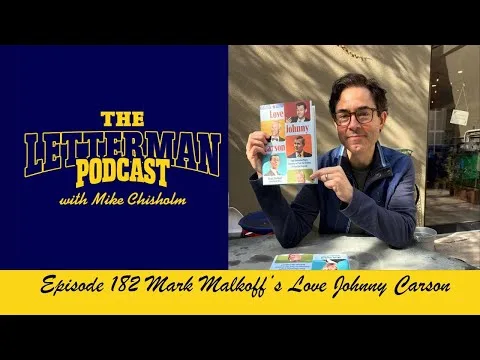
Episode 182 – Mark Malkoff: “Love, Johnny Carson”This week marks the triumphant return of Mark Malkoff, released just one day after his brand-new book, Love, Johnny Carson, officially hit store shelves — both digital and delightfully physical.In this special two-part conversation, Mark and Mike dive deep into the world of The Tonight Show Starring Johnny Carson, exploring the legacy, influence, and pure magic of the era that defined late-night television. Mark opens up about the research and stories that shaped his book — including brand-new insights about David Letterman, and how Johnny’s Tonight Show helped forge the late-night landscape that followed.Together, the two compare and contrast the genius of Carson and Letterman — the similarities, the differences, and the unshakable threads that tie their work together. It’s a thoughtful, entertaining deep-dive into two of television’s greatest giants, guided by one of late-night’s most passionate historians.Before you do anything else, swing by Hello-Deli.com — the only place on Earth to get officially licensed Late Show with David Letterman merchandise, straight from the legendary Rupert Jee himself.And if this episode made you laugh, learn, or feel even a tiny spark of nostalgia, please like, share, subscribe, and leave us a glowing comment — or a mildly amused one, we’ll still frame it.
Episode Transcript
Read full transcript
Hey, it's me, John Beckerman, and you are watching the Letterman podcast with Mike Chisum. And coincidentally, I am Mike Chisum. That's your bit, right? That's your bit.
That's my bit.
Doing your bit.
Thank you.
Welcome once again to the Letterman Podcast. My name is Mike Chisum. All right. Uh, this is the intro for well, I don't know if we're going to do two parts or not. We went over well over two hours. Um Mark Maloff, uh friend of our show, uh as far as I'm concerned, has taken pity on our show because he is just um such a wonderful, wonderful human. Host of the Carson podcast obviously um host of Inside Late Nightight, lateer.com, the Inside Late Nightight podcast. That's Mark Malov. Um been around for a long time.
um as as as as somebody who is a massive enthusiast of the genre of late night and that goes from of course uh you know he's a huge he worked for Letterman um you know worked for the Co Bear Report um you know Saturday Night Live you know the other day we're we're going back and forth a little bit and he puts up a picture of him he looked like a little he still looks like a kid I mean he looks amazing with Phil Hartman back in the day uh Mark has this unbelievable um combination of an encyclopedia type mind with a passion and a curiosity and an optimism when it comes to the things that he is interested in and and chief among those things is all things late night and Johnny Carson being of course the top of the heap the host of the Carson podcast I uh I aspire to have an episode um that is as good as his worst episode uh I just I I really appreciate him I'm inspired by Mark um very very much So, um, you know, talked about him before I even knew him back with Rick Sheckchman back in the day when She appeared, um, on on on his show.
This show doesn't exist if it's not for the Carson podcast. Shecky says to me one day, he goes, "Ah, yeah, I'm going to be on this this this Letterman podcast thing. I don't know what it is." And I'm like, "Okay." And that's a terrible Shecky, but that's okay. Um, and uh, and I and I and I I'm like, "Okay, somebody's finally hosting the Letterman podcast." All right. Um, and I just let that dream go for an afternoon. And then I get a call back later that night and check he said, "Oh, no, no, no. It was it was the Carson podcast. It was Mark Malikov's Carson podcast that he was a guest on." And suddenly the dream exists and within a few months this show um this show came into existence again with the help of Rick Sheckchman. Um and there was a there's a potential future project there with some of the footage that uh that Mark has with Shecky and and and anyway, so we talk about that the very end. Whether it's a part one, part two, I'm not sure. But why do we talk today?
Well, we talk because uh Love Johnny Carson has just been dropped.
Anybody who loves anything to do with whether it is Letterman, whether it is uh the genre of late night television, whatever it is, I cannot endorse this book more. I put it up there with Bill Carter's books. I put it up there with Last Days of Letterman by Scott Ryan. It is like I I I I I have so many accolades that I can give to this book, but the number one one is going to be how optimistic it is. Um it's it you talk about this show is a celebration, right? We don't talk about the salacious stuff. Not that Mark leaves out any of the of the of the the negative things that could be perceived of negative things that happen. Um you know, and I can give plenty of examples. He doesn't leave any of that stuff out. But um I believe that a lot of the books that have come out on Johnny Carson over the years and many of the narratives paint Johnny in a picture um that is sometimes um a little more less than perfect than it needs to be.
This book corrects that and um he sources it. There's 40 pages of citations in this book at the end of the book. Okay, it is very very very well researched. Um and and not just that, um accounts from the people who knew Johnny best, many of them who worked with Johnny every single day and they talked about Johnny Carson. Um I I the blueprint for everything that exists in late night right now is in this book. The stuff that's been created since then, a lot of the breadcrumbs were uh led from the things that Johnny Carson did back in the day. I was surprised so many times by details in this book. Some things, some Letterman things. There's a lot of Letterman in this book. A lot of details. Um, you know, one example being the idea that that that before Dave kind of came under Johnny's production company and and and NBC put the holding deal on him. Westinghouse was negotiating to have Dave go on opposite Johnny Carson back in the day.
Like I'm talking there's crazy details that are in this book that I don't know have been put out in other um in other you know uh productions of the narrative of Johnny Carson and and this book does it justice. They call Johnny the king of late night TV. This book does it justice. Okay. It is so good. And the fact that Mark um he knew it was going to be a long one with me uh because when I get excited about something, boy, I I I I really get into it and I really got into this book. Highly recommend it. Um if you want a signed copy, I'm that guy, right? I'm a memorabilia guy. I love that stuff. A signed copy, you can get them at the Histori book uh bookstore. Um go look on the website, you can find them there. Available where every every books books are sold. Try and support your local bookshop. I just say that as a my wife and I are authors. uh you know, we we appreciate the fact that Amazon exists and it's so convenient.
But at the same time, if you can support your local bookshop, go ahead and do it. I'm getting a hard copy. He also just finished recording the audio book, um which I'm very excited about because it's going to sound to me like a Carson podcast. If you have uh been lucky enough to to know what the Carson podcast is and to know Mark and to hear him, this book is written in his voice and you can actually hear it throughout the book. It's very very good. I cannot endorse it enough. Um Mark has all sorts of stuff going on. Please go and and and if you can share the book, that would be great. I don't know why um you know he's he's not on the view promoting this book, but he in my opinion should be. It is so good. It's so thoughtful. It's it's it's uh um it does justice to one of the giants in all of entertainment, dare I say even pop culture during his time. Um Johnny Carson was a giant. This book does it justice and um yeah, I hope you enjoy my conversation with Mark Malov. All right.
Uh no pre-in here whatsoever. I am jacked and excited about this, Mark. Um now I I I don't know. Have we hit I guess it's probably still for you the calm before the storm when it comes to you doing press for this thing and you talking about this uh about your book love Johnny Carson here it is I've been talking about it for weeks it's phenomenal everybody needs to go everybody who likes late night at all past present whatever needs to go out and get this book um is this the calm before the storm for you or are you already uh feeling tired and [laughter] from from the pre-press I felt tired for the last four years writing it. So, it's nothing new.
just I feel like this enormous weight just that I wanted to get the story right and then now it's the weight where I just want people hopefully to to know about and read about and there's just so much noise out there and um the title love Johnny Carson you know it can go a bunch of different ways how people interpret that but I mean there's so much as you've read so much Dave Letterman in it and so many other people that were were guested on it so just trying to get the word out as as much as I can but yeah it's not I I'm not Um, I'm not sleeping well, but I don't usually.
Um, do you hate the book yet?
I love You know what? I'm really happy with the book and I'm grateful. I'm grateful for David Ritz who did Paul Schaer's book who worked with me on this and um, no, I'm I am excited about it. I am. I want people to read it. I hope they like it. Um, there it's like my my my goal with this, one of my goals was just as much new stuff as possible that I didn't think the reader would know. So, it's maybe 30% Mike Carson podcast and maybe 40, but most of the stuff is are things that people I don't believe would will know and a lot of exclusive stuff and yeah, so forth.
I I I I phrased it wrong. I should have said, "Are you sick of the book yet?" Um because I mean, you know, I uh my wife and I wrote a book and and we did a little like I'm talking [clears throat] a little bit of press when we wrote our book 5 years ago. And um at that point, you know, [clears throat] you get into the uh just like when you're driving down the road, there's the worn spots on that road where the tires you don't really even need to to steer the car because it just goes and you you have these little uh sound bites that you have that you talk about over and over and over again to people. And I just wondered if um that's happened for you yet. I don't want it to happen today. I do want to go into a deep dive. Um, I don't want you to just to be the same saying the same things over and over and over again, but there's going to be a lot of that as you get the message out about this book. Um, I'm gonna ask a couple of uh, you know, process questions first because
the book itself um,
okay, well, there's a couple observations I want to make first right off the cuff. Uh, we talked about this uh, we were on Jay's show the other night, the late night playset. We were on that show the other night and and a couple of the observations um, that I wanted to say for today I did kind of let out there. First off, um, this book here, I talk about the we talk about the late shift. You and I are bonded in in our love for Bill Carter and the works of Bill Carter and and and and that book. This book here feels a lot like it was written and when it ends, the late shift begins. It it really does feel that way. Um, simply because of the way that it was formatted. It was written similar to the way that Bill Carter wrote The Late Shift in the sense that um the tone of it written kind of like a thriller, an optimistic thriller, though it was it was written in such a positive way with so many amazing details that people might it might have literally been lost to history uh were they not uh meticulously collected in your head and and in all the information that you've gathered over time. Um, I guess my question is, was it your intention to write it with that tone from the beginning?
My intention was just to tell the truth and to present it in a way that would be most succinct and easiest for the the reader. I mean, we David Ritz and I went back and forth. David Ritz a lot of times his style is these short paragraphs and we we we've talked a little bit about going um out of sequence, but um I definitely think in terms of the of the finished book um with everything pretty much in order for the most part. Um I do think it works. I'm happy with it. But just the fact that you even mentioned Bill Carter in the late shift in the same um sentence as Mark Malov is is a huge compliment. I'll I'll take it. But I am really happy with the book. I mean, you know, I the book is I think it's like 130,000 words. It's 400 pages or something 50 pages or a little less than of citations. So yeah, a lot went into this.
Let's talk about the citations for a second. I think it was when when I received it, I think one of the first impressions that I got from it, I I I flipped through it really really quick just looking at it. 40 pages of citations at the end of the book. Um, you know, and and and and really we can talk a little bit about how we how you assembled the book. And I've got a a few examples of that here. um expertly assembled and and and the way that you did it in a sense uh feels to me in the best possible way. I just don't know how else to describe it. It feels like there's a little bit of Frankensteining going on in here. Um where and I don't know how you would have done that. Um you know, you you come up with a topic of some sort and then might use two or three different sources to build that um to build it. I mean, if this were a paper uh or a thesis that somebody wrote in university, uh the bibliography at the end of it, I guess if you call the citations that, just meticulous. And I'm curious as to um the process of some of these anecdotes that might be three or four lines long might have um you know, two or three notations or citations to it. Um am I am I am I on with that? Am I am I taking the book apart properly with that?
No, I think so. I mean, I just there were there definitely were some common things that had been reported in terms of um Carson's stories, but I really wanted to add more layers and details that did not exist. So, yeah, I mean, I just dug as as I mean, I I get obsessed with things sometimes and um in a in a positive way in terms of my interest in terms of like something like uh Late Night for example. and and Johnny Carson. And I just I just wanted to find those those nuggets of um of newness. And it was going back to newspapers from literally the 40s and the 50s and 60s and going back to Variety from when Johnny was still local at in in Los Angeles and cold calling um individuals that knew him and and just um yeah, the the definitely the sightings. I I probably went a little bit over the top, but I I wanted to cuz cuz there I was explained by many people there is no rule for citations and you don't have to site, but I make so many I would say big claims that I want to show people that that this is my evidence for it. So, you know,
and now we're unraveling it a little bit here. I love how you started the book. Um and and and I mean again, this is just my impression of it. You start the book where you kind of I don't want to say take shots. What you do is you just explain the narrative. Okay. If somebody were to go out and and and and uh get educated on Johnny Carson by reading the materials that are available out there um you get a certain slant and I mean there are some people when they write books uh they enjoy going down the path of the salacious and taking maybe the negative uh I mean all people are have positives and negatives. Nobody is perfect. And there are some people when they'll write a book on somebody who is um you know iconic, what they will do is they will take some of the negative and they will make that the focal point thus distorting who the person was. This is my impression um uh especially after reading your book. Um it certainly has been solidified but I mean there was a lot of stuff that's out there and at the beginning of the book you kind of throw out hey this is out there about Johnny.
This is out there about Johnny. This is out there about Johnny. And then for the next 300 and something pages, you basically in my opinion um at the very least create a fair balance, but at the most you actually dismantle some of these um these things that are out there. Uh was that was that the intention from the beginning?
My intention was to tell the truth and I talked to 400 plus people and I was really shocked especially in the beginning how many people gave me this other picture. Bill Murray was talking about the the Belushi book, Wired by Bob Woodward. And and and Murray was saying it's like he got this so wrong. And all of Belushi's friends, I read the Woodward book back in the day, Wired. And Belushi does not come off as a friendly person. And his friends and everybody I've ever talked to that that knew him said he was loved him. People loved him. And you would not from reading that book know that.
And I from talking to the 400 people overwhelmingly the reason it's called love Johnny Carson is cuz so many of those people that I spoke to said I love Johnny Carson and they would just give me this completely you know not he's not cold and aloof and if he was cold and aloof certain times there were reasons I mean people would would grab him by the arm in public and say hey come say hi to my friends and the FBI had to protect him because um I mean Mark David Chapman who assassinated John Lennon And um he Mark David Chapman had a short list of people if it wasn't Lennin and Johnny was on the list. I mean it was constant people climbing over his his fence in in Bair trying to get at him sneaking into NBC with knives and guns.
So he just had to protect himself and even people he knew were trying to get to him and use him and it was just he had this a small circle of people where he felt comfortable with and they all will say the same thing that when Johnny felt comfortable with them he was this almost the same Johnny you would see on the Tonight Show that was Johnny. You can't for 30 years be on top and not have that be your personality
when yes he he you know the he was in control so he could hide. He was very shy, but the the cold and aloof thing was more of self-preservation, many people say, but they constantly people would say he was the he was very close to not were the same Johnny um that you would see on camera, which I think shocks people and it's it goes completely against the cold and aloof thing that Johnny would joke about just because the media made him out to be like that and it they made him out to be JD Salinger or Greta Garbo and in um in retirement this recluse and It's like, no, he's out with his writers at lunches. He's hanging out um with Bob Wright. He's all over the place. And I I just didn't it just didn't really make sense. I mean, people said he disappeared after his final show. I'm like, no, he had two more years um till May of 94 where he was did the Simpsons, the American Teachers Awards, Bob Hope's 90th birthday.
He showed up to get the Presidential Medal of Honor um from from George uh Bush um George um Herbert Walker. He did the Simpsons. He did a cameo on Letterman, too. One which was the pretape with the the tire with Paul and Dave on Stranded of the Road and Johnny Drives by another one where Peter Laselli the I think the day of finally talked Dave into doing this CBS television city that brilliant walk-on with Larry Bud Melman. And um so he was out and about for 2 years solid. So I 94 he got to the point where he's like I think this is enough. But he he he was he was able to walk away where some people like Rages or Don Rickles needed it up until they they passed away. They just needed the attention of the audience and Johnny was able to walk away and said I I just want this is the best work I'm ever going to do and I don't want it to slip and I give them a lot of credit.
Yeah. Um and and I appreciate that answer very very very much. I think um to go back to the the idea of JD Salinger, Greta Garbo, whatever. um that moniker was thrust upon him by others and and and you have confounded that um beautifully. Um yeah and and I mean I want to talk about layout of the book uh without giving too many too many spoilers. Um because go read the book everybody go read it seriously it's it's you will not regret it at all. Um in fact you will be uh better for having do doing so if you enjoy this stuff that we're talking about here. But let's get I I do want to get to the end in that regard. I've got it I've got a bunch of things written down here. I don't think that there is ever been um uh the the factoids that you have about Johnny during his retirement. Um his retirement reading um how how you portrayed it here was a very sweet retirement. He had a he had a lot of beautiful beautiful things in his retirement and and the the people around him. Uh but the opportunities to come back and how close he came to coming back a couple of times were uh fascinating to me. I had never read um you know a couple of these things that the the the one special in particular where he was it seemed like it was really close that there was a special he was gonna Yeah. And
Mahal Barry Yeah. Maholland Barry who wrote for Dave for I think 25 years or something like that on the CBS show and were Johnny's longtime writers wrote a really funny special and Johnny strongly considered he was taking meetings in retirement. He said on his final show, "If I if I decide to come back, um, I hope you will be as gracious allowing me and Jerry Holmes." And he really meant that, like he he was was strongly thought he probably would do something, but
yeah. And they wanted to get him for award shows and things like that, all sorts of stuff. And and again, it it didn't seem like it was a hard no. And and and um you know, in the tribute the tribute show, Peter Lasali talking about how he would uh this is another thing that I was delighted by. It seems like a few people got the monologue treatment post retire post uh retirement for for for for from Johnny where where where he would put on a a little monologue or a show for people because he just even up to the end could not turn it off and to the point where was writing jokes for Letterman. Of course that is uh has come out. Uh I thought it was very interesting how that came out. Peter Lasali um looking for something to say and basically revealed this this this very uh juicy tidbit that that uh Johnny had been writing for Dave. A lot of people found out about that during the tribute show, but it actually came up before that.
Yeah, it was Craig. I think it was the Craig Ferguson press conference and they they asked the uh the press asked about Johnny to Peter and uh Peter's told me a bully. he started to panic and he thought that that'd be one thing he could throw out that that Yeah, Johnny got a kick out of that. Um I I really want to go back because I know um I know um obviously Dave did on the tribute did all those jokes that Johnny wrote, but that
um I think it was Bill Zan wrote the piece that when Dave would um do one of Johnny's jokes that Dave sometimes would do the the golf swing and and is an kind of an inside joke to Johnny um which I got a kick out of. I have to look back. But yeah, I mean Johnny in retirement was doing lunches. He he definitely liked his alone time on his yacht. But at the same time, he was going into the office. And this would not happen with other retired late night show hosts. I'm not going to mention names, but you do a podcast about one of them where they're actually signing their own mail, like autograph requests. Johnny would sign everything. He would read the letters. He would um dictate um you know, answer specific questions from fans. He would sign everything himself. Helen Sanders, his assistant, said, "I I never signed any correspondence." And everybody, unless, you know, there was something off about the letter, um, for the most part, would get a response.
And Johnny would sign autograph requests. He would sign letters. And, um, I wish I would have known this. It never occurred to me. I would have written him in retirement that he would be that accessible. It never made sense. But that's very Johnny Midwest about somebody writes you a letter, you get back to him, back to them. Johnny, even during the 30 years, if um there were sometimes letters with somebody upset at a joke or there was something, he would just call up the person. I mean, he was way more accessible and more so such a Midwestern uh person at heart, even though he was, you know, the king of television and the one of the most highly paid entertainers in in in the country.
Yeah. Um it's funny. I have a uh Oh, I don't know if I should tell you this off camera or not. What the hell is that? That that the part that you the part that you just said there. Um I actually have that written out. Um I haven't written out. I'm writing a letter to Dave. I haven't written one in a while. I did at the beginning of this show here. That's when I got the pictures signed and all that stuff. Um and I haven't written him something for a while. Um and so I'm actually doing that. And at the beginning of the letter, I am citing that small. It's like two or three sentences that you wrote near the end of the book talking about how how Johnny did that and how you said it never even occurred to you to to potentially start a correspondence with Johnny.
Yeah, that's right. Yeah, he was writing people back. I mean Dave, I don't think it's any secret cuz he mentioned it to Jason Zinnamman in the book that I mean Jason had that canned ham autographed by Dave and they would do that. They did it the NBC show. Dave's one of Dave's assistants um well he had one assistant back then say if anybody want anything sign I'll have Dave do it after the show and she was she'd be backstage and just sign everything. I mean I I it's just a different thing where Johnny would not
um he would not have wanted anybody to sign his name like that from the people at least I talked to. It's just a different approach.
Yeah. Um and and and again when you consider the level of fame and how he got to that place and I want to get to that here as as we do this. So I want to talk about the layout of the book for a second. We get a really nice intro um that does talk about the narrative that's out there. But then also in that intro we get to learn a little bit about you and you are one of those guys. You are like a slippery cat uh to a lot of people. People have asked me they're like okay wait a second like how has Malov done all of these things? how has he worked for Letterman, worked for Co Bear, done the Carson podcast, done these stunts and all these sorts of things. H how has he done all of these things um in in in his life and whatnot? You actually do a really nice little intro about yourself. I'm curious, was that difficult?
Oh, I didn't want to do it. I mean, my David Ritz insisted, the publisher um that I talked to um yeah, they were like, "We want you to do this." I just I I struggled with this in the Carson podcast as well because it's I don't it's I I really feel it's not about me. I didn't want the book to you know I I I don't know some people really love that. Like I know that there's certain people that were interviewed on their own. Why don't you do an episode of the Carson Podcast and have somebody interview you? And I'm like it's not about me. So I felt that but um talking to David Rhodess and the publisher they talked me into it and I I did it. it wasn't my favorite thing to to to to do just because I I just I just again I don't want to take focus but at the same time I know that the that if it helps and they think it will just for the the um the readers to know where I'm coming from and how I got into Johnny and the approach I took with the book and where my I just think where my curiosity um lies and that I did this podcast for so long cuz I mean some people know about the podcast like it did well but there's still I mean most people do not know about it and just talking about my whole journey and mission with you know Peter Jones who did the American Masters um Johnny Carson in 2012 which Dave Letterman was in
and Peter was the one that I told my idea I was going to do a generic podcast cuz I was too scared to do one about Johnny Carson and he's like you have to do this he told me after I I recorded an interview with him Peter and it was like just like to see the part it like um I called him the next day and I was like Peter that meant so much to me. Um, we had this really connection, this bond, and he's and I was like, "Who do you think I should have on the podcast, and he's like, "Well, do you want Doc Severson's cell phone number? Do you want Carl Riner's home phone number? Do you want Angie Dickinson's email address?" And it was it was just like every I've done a lot of these projects with my curiosity where it's like you're just breaking down walls to get to the one success and persistence and it's just perseverance. this thing from the beginning um part the seas parted and I am so grateful. I've only had that happen maybe a few times in my life because I've my whole career and just everything has just been following my curiosity and um this was something that just yeah it just it was the timing and just I don't know um some people call it God I would some people just the universe but it just everything lined up.
Yeah. and and uh what a blessed thing to be able to say that I I mean I I can certainly um identify with what you're saying when the doors are open and we dare to walk through them and I think that that's the other thing is that you uh inspire so many people because you do dare to do that and I mean you know I go back to all the things that you have done like look at all you posted a picture of you and Phil Hartman the other day and I was just like like like the the the ways that you have stepped forward in your life from when you were young um to move towards the things that you do love or that you are curious about. It is inspirational because sometimes just that the vision of knowing what it is that you love and then actually walking through the door and putting action towards that sometimes um that's where you know God, the universe, whatever says hold my beer. I'm going to blow you I'm going to blow you away. And you've had so many of those moments.
Um and it's a beautiful thing to see. The intro, I got to tell you, it was the exact right move for a variety of reasons. Number one, it does scratch the itch of some of those people wondering, okay, who is this guy? um or or or people who have uh the thing that I loved the most about it was it set the stage for me and those of you out there who are listening to this that do enjoy the Carson podcast. For me, the intro was the flipping of the switch that I actually read the entire book in your voice similar to if it would have been a Carson podcast except transcribed and you were the person that read it. like I read this book like it was an episode of the Carson podcast. That is a gift that those of us who do love the show and have followed you that I think will receive and I think that switch gets flipped during the intro. So it's it's it's it was a a master stroke to do that.
the idea of you as a kid being taken to Burbank um and on the set of the Tonight Show, you know, I only imagine your eyes must have been as wide as saucers, you know, having to be pulled out of there because you could have spent all day there. There are a lot of us out there who have this curiosity and when we get into something, we really get into it. I've been on the stage of the Ed Sullivan Theater a few times now. um once for Letterman, twice for Co Bear. And I have that same awe um that same resonance with that and and when you when you gave us that story and a couple others in the intro, I believe you were giving us the ability to open up that childlike piece of wonder. So, it was a very very good move to do it. And I know I asked you if you enjoyed it. I knew you wouldn't. Um but I'm glad you did it. I'm glad you thought through that and did it. I'm glad you like it.
Yeah, just opening up myself is probably a good I know it's probably a good thing for the book and hopefully people um talking about I talk about going um I had a job at Letterman and then I was at the Johnny Tribute Show. They kind of snuck me into the balcony um the Johnny um when after Johnny passed away. So I talk about that a little bit but yeah it was good. I just think for the book and definitely at the podcast it was when the seas parted with the podcast it was it took a while at least a few months of me sitting down with these people like Stephen Wright and the voice would be like Mark you have no qualifications to be hosting a podcast you are not an interviewer you have no I just had to fight that voice that was just telling me I was a complete impostor and I shouldn't be doing this and um it took me it just took me a while my listeners were really really good with their feedback. They were completely um clear with what it was, but they were at least polite about it.
Um this Yeah, I just would I think it's cuz of ADHD in me. Um I'm much more aware of it, but I would inter interrupt people a lot and I hear that on podcast all the time. People are like, "Johnny didn't interrupt people."
I'm like, "Well, I know he did because sometimes cuz I would watch the interviews and I'm like, "I wish you could see this clip right here." But um it re I think it made me a lot better and I was um it just took a a little bit of time to get comfortable. But I'm glad there's I I've definitely um am happy that I've allowed myself to like the book as well. I mean I had that voice for a long time. You've never you don't know how to write a book and all that stuff. It's just getting through it. And um but yeah, I'm glad that um was able to persevere.
I can uh I can relate to everything that you just said. a lot of vocal people uh you know very very uh you know very blunt in in in how they
Oh yeah
you know it's the whole thing of is it an interview is it a conversation and I talked about this um actually even just like even shortly before he left this earth she and I talked about that it was like the idea that a conversation when you have when when you're at a coffee shop with your friends and and you're and you're having a conversation and you're all in that flow state and it's that that that place of friendship that place of of of of connection um interrupt Corruptions happen. You do that, but at the same time, you don't want to step on things. I had when I had O'Donnell on
early on, and I mean, this guy's a god to me, you know, u was a small small case g um you know, and and and I the first part of our conversation I was really really happy with and the second part I realized I stepped on him like four or five times and I there was this one night when I was listening to it and I hate listening to myself again, but as you know, you don't get better if you don't fight through that. And I felt like, oh my gosh, I just stepped on Steve O'Donnell five times and I just I I wanted to crawl into a hole. Uh thankfully his grace and actually I gotta have him back on the show. I want to talk about uh today, but I know exactly what you're talking about. I'm segueing to today because um here's how I wanted to start this. This is this is the intro to you being on the show. Um there's a quote from Johnny. I I I I I threw it back at you again the other night on Jay's show, but this is how I wanted to start the show. Johnny Carson said this 30 years agoish. Um, there cannot be four or five late night shows on about the same thing without somebody else taking or without somebody taking a bath. Someone taking a bath. Actually, here I'm going to do the quote again.
There cannot be four or five late night shows on about the same thing without someone taking a bath. Um, kind of prophetic words when you look at the state of late night right now. Johnny was talking about the expansion um of of late night television, which he seemed to take a little bit of exception to. Uh because I think for decades he was the gatekeeper for late night television not expanding the way that we know it now. Or at least that's the that's the narrative that a lot of people think once we get to the first decade. It wasn't really so much like that. He kept everybody at bay and stopped the expansion happening. That wasn't for lack of trying, though.
Yeah. Yeah, I mean he had competition. I mean, in 1971, as I mentioned in the book, he um at 11:30 would turn on his show and he'd have four TVs in um set up next to each other these at his UN Plaza um apartment. It' be him, um Dick Cavitt, which was on opposite him, David Frost opposite him, and MV Griffin. And he was just very competitive. I mean, I don't nobody really gave him I think Jill Bishop probably the most competition but certainly people tried but yeah unbelievable with his longevity but yeah when he was interviewed by Tom Shells of that quote that you mentioned in 93 I think it was December of 93 he he just was he was talking about that that that young boy Conan O'Brien he called him a boy he had only been on for a few months that's going to probably take him a little bit longer to to to figure it out and Johnny did say that cuz him and Chvy Chase played in a poker game that leading up to the Chvy Chase show when I was announced, Jeffy, you really want to do this five nights a week. He would he wouldn't sugarcoat how hard it was to people. And um it just Yeah, it it was definitely from the people I've talked to and Sha talk about Gary Shanley talking about this I think in the book too about how exhausting the show is. One of Johnny's competitors said it's like shoveling snow being on for 90 minutes back then.
Um in in in the 60s it was like shoveling snow for eight hours is is um it's more exhausting than that. Um and it for some people it is I mean Johnny in the beginning was doing an hour 45 if you can imagine that.
Yeah. The extra 15 minutes just for the uh for the for the New York audience or for the for the the Northeastern audience.
It was for some of the affiliates less than half and then it went down. New York dropped the first 15 minutes. Then San Francisco and then it was like a ridiculously small number and Johnny in 1966 um stood up and NBC tried to fight him on it and Johnny was able to um to be victorious. He certainly it took him a while to get the leverage back from NBC cuz oh my goodness he was doing an hour 45 minutes and then the weekends they were having him going to affiliate meetings and lunchon dinners and it was just it was pretty brutal in the beginning for like a year or two. I mean he I I put this in the book too. I mean he didn't even have a a bathroom a restroom in his office. He had to you know use the shared office with all the other NBC employees. And it's like this guy's a star. Um, it took him a while to get the leverage and to start being treated um, the way that he thought he should be for making that much money for the network.
I have a bunch of that stuff written down here. Um, the way you formatted the book is so beautiful.
The intro, the first decade, the second decade, the third decade, and then in within that all these sort of mini chapters. Uh uh sometimes there's a greater narrative that that that that moves the story along the progression of Johnny's career, but then there's all these little mini chapters of of of anecdotes of things that happened. Um you talking about the idea Johnny Carson really at the end of the day the person to um create the uh the ability for late show late night hosts to be treated as stars. Um and and and that really, you know, there were a couple moments where where that happened where and and of course famously the crescendo of power uh that he had by the end, you know, one of the most powerful people in entertainment owning the Tonight Show. Um you know, some would think that would be an unthinkable act. Um but it didn't start that way. It started, you know, um very very very minor, very very very quiet in the way that these people were treated. um Johnny's wife a huge part of how that um that changed at the beginning of that if she she I would say that the way that the book presents it she is the one that removed the keystone uh for Johnny to start that crescendo
wife too and they were it was this girlfriend at the time that was Joanne Carson Peter Lasali told me that she was basically running the show behind the scenes and Johnny didn't know her her influence I And it was like producers hired fired. Uh yeah, she was the one that and I talk about this. I don't Johnny wasn't aware of it to my knowledge that she Dave Teet was the vice president of NBC and there was this guy other guy Mor Warner and Joanne knew both of them cuz Joanne had been in in entertainment herself and um got them to go to a Friday club um event. and they were doing a roast of Gary Moore who was a big TV star back then and Johnny crushed it and she knew he would. But it was all set up um by Joanne that to to to try to get Johnny to take the Tonight Show and be offered in the first time that they offered it and they turned it down and it made Joanne look bad and she really had to talk him into it. She was in the front row for I mean um for at least for like every night for at least a few months.
Mhm.
Um in that audience and just so supportive and just everything was about Johnny. But yeah, she's the one that convinced him in um in ' 67 that uh to go on kind of a strike that NBC had violated their contract that according
and she um I I don't know if Johnny would have been as tenacious um without her especially Yeah. during those the New York period. Oh man, it's it's Joanne Carson deserves so much credit for that. for those of us um especially for you and I who who who are Gen Xers that came in sort of at the tail end um you know we kind of came out of the box knowing Johnny was king knowing that Johnny had this power knowing that uh Johnny couldn't push around he was the guy that pushed people around um not so much at the beginning like even if you look at and and also the uh the narrative that you and I always saw was the joke was always that Johnny oh yeah he works uh he works three days a week and he he has a lot of nights off and and and all that sort of stuff. not so much at the beginning. He earned that uh 251 shows a year has 261 working days and he had 251 shows uh either that first year or those first couple years even the work ethic I mean and and then like you say um hour and 45 hour and a half all the affiliate stuff that he had to do. Um that guy you know as they say in the wrestling business that guy paid his dues and then some and then some.
And I'm wondering like he probably needed somebody like that behind him um who had not just had his back but a vested interest and and and had this u mission in life to elevate and to promote and to and to push him forward. Uh the team behind him um extremely important especially in those beginning days because these people were not treated like uh like stars in in in some in some respects. They were they were treated like like stage hands, you know, uh uh to be directed here and there. And the idea that Johnny Carson was treated that way at the beginning, I don't think that's something that a lot of people uh realize either.
Yeah. I think it was like maybe six 1964 when he debuted at the era hotel doing at Vegas Act and he broke Judy Garland's record. There start there were certain things that just this the tide of power started to shift a little bit. Yep.
Um and he did get power. I do want to mention when he was doing the three nights a week near the last couple years. It wasn't because he was lazy. It's not because he didn't like the show. He just was getting older in his 60s and he did not have the energy that he did and he didn't want the show to dip. It wasn't a matter of him um yeah just being lazy. It was just he was exhausted and that was the and people really I mean when he did the show it was such a big deal when he hosted the show. But Ed, I mean Ed McMahon I write in the book in the warm-up would always say and guess what that would tell the audience before the show and the man whose name is in this the title of the show is actually going to host his own show tonight when Johnny would um would would be there. So it was it was a big deal. But this guy did was doing 90 minutes up until something like 1980 something like that. So
yeah, he definitely paid his dues and uh beyond in terms of like yeah, the first year I think he did 400 and over 400 hours. I mean um of the Tonight Show and now the the the the current crop does 180 at the most. So it was it's the equivalent to like to one these late night guys late night um host having to do the show every single day for a year. you're doing weekends and doing two shows a night for like one month on top of that. So,
yeah,
it's a it was a lot and um it was very very interesting listening to or reading the um the atmosphere for him um because it was again paying dues. talk about this. They had Murf G MV Griffin waiting in the wings and and not just him like there were always people who were ready for Johnny to be done and and I think part of that was because uh there was no longevity really at that point you know uh was it 5 years that that Allen did it in four years that parted it something like that um you know there was no longevity and people thought oh my goodness that's a long time for these things um you know I don't know that anybody thought that uh that that the longevity that Johnny showed us would be possible. Um, and now we've got a few hosts that are, you know, Dave eclipsed it. Um, you know, Conan was close. Kimmel has the opportunity potentially to potentially get there. Um, you know, again, you know, with with one franchise with Conan and Dave, they had two different franchises when they did that.
Um, but yeah, at the end of the day, uh, how hard Johnny worked, how, uh, difficult it was, and how many people were actually ready for him to be to fail, um, and not not work out with this thing. Um, I don't know that a lot of people know that either.
People don't like change. I I think Conan had a really tough time for a couple of years when anything new um, is out. Obviously Dave's Morning Show, the David Letterman Show, won Emmys, but I mean, the audience, there was a disconnect with anything different. It's going to take um some time and they gave Johnny I think it was a 26- week contract. That's what I mean he his his contract was and for um at least in the beginning and it was I mean the guy was a game show host.
I mean once the public thinks about somebody is he was a game show host for 5 years very successful it's hard for them sometimes to accept something new and then you have Jack Parr who was one of the biggest stars in television who was some of the controversy that was on that show was organic some of it was like professional wrestling completely made up in my opinion with some of it but I mean he was he was feuding with everyone Ed Sullivan he was feuding with Walt Walter Winchell he was getting sued by Jimmy Hafa I mean he thrived on that controversy versy where Carson is like I'm just going to do an entertainment show and just um if the controversy organically happens like once in a while it would like with Jim Garrison who um from New Orleans was a was a a lawyer who went on the show and I believe it was 68 around there to talk about the the JFK. Um he was one of the first I think to say there was a conspiracy and they had him on and that was some controversy.
Johnny said that was good controversy, but he just didn't want to do what Jack did. And people in the beginning missed it. They called some people, critics were, "This is bland.
This is boring." Um, people would write into the newspapers that this was a mistake and we wanted our Jack back. There were all these rumors that made the press that NBC was going to bring Jack back at least like one night a week or more to take Carson off. But, uh, thank goodness they gave him some time to figure it out. Um, you always need that. Yeah. And and I'm I'm I'm grateful that we're talking about this. It was like Carson was fighting off a lot of people with a machete and and and uh and again, some of these things that you're talking about here. Um, now I I do have a ton of comparisons uh with Dave and and and Johnny hopefully as we go through this uh because there's a lot of things that I think a lot of people won't even realize. But one comparison that I would like to make um between uh Johnny and and actually and Jay Leno was the idea that back then with the four TVs, you know, not as easy to do that back then, by the way, as it is now. Very difficult. You know, you got to have a you got to have a pretty special cable package to be able to do to do what what what Johnny did. the idea that he was looking at what the competitors were doing and wanting to make sure that his show had the best of everything in the exact right alchemy um was something that he did. That's something that Jay Leno did as well. He was unabashed in in in saying no, we want to be number one.
We're going to take if we got to take elements from Letterman or or staff from Letterman or or or things like that, we're going to do that. if we've got to lean into a story uh like the OJ uh like the OJ uh trial um and that that that's going to give us that edge, we're going to go ahead and do that. Um Johnny, I I would say that is something that is very similar to uh to Johnny Carson's mindset back then.
Johnny and he struggled with this. He would talk about just being overly competitive. It would show up in his tennis game, but just he took it and I think he would acknowledge it a little too far. I mean, he couldn't enjoy playing even a board game and losing. I mean, he would just be so upset. So, everything, especially the the the show for him to survive for 30 years. Um, definitely. And especially when he got that that the power back from NBC, just to protect it at all costs.
Yep.
And to own the show. Um the other thing that you mentioned there um that I think is important, a lot of people don't realize this, you know, um right now with w with the current, um atmosphere in late night television, they're talking about, you know, Jimmy Fallon. He he he talks about I don't even know if he mentioned Carson by my name, but he's the Tonight Show, you know, really likes to stay away from uh the polarization. And I and I can see why he would frame it the way that our culture is polarized right now. I totally totally get it. But back then, um, let's not homogenize the fact that, um, you know, Johnny Carson, um, I make I make people mad all the time. I compare Rogan to Car Joe Rogan to Johnny Carson sometimes and and people do not like when I do that because he's a polarizing name. But the idea that there's a couple of comparisons. Number one, the Rogan bump is similar to the Carson bump. You make one appearance on Rogan and suddenly your entire stand-up career can be booked for the next couple of years.
uh bec based on that one performance, Johnny certainly had that power. Another thing though, Johnny did have while he didn't necessarily throw out his uh political affiliations, he had a metric ton of thought leaders, but also thought provokers, people who were considered uh controversial in their in their in their opinions, and he would give them um the opportunity to have a voice on that show. A lot of people back then
Yeah. all the time he would have people on that he would agree with that he really didn't feel like he could take a stance definitely Gore Vidal Joan Bayz even though that there was an incident with the two of them where they kind of got into it um uh but yeah there definitely Paul Erlick who was uh wrote a book about the population control and would get death threats and it was like they got so many IATE people some people were positive as probably split but so many people were I rateate that Johnny had this guy on cuz population control especially back then very controversial. I mean Johnny had the the head of the church of Satan on the head of the NRA Maline Murray O'Hare the mo one of the dubbed the most hated woman in America. She was a an atheist and to be an atheist back then especially was mainstream and there weren't it wasn't a it wasn't um you didn't have that as much back then. So it was a big deal and he gave people voices.
I mean definitely he would Harry Bellfonte giving Harry Bellfonte a week in 1968 to have anybody he wanted and Bellafonte said really anybody said yeah whoever you wanted NBC was terrified I mean he he booked Martin Luther King and NBC's like you're not going to talk about racism are you or anything depressing and it's like no we're going to talk opera [laughter] said um back to him but it was really revolutionary um the people that he was booking a lot them. And it was definitely one of those things where Johnny personally called Harry Bellfonte up. It wasn't like that was an accident or NBC's like, you know what, we want to give Harry Bellfonte a week of complete control on network television.
Um so yeah, Johnny throughout I mean he if something was injust he would talk about it. I mean he Anita Bryant who was um famous singer very famous um was against um gay rights and was trying to get law in Florida I think and Johnny just took her down. I mean Tom Shales and even other people um he would just do monologue jokes. This was the late '7s about Anita Bryant um being approved and ridiculous with gay rights back then even though I'm sure some of the audience was not happy. I mean there was um somebody was sentenced to a marijuana possession. I think it was like a really small possession to 12 years and he would talk about how that was such an injustice and pot mild stimulant and um he was outraged and um the Rolling Stone I think did a piece and eventually it got um the the the sentence got changed down to like less than a year or something like that or I I don't know what it was but um no Johnny definitely for back then I mean this is back when politicians if they admitted that they smoked marijuana would not get elected.
I mean, for Johnny to talk about marijuana and what it actually was was not a popular uh thing for a lot of the country. So, he he would make his his um he would definitely [clears throat] be open um with some of his views if he felt extreme and he would get them the mail and the the people would be upset and it's just it was something that Johnny I think if he said it on the show he would stand by it.
Right. And uh and again, you know, we referenced this the other night on on Jay's show. Um you know, the night Martin Luther King was shot. Um and and and by the way, a lot of uh famous and infam you know uh famousness and infamousness around that uh that moment. Um and and springboarding it to iconic moments, too. Tiny Tim's very first appearance uh was the night was it the night Martin Luther King got shot and they had a show in the can. Is that is that is that the story?
Yeah. Johnny walks off stage. I think it was like maybe 8:30. It was something like that or maybe 9:00. He walks off stage in 6B through the double doors and they told him Martin Luther King was was assassinated and and and and died. Carson was was really upset. I mean, obviously the nation was, but um it was one of those things where he just couldn't believe it and watched the news with everybody. Um and you know, Martin Luther King had just been there. This was um 68. So just months earlier um Martin Luther King had been in those very hallways in the very studio with Harry Bellfonte. So you know everything rightfully so the news preempted everything. So um yeah Johnny had just taped a show was Tiny Tim's debut I believe and um Johnny never thought in a million years that NBC would be foolish enough to broadcast the show at 11:30 or 11:15 11:30 at that point I guess. um foolish enough to to broadcast it because there were people back then and even people now I guess that watch the show that think it's live at 11:30 and that they don't pre-tape. So it's it's like Martin Luther King all just lost his life in the worst way [snorts]
and then it's this comedy show where they're not acknowledging Dr. King and they're just laughing and it's this big party. So yeah, people were upset at Johnny. Johnny the next night um didn't do a monologue and he said that he explained that that was pre-taped and he apologized to everybody and they did a tribute show with Sammy Davis Jr. and Diana Ross. But um the fact that NBC at 11:30 would broadcast the show without especially without saying this was pre-recorded or anything, Johnny just was was not happy.
Well, an irony about Tiny Tim, we'll get to him in a second. Would you compare if we're going to compare um you know Carson moments um when national tragedy or or or events certainly in the national eye and Letterman would you say that the the the that next night um that Martin Luther King show would that be akin to David Letterman's um 911 response? Uh- would those be the same thing in your mind in their careers? Um, from from a place of of of gravity in the moment, the nation is gripped um in in in a in a tragedy that everybody is talking about and and what's Johnny going to say or how's the Tonight Show going to respond? Would you say that those are comparable?
It's hard to say. I mean, Johnny's um because actually Phil Grize who has all the audio uh from the ' 60s, '50s, 40s, he's this um blinking on his website. He's an amazing man, but he played the audio for me. It exists. It's not for public um about what Johnny's um what he said, the words he said about Martin Luther King, but they definitely were much more brief than Dave what he did on his first show back. I think when Dave came back, it was just such a big deal because it's so much time had passed, not so much time, but enough time had passed that
um versus this had just happened the day before. But both very eloquent. Um yeah, I mean I really wish that the the clip existed um for the public for the the Martin Luther King Johnny said, but he was always really good about that those things like when um his friend Robert Kennedy was assassinated. I mean, they lived in the same building at the UN Plaza. They were friends. Bobby Kennedy would swing by Carson's office at NBC and um a couple days later after that, they did the a tribute show without an audience um to with a panel
talking about um RFK. Um I think Johnny was very good at those things when he needed to and he he realized what he as a broadcaster his responsibility was to his audience. So like this time uh you you allude to the fact that so much of this has been erased uh which is which is abhorrent as far as I'm concerned. Um the fact that this body I talk about Letterman being um you know responsible for the greatest body of broadcast work in history you know that of David Letterman and company. um a big chunk of that uh you know for Johnny is gone and and it's only available on these these little inroads that you can have and sometimes it's only audio and whatnot. Um you know the tragedy of that yet this is where I go back to the book and let's go into some of the lighter areas. Um it's funny somebody that we both know once once said to me about about this show is that it's kind of like the Chris Farley show where I like to just sit down with somebody and say, "Hey, remember that moment when And and I mean really at the end of the day, the Chris Farley show um you know, you know, an exaggeration of the human condition where we like to just sit down and reminisce about moments that we really enjoyed in the past.
Um you know, going through that first decade, there are a lot of very very entertaining moments just being retold again um that that we can't go and see. we can't jump on YouTube and jump and see them. Um, first off, I I appreciate the fact that, you know, your fandom and your curiosity has been rewarded where you've gotten to see some of these gems here, but you haven't just seen them, you've taken them then and then retold them for all of us to enjoy. Going through and and reading some of these things and I mean, I've got a whole bunch of them, you know, um um um Jaza taking off after Brando offended her and and and the Peter Oul stuff. Uh um you know, the idea of Barbara Stryand. I mean, my gosh, she she made her made her bones in her career, uh, four appearances and then became Barbara and then suddenly it's everything's different. You know, all these moments in that first decade that happened. Um, many of them just don't exist anymore.
And and one of the things that you have done in this book is you've given us the ability to relive those moments. One of the one I want to talk about is is Tiny Tim. Uh because again many people today have no idea the cultural significance of the time of Tiny Tim. Uh Johnny Carson's staff wanted to revolt because of Tiny Tim. He was It's unbelievable to think about um today in the year 2025 that Tiny Tim
would be such a radical polarizing figure to so many people. I think the crew especially was very conservative and just this the his appearance just offended people and um they were revolted and he Craig Tennis who booked him. It was a talent coordinator um who's Carson really did appreciate value his op his opinion with his booking. um they was strongly advised not to book this guy to book Tiny Tim and Craig as he said I think he had only been at the show for a month at that point put his career on the line
and very quickly the audience started um they they they were laughing but they it wasn't at him like Murf Griffin made the mistake of making fun of Tiny Tim where Johnny didn't do that
right
and um he was just so different and so unusual but they they the audience just
is that the right word he was delicate with him is that the right Oh yeah, I think so. I mean, he I mean, Tiny Tim turned into a huge star. I mean, he's playing Albert Hall, the Beatles, I mean, Bob Dylan, and like there were so many people that wanted to meet him and he did this is back when he he did a book signing in Philadelphia. That's where he met Miss Vicki, who became his wife, and he it was like 10,000 people showed up. I mean, and that's not an exaggeration of how famous he was. Um, but I mean, George Schlaughter put him on laughing at first and NBC. He was like, "You can't put this guy on television." And um yeah, George, thank goodness George Slaughter went with his instinct and um it just became TV history. But there was definitely resistance. I don't know. I can't think of anything today that would be as comparable where they would they would just like you can't have this person on and they would put him on some a figure like that. Now, I'm sure that they there are um just based on appearance, but the his appearance definitely uh it was shocking for for a lot of the viewing public.
Yeah. I uh I one of the things that I kind of uh have been messing around with with with with as I was writing notes for the book and knowing that this conversation was going to happen um is is the idea of of maybe like the uh the SAT uh word association kind of a thing. And and I was trying to think tiny Tim is to Carson who what who is to Letterman and and and in a way I almost feel like it might be a little bit Andy Kaufman uh a little bit just you know that there's that subversive thing that's there and we're just going to go with it and everybody's going to be um in on it sort of. Uh, but also that innocence as well. Like I don't know. I don't know if it's it's an apt comparison, but but it to me it feels a little bit like he might have been one of those characters the way that Letterman had panel characters who would come on the show um and and and for Carson. And I I was curious, who were some of the other um cult panel people for Johnny? Um Dave has so many of them.
Who were some of the other ones?
Sure. I'll get to that. I just do want to say before I get to the cult thing that um Johnny was very concerned about Tiny Tim that it was an Andy Kaufman thing that he was doing a character and by the end of the interview he figured out that this guy was legit and he wouldn't have kept putting him on the show if he was legit. Y um Dave did not Johnny did not like putting people on in character unless it was very clear to the audience like like Baba Heinstein with Super Dave was okay nolla with with Father Sir Duchi was okay but if it was somebody like Gilbert Godfrey or Judy Tanuda or um I mean the Emo Phillips just you where you couldn't tell Johnny didn't like he felt that was a disservice to the audience. Um, but so and back in New York, a lot of the people that were regulars that were just great and they didn't have to have be on the number one show. It wasn't booked like it is now with like the hottest star. It was just a lot of people who were just really good talkers.
Phyllis Newman, Tony Randall, um, you know, some people like that, Jimmy Brereslin. I mean, even when they put Rickles on in 1965, he made his debut, no television show in late night would book him. I mean, he the getting him booked on television. Oh, he it was just so radical for someone like that. He became one of those people that they would put on all the time. But yeah, they were they he was do really redot in the clubs, but he gives Johnny Carson and Sinatra all the attribution for his big breaks and his careers. And I write this in the book that they told Rickles, and this is hard to believe. They said, "Okay, we'll book you on the show, but you cannot make fun of Johnny or anybody on the show. any of the guests and Don's like then what is what do I do? So they really uh had to go back and think how are we gonna make this work for the audience because they don't want the audience to turn on Rickles.
So what happened is we're for the debut and this was during an LA trip um they were in Burbank that Johnny did like two or three minutes of exposition talking about who Rickles is and he he makes fun of people but it's okay and he had to do just really take precautions and it was decided that Rickles could make fun of Skitch Henderson and could make fun of Ed and then the audience would see Johnny laughing and the television audience would see Johnny laughing and after a few minutes it would be okay for him to make fun of Johnny. Yeah.
And that was uh how it was arranged and it worked. But it definitely took a few times, I think, for America really to get comfortable with it. But it's amazing to think that that would be such a huge deal and they'd be so worried about an insult comic. Um when you think about it today, but Johnny definitely took uh chances like that. But Rickles became one of those uh regular guests who was just so good on panel, just effortless.
Yeah. Absolutely. Um, a couple of these comparisons that we were talking about here, uh, between, um, you know, Carson and Dave and of course Dave emulated much. These comparisons are exist because
Dave has been so unabashed in talking about, uh, you know, Johnny and and the influence that he had on him. Um, but there are some that people may not again realize. Uh, early on in Dave's career, of course, everybody talks about the stunts that he would do early on in Johnny's career. That that first Johnny did stunts. He did a whole bunch of stuff that that that would be considered Lettermanesque, but Johnny did it first back then.
Yeah, he was doing stuff Dave never would have done like Trump, jump out of a plane, hot air balloons that I know of. I mean, he played with the Yankees. Dave did a little bit like that. But yeah, Johnny was um you know doing what you would think what Dave would have done which was be at Indianapolis Motor Speedway and racing with with Parnelli Jones and I talked to Mario and um yeah he was would do these outrageous demonstrations that some were a little bit dangerous. Um, but yeah, Johnny was very physical in in the Burbank uh and and rather in the New York era to kind of um look look like that. Yeah. Um I I know that from people that worked at the late show and I was only there for a little less than a year that that Dave would walk off stage sometimes and be like what he'd say what did Johnny ever do this on his show and at what year in his career did Johnny do this this and [clears throat] he was yeah very um on that very hands-on in terms of of always what how would Johnny handle this.
Sure. And then and then we can um switch the dice to another number here for a second and go okay. But then there's also legacy pieces. You talk about Rickles that that you know Carson leaves the air and Rickles of course appeared on other shows too but then went over um you know and and and Tony Randall again you know these are some of these people um uh that uh that that appeared many times on Carson and then the bridge was built and then they would just appear um on Letterman in the way that they would back in the day and there's so many examples of that as well. Charles Groden, uh some of these other these other uh people who just Letterman just continued the legacy of Johnny. I always use the Godfather example, you know, you know, you know, Johnny's Veto and and Dave is Michael and and I I really like that as a as a as a comparison because in some ways there it was a continuation with some of these legacy players from the Tonight Show.
Yeah. I mean, Rickles, I think, only did the Dave's NBC show twice and New Hart only maybe did it twice. Um
Exactly. But um
but then they went on Late Show and they characters and did a did a did a complete, you know. Yeah.
And it was wonderful. Um yeah, I Dave was very loyal. I mean definitely I know the CBS book in Sandra Burnhard only they only had her on once and I I do miss I get why at 11:30 you want to play a little you want to play more to broad I guess. But I definitely miss the RVP car. I think did the show once. Did he do it maybe more than once at CBS? I thought he
wasn't if it was more it wasn't
did he not I'm not sure. Um
but yeah, I kind of missed that. The show became something else. But yeah, definitely um your Amy Sedarises and people like that that were just wonderful um with Dave and just if you can get somebody like that where it's a night off for the host
Mhm.
it's like winning the lottery. But I I love the fact and um I've watched some of these episodes that are not online of um that Johnny gave Dave the practice of guest hosting the Tonight Show so many times as an unknown specialy. He was unknown. Him and Shanlin are the only two people I know of and I can name a hundred guest hosts um that did the show um that were complete un were unknowns that guest hosted the show. Dave was struggling and as Johnny did, Dave really struggled as an interviewer for a while. I mean, he he figured it out, but even in the morning show, you can still see he's figuring the thing the thing out with the interviewers and early late night. It it it takes a while, I think, to to learn that skill set. I mean, Conan took about two years on air. Kimmel would I think say even longer um to really get that and and to figure out but um yeah it was for for Dave um to get that break from Johnny to be doing the guest host in and then getting the real estate at 12:30
um is the idea of being able to do anything he wanted to do there without without the pressure of things. a part of that being because uh Johnny you know this is when when the power we talk about the power here that he was getting at that point um you know did his little move own the Tonight Show but also then the 12:30 Carson Productions got a chance to um upend the tomorrow show you know and the idea of power too had to sign off on every guest on the tomorrow show too that's that's something I wanted to throw in here as well you know this is the ascension this is we're into the second decade now and the ascension that was happening. Johnny getting this clout uh where he could take it out for a spin and do some of these things. Um you know, the the idea of he and Snyder having um you know, you know, being a bit of oil and water with each other. Uh Johnny getting to have the approval of guests on the Tomorrow Show. That's very interesting.
And then ultimately um you know Letterman coming and and and and taking late night and now um and Johnny able to provide that bit of protection because of that clout. Tom's first show on CBS I think he mentioned and Johnny never said stay tuned for Tom Snyder. He said that on his [laughter] first CBS show and it's so nice Dave. He never Johnny never did that for Letterman either. And the thing is is Johnny with his competitive nature. I mean, originally NBC wanted to give Tom Snyder's debut on Tomorrow after um Johnny's anniversary show, and Johnny vetoed and said absolutely not.
Um they gave him they made sure a guest host I think it might have been Joey Bishop was guest hosting the show to make sure that the ra the ratings were were lower. I mean, he was just he was insecure. I do make the argument that I re and I 100% believe this that that Johnny specifically um gave Dave 12:30 to ensure that he that Dave didn't go um opposite him because Westinghouse was going to give him a show and they wanted him and even though syndication doesn't reach the whole country oh my goodness it was the only person that really I feel could have given Johnny um mass communication and NBC paid him for a million dollars or something like that for a year. He was he'd complain about it. I have it and I get it. But he was just sitting on the bench. They'd have him guest host the Tonight Show once in a while. But I mean, they were basically Tom Snyder. Yeah. Was tomorrow. They gave him a morning show with Okay, good. Letterman is not a threat to Carson. Yep.
And then I I feel like my what what I really do believe is that the best case scenario that for Johnny what he did is because um Dave was getting antsy and was met with West House with the buddy Mora is that we put him on an after me. We don't give him Fridays. He didn't have Fridays for like three years which is the night all the young people stay up. They gave him a couple I think it was like five Fridays a year at the most. Um, we're going to have them in New York where they have less access to get to bigname guests back then. That's how it was. Um, and just like Merrill said that she thought those rules, first of all, she said there's no way they came from Dave Teet
because they came from Johnny because everything came from Johnny and all these rules that she thought were hilarious that were hilarious cuz they're so minimal. But it was like no stump the band. No, only you can't have brass instruments as like four people band. You can only do uh no monologue. all these things like Johnny thought you needed a modeling. Yeah, he gave Dave the real estate, but I mean he I don't believe that Dave that he I think I don't think he was hosting the show when Dave I think it was David Brener might have been the guest ho was a guest host but he definitely didn't have wasn't hosting the show that night whereas he was friends with Bert Sugarman Midnight Special and he made sure that he they plugged that that was in his interest to have the the the people that wouldn't watch Carson's show like the heavy metal people or the metal people or the more rock and people rather um tune in to right before to see Midnight Special. It would help him. So yeah, Johnny would never, to my knowledge, had stay tuned for for Letterman even though he produced it. So I think he wanted Dave to do well but not too well.
Right. Well, and then and then a few years into the run, you know, you you've got this I don't know if Johnny would have sensed uh the reverence that that that Dave had for him at this point, but I mean, you know, getting into the to the time during the 80s when then suddenly now we have some of the the times where they would, you know, Dave would be on the show, he'd be on panel and and they would uh the camaraderie would start to begin and then it would of course evolve into bits and things like that.
um you know the probably the most famous being you know Carson lifting um Dave's truck and I mean that the you retelling of these moments here again in the book going back it ain't Chris Farley because yes it is in the sense of remember that that was a fantastic and and re reliving that moment okay uh in a positive way uh but also all of these little moments that we relive you have a little anecdote a behindthe-scenes thing to add to the conversation that is um is is is absolutely priceless and delightful. You know, uh you know, the glee that Johnny took in stealing Dave's truck. I I I could feel the glee in you retelling the story and it was it was such a beautiful little moment. And that's a that's a beautiful example of of these anecdotes that you talk about in the book and you bring real life and joy to it because of the behind the scenes.
how many people have told you the different vantage points of that story and now it's so well-rounded that again it it's better than anything that's ever been put out there by anybody else.
Oh, that's nice. I wanted to know how all the magic tricks were done. Where I say magic tricks is like what went what how was that done in terms of did Dave know about it ahead of time? Whose idea was it? And I just wanted to know all those details. So, it's like, yeah, the Ed Ames tomahawk um is one of the probably the most famous Carson moment from ' 66, but I get to sit down with Ed Ames in Los Angeles and hear all behind the scenes. Yeah, that was fascinating hearing from the Carson staff and some other people, somebody who worked um was doing work for Dave just um on how everything went down um with Carson legit
stealing the truck and Dave not knowing cuz I so many of those shows now, I'm not even saying necessarily late night shows, but everything is so produced and planned and they act like it's a surprise. But that was like legit Dave was thrown. It was beautiful. It was wonderful television.
Absolutely. And I mean there so many little moments like that. Um again comparing the late night hosts now have this camaraderie and whatnot. Was not like that with Dave and Jay and and and and you know these shifts that have happened the ups and downs. The story of uh of Steve Allen and uh and and uh was it it was it was I think I have it right. Allan and Carson they made a prank call to Jack Parr. That's right. Prank phone call to Jack. Right. You think about prank phone calls and whatnot. You think oh that's thing. There were antics that happened that directly influenced uh Dave's mischievous nature on the show. I think they just leaned into that mischievous nature a little bit more, but it's not like it was completely foreign to Carson. A lot of this stuff Carson wrote that playbook and admittedly also took the playbook from previous hosts and and and other franchises in in in in television as well.
Yeah. Yeah, I think like Carson confronting Rickles about the broken cigarette box and interrupting a taping was you could compare that to him interrupting the the local news on the sixth floor. Yep.
Um in New York when he would do that completely legit. Um I'm sure that I'm guessing the news people probably knew a little bit that Dave might do that whereas Rickles had no idea that that was going to happen, but interrupting a broadcast, oh my goodness. um was um yeah, something that was just completely different that you would never see happen. So, yeah, that that that that's a that that specific moment. I think a new products Johnny did like a new products thing with a joke
with a joke that I know Dave ended up doing. And I always say that um Johnny was doing I mean Steve Allen pretty much did um was did the man on the street thing but the the specific like uh jaywalking bit Dave um Johnny did a something that was almost exactly like that but he was such a polite guy that he kept saying you know we're not making fun of these people. We're not making fun of these people and but it was very jaywalk uh jaywalking which became Jay's signature piece on his Tonight show.
Yeah. Uh um there's so many homages, uh blatant thefts, things like that. But but yeah, it really is uh the through line to me reminded me about how many similarities there actually are. As much as technology has changed, as much as the audience has changed, as culture has changed, um how much of the bare uh you know the framework of of of this genre is really still similar and how much of it, you know, Johnny is the king and and and and um uh so much influence even today is still evident. Um other comparisons, you know, the idea that um they kind of had these one of the reasons why I think the longevity exists is because of the way that they could both Dave and Johnny um could both reinvent themselves a little bit, you know, and it's about the 10-year mark uh where they decide to go to Burbank and and it's it's just after 10 years for for for Dave that they go from late night to late show and completely change things.
I I feel like those are two pivotal moments in both um both of these legends careers that are that are similar. After 10 years, there was a major change in the Tonight Show. Moving it from New York to Burbank was a massive massive massive change. Dave moving from NBC to CBS and and and expanding the show, moving to 11:30, a massive change that uh for better or for worse got both hosts um into a different headsp space. Yeah, that that definitely you could see the bookings um starting to change on on both of the shows and they it gave a lot of energy. I mean, oh my goodness, to go from D 6A to the Sullivan with the the big audience and Dave um Johnny was in in um when he was in 6B,
I think it was like maybe 240 people to go to to 460. I mean, yeah, it was definitely um a big deal. There are so many comparisons. One comparison I did want to mention before I forget though um is and I I this is a myth that I really do want to clear up is that you know Dave would be at the show all day working on the show and people you know Johnny would show up 2 hours before and roll in with his Corvette and and then host the show and he he was working on the show until the from the moment he woke up he just his whole philosophy is like I am going to guard my energy and I know if I'm going to be in the office all day and interacting with people, my energy is going to dip. He would not have lunch with people or or have anything with people on show days to protect his energy.
Um he would he'd show up and he'd have like 2 hours or so before the show maybe if it was sketch rehearsal a little bit more where um I mean Dave probably put more time into the show definitely with pre-tapes and hands-on stuff like that. Um but um yeah, Johnny, it's not like he was just rolling in and phoning the show in. He was working he was obsessed with the show on on even on weeks off he'd be calling Fred Decord of a um guest host. People would be guest hosting the show and um New Hart said that once. Yeah. The phone rang and it was Johnny um calling Decort of in the office just with with um just an idea and stuff. It was an off week and Johnny Johnny just couldn't turn it off. Uh, another myth that I want to I want to throw out there again for both hosts, I think that um, you know, we live in a time where people like to take the lens that we currently see and they like to apply it to uh, previous generations, previous times and and and and then start lampuning things. Um, sometimes fairly perhaps, but many times unfairly.
The idea of of of uh elevating women um, I look at worldwide pants and how many women have elevated to places of power. Was it the writer room? No, not necessarily. You know, that wasn't the uh the hill that they were going to climb over perhaps. But at the end of the day, a lot of women um had had positions of prominence and power uh within the Worldwide Pants organization. Still to this day, the the flagship show of Worldwide Pants is the Barbara Gaines Show. Okay, here we go. Uh Johnny Carson, same thing. A lot of elevation of women to prominent positions um and and elevation of women and and and women's power. Johnny was a big supporter of that and I don't know that uh he gets the due for that.
New York on the staff not so much but I think in Burbank it's it shifted. Definitely some of the talent coordinators like Shirley Wood was unbelievable to have a position at that po at that um Johnny's talent coordinator who was very influential and was with him for over 20 years. She's one but yeah I mean he was booking Strong Women. He was booking um as guest host back in New York. Everyone from Pearl Bailey to Dela Ree to Phyllis Dillard to Joan um Joan Rivers. Phyis
a dozen female guest hosts in the 70s.
Yeah. Vicky Carr. Um I'm trying to think. I mean there were a lot of women guest host. Um and then he the same with Burbank like Diana Ross. I mean he Barbara Walters was guest host in the show. I I have to look. But yeah, he put a lot of um a lot of like Gloria Steinum and and strong women um that back then had some controversy in terms of their their their outlook, their views.
Um so yeah, people like Gloria Steinum. I mean Johnny
lots of female athletes on the show.
Oh yes, all the time. The female athletes. Um yes, he showcased them as as well. I I think it was definitely one of those things where um if people had an interesting idea, if it was a little controversial, he would still put them on. Like Ellen Peek was I used an example. She was an author and she wrote a book where she argued that women didn't necessarily have to have kids and get married. And Johnny said the audience seemed like they wanted to kill her. I mean, that was very back then that was very a controversial subject that he still leaned into and and and had on on the show, but uh very strong women. Um definitely Maline Murray O'Hare, the the atheist. I mean, oh my gosh, that was that was in response the second time in Burbank to Billy Graham was on the show and she wrote Carson a letter wanting to refute um what she said were Billy Graham's lies. But yeah, it was definitely interesting television and not what the audience would expect.
Absolutely. Um I want to talk about the couch for a second here. Uh cuz you know uh coming over uh to be called over to the couch uh has become this iconic thing. People talk about it all the time still to this day. It's a it's it's something that is um again famous and infamy as well at the same time. The first time that it happened, it didn't go that well, but it ended up being a
I do want to point out in 30 years though, I only know of 15 people that it actually happened to that got called over. It didn't happen much, but but
Pete Barooti was on the show and he's still with us. He lives in Vegas. He was on the show in ' 64. To my knowledge, he's the first person I know of that was called over. It went so well in his Carson debut. And um yeah, who else was on the panel was Mel Tormet. And at one point Mel uh later in the show was laughing and Johnny's like, "Oh, thought that he laughed at him." And Mel's like, "Oh, I'm sorry. I was laughing at something that Pete Barbbouti had said previously and Johnny just according to Pete got very icy." And Pete didn't do the show for like 14 years or something. Eventually, he started to get to do with guest host. And then one day, they called and they said, "Okay, we want you to do it with Johnny." He's like, "I'm not alone to go on with Johnny." And he's like, "Are you sure? Let me ask." And she's like, "No, Johnny said it's fine." And then I mean Pete went on I mean he was with Johnny up until Johnny retired.
He became a regular again and everything was good and they didn't talk about it. Um I I just think the exhaustion um brings out and I'm sure Johnny was just Yeah, he was really tired back then and it probably had maybe personal stuff going on. It was just a bad day where Pete got him. But for the most part um if you could get called over or if you got a handshake like David Brener got a handshake, Louis Anderson got the handshake. Um, Gabe Kaplan got a handshake. Morin Murphy.
Um, yeah, there there were if you could get a handshake, that was a huge deal as well.
A lot of a lot of the okays, right?
Yeah, that was def that was definitely But like like Seinfeld, I think took five times to got over to the panel. I mean it took people um certain people I mean the only automatic panel I know people that got automatic panel in Burbank were Dave Letterman um had automatic panel Eddie Murphy as well
Klein was New York that he was automatic panel and if you if you noticed they're both Jack Rollins Buddy Mora
and my good friend Steve Winer wrote for both of them so I'm going to throw that out there shout out to Steve love Steve [snorts]
but yeah so okay the automatic panel Um uh and and uh in Burbank the first person to be called over was Freddy Prince.
To my knowledge, yes, Freddy and and was called over. Uh a lot of people speculate, including a talent coordinator I talked to that was there that it was Sammy Davis Jr. that was laughing really loud at Freddy Prince's material. And that is what got the the audience really and Johnny laughing more with Sammy Davis's reaction to Freddy Prince. and without that questionable whether it would have happened. But um yeah, he I believe the timeline was he Freddy Prince maybe a couple months before was on Jack Parr who had a I think it was a Sunday night show and Freddy Prince smart guy had his manager send a tape in uh to Craig Tennis at the Tonight Show very proactive and they that's how he got booked and the whole myth to this day that Freddy Prince got offered his own show the next day is completely and James Comarmac the producer of Chico and the man was watching is ridiculous. It never happened.
Com somebody gave Comarmac a tape a couple weeks later and he watched and he loved it and he it was the toughest sell to NBC. People are like NBC wanted him and did he get his own job and it's like no there was resistance. Now it did happen very quickly from his debut on Carson until he finally was able to get um him cast Freddy Prince cast. They did the pilot and it premiered in the fall. It was about six months and yes within six months he had a number one show or in the top five whatever it was and it was that the such a huge rise to fame but the whole myth that it happened overnight or even in two days or three days is completely ridicul it's it's just not it's not how it happened but people to this day still believe it it happened
just like the thing with the never happened.
Yep. that that I love I love the myths that you do uh pop in the in in the book here because you give them their like the the the ja kitty cat joke it's funny um and it's you know again lived in infamy um so you kind of give it its due or the legend of Freddy Prince you give it its due but then you also then come in and say no this is what actually happened and to me uh the what actually happened many times is more interesting um you know I I got a couple of a couple of little poperri here uh comparisons Um, yeah, let's do that. Okay. So, Letterman, everyone, you know, uh, uh, the stereotype of that, the exodus of of David Letterman writers, uh, to the Simpsons, uh, wasn't just Dave. Starts it starts with Johnny actually. And I I I didn't really realize that. The idea that, uh, Mike Reese and Al Gene, two of the architects of the Simpsons, came from Carson.
Yeah. He didn't have a lot of Harvard Lampoon people. I don't I forget when the lampoon started, but um yeah, Ree u Mike Ree and um yeah, Al Jane were there I think a year and a half and got fired and then they were asked back apparently. But um yeah, I've gotten together with Mike a few times and I love hearing the stories and yeah, it's
Pat McCormack, I believe, one of the first Harvard guys that uh Pat McCormack would have
it could be. Yeah, he was
Yeah, he was like a big track star. his rival in high school or college I think was George Stein Brener but yeah McCormack was brilliant guy um definitely but like like like McCormack's probably best known for um streaking the Tonight Show and um that clip is on YouTube somewhere that the black bar over it but I always wanted to know how that was set up and that's another one I go into and get people's versions that were there and what behind the scenes of how this the streaking thing was really popular on college campuses and other things. So, um, yeah, I'd like to go into that, but that's Pat Pat McCormack is probably best known for doing that. They don't talk to me.
Yeah,
I don't talk to them. Bang zoom.
All right.