The Letterman Podcast · Episode 170
Jordan Zevon Talks About Warren’s Rock & Roll Hall of Fame Induction and Much More
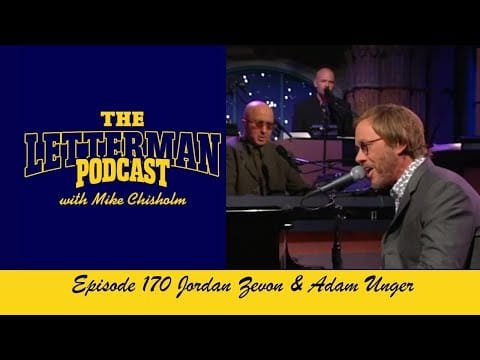
Episode 170 of The Letterman Podcast features our very special guest, Jordan Zevon. A gifted singer-songwriter in his own right, Jordan is also the son of the late, great Warren Zevon — the genius, the icon, the soon-to-be Rock & Roll Hall of Fame inductee.Warren Zevon was a brilliantly bright thread woven into the fabric of David Letterman’s legacy, appearing on the show more than 30 times as a guest, musical performer, and even stepping in as guest bandleader when Paul Shaffer was away. His work and wit were cherished by fans — and by Dave himself.Joining in the conversation is friend of the show and official Warren Zevon historian Adam Unger, who helps navigate this heartfelt and often funny discussion. Jordan opens up about what it was like being Warren’s son, shares personal insights into his father’s legacy, and recalls his own performances on Late Show, including a memorable one with The Wallflowers. This episode is sponsored, as always, by our only sponsor — Hello-Deli.com, your official source for Late Show with David Letterman merchandise, run by the legendary Rupert Jee. If you don’t go buy a mug, Dave might throw a pencil at you. If you enjoyed this episode — or even just mildly tolerated it — please like, share, subscribe, and leave a kind comment. It helps the show more than Mike helps himself to snacks between takes.
Episode Transcript
Read full transcript
Yeah. Hi, I'm Paul Schaefer. I'm Will Lee. And you are watching the Letterman podcast. Welcome once again to the Letterman Podcast. My name is Mike Chisum. All right. Uh this is a fantastic episode. Um and by the way, uh it's great to be back. Thank you for everybody who has reached out. Uh appreciate that. We've got a few episodes in the can. Uh, but this is our first episode back and it's the most recent one. Uh, it was shot a couple of days before the release date um before what you're listening to now. was just shot a couple of days ago because we have Jordan Zevon, uh the son of Warren Zevon, collaborator with his dad of course as well and um the announcement made a couple of months ago uh was that that Warren Zevon is going into the Rock and Roll Hall of Fame, which is really awesome for those of us who are uh you know excited about such things and and and a few years ago where we thought it was going to happen and then there was voting involved and all that sort of stuff and Warren almost made it but it didn't quite happen and there was a bunch of disappointment. Oh, we talk about that. We talk about that and many, many other things in this episode here. Jordan's awesome. And we're also joined by Adam Anger, who has been on the show, friend of the show. He is the official Warren Zevon historian.
Um, he's on the show as well, uh, with with Jordan. And we have just this amazing conversation about, um, of course about Warren, but also about Jordan and what he does and and and and um the way that he has interacted with this amazing legacy. um you know with his dad and and the body of work uh that that late night and late show with David Letterman produced it um he was there he was there for all of it you know whether it was observing his dad or uh postumously or performing with his dad sometimes orostumously um in tribute um to his dad or sharing his own music on Late Show. He appeared on Late Show four times. Uh one of those times was with the wall flowers. Um, we talk about all of that stuff and it's just a very fun conversation. It was just a lot of fun. Adam and I are are are buds and that was really nice to reunite with him in this way and then having Jordan just put in all of this color.
I highly recommend um, you know, let's let's look at the body of work of Warren Zevon and some of the songs that we talk about. Um and and and Jordan um sings a song called Studebaker and he talks about the story of that song in uh in this episode and and all of Jordan's stuff, the EP and the compilation are both very very good. I highly recommend them. Um add them to your streaming library. Um and yeah, I just really honored to talk uh about Warren Zeon with his son Jordan. Uh the Letterman podcast has one sponsor, one sponsor only, and that is hell-delly.com. Go to hello.com and uh go find some Late Show with David Letterman merchandise, t-shirts and mugs and all sorts of fun stuff curated by the man, the myth, the legend Rupert G, who by the way we also shot an episode with uh along with Steve Young. And that's going to be coming out in a few weeks and Irene Hoffman for that matter while they're in Greece.
That's going to be coming out. Uh we've got uh Andy Calfman um official historian Andrew Bus coming up and other episodes as well. a long lost episode with Steve Winer that's coming out and uh another new one with Steve Winer. We got lots of good stuff coming out. I'm getting my energy back and I just again appreciate everybody. Please enjoy uh the return episode of the Letterman podcast with our very special guest Jordan Zevon. All right. Um Adam, you've been on the show many times and and you're a friend of the show already. We're going to get to you in a little while. you're I'm grateful that you're here because you're going to keep us on the straight and narrow when it comes to facts and numbers and all that sort of stuff because you are the you're the Yoda when it comes to that. Um, but Jordan, I got to I got to ask you the first question I'm going to ask you. I I've got about I've had about six or seven different ways I wanted to start this episode and I didn't really know which question I was going to start with um until right this very second. I now know what it is.
I am very curious what your response was uh when Kid Rocks All Summer Long came out. Okay, so here's the deal. Um, was a long time ago. Kid Rock was a different, not a different person, but it was a different climate. Okay. And he was extremely professional and sent a demo of it. And, you know, back then it was just like he he was using the song. He made us co-writers. Yep. So, it wasn't like, you know, people heard it and said, "Oh my god, you got to sue." And I'm like, "No, no, no. We're good." Yep. Um, and you know, I used to listen to a lot of Bill Cosby albums. What can I tell you? Oh, yeah. And and like, okay, so I'm the guy that basically says I can separate the art from the artist. I truly believe that great art um is made by messed up people many times. I mean like like you know you hear I'll I'll use sort of a maybe perhaps a more um you know innocent example.
You think about Prince and the the the work the body of work that Prince created and then you hear the stories about how odd Prince you know may or may not have been or whatever. But yeah to to come up with the stuff that you come up with uh many times you have somebody who is a very outside the box type person. That being said, I remember hearing All Summer Long for the first time and I got goosebumps in a way because it just felt like such an honor to both the songs, like not just to Werewolf, but but to both. And I was I I thought in my head I thought, "Yeah, I bet you I bet you the family's really grateful that uh that song has become relevant again in a different way to a different group of people."
Yeah, it was just a cool thing. And I think that um from my experience with dad I I feel like I mean obviously all these choices that I make I've joked with Adam when we as I call it get cute with things um that you know we're going to get haunted. Yeah. Um but at the end of the day I don't think that we've done anything that would really kind of you know open up the the gates of hell. Um, and I think that he would appreciate that. I mean, he really liked Eminem. He really liked uh he thought Personal Jesus was one of the most brilliant songs ever written. So, it wasn't he he he was open to different music and stuff like that. And I think he would have I think he thought it was a cool tribute. I don't know if musically he would think that it was the most most creative thing that's ever been done. Yeah. But nonetheless, I think that that he would have appreciated it, especially being a coowwriter. And like I said, having done done the whole thing the right way.
I totally agree. It wasn't like it was a sample or something like that. It was a it was it was a tribute in every in every uh sense of the word. The idea that Warren Zevon liked Depes Mode or a Depes Mode song anyway um really really really intrigues me a lot. Um yeah, I'm a big big music fan. There's a few things that I want to get to here in a second. A lot of the different circles of how different artists uh circle around different artists. And I do want to get to that, but I want to ask you this. Um, do you find that you live in the shadow of your father? And did you live in it more before he passed or after? Well, I mean, the thing about it, it was definitely, if there is any of that, it came after. Yeah. Um because I was also in a band and it was just kind of a different focus. Yeah. Um I I honestly I think that I live in the shadow of the music that I like. It's probably the reason I haven't put out more music is because I'm so picky because I spoiled myself on Miles Davis and Jody Mitchell. And what my dad did is is he opened a door to a sophistication in music that a seven-year-old normally wouldn't be into.
Yep. And so I had that on my side, on my dad's side. And then on my mom's side, she was taking me to see like Monty Python movies. We I saw Monty Python at the Hollywood Bowl when I was like 11 or something. So I was introduced to this kind of like higher bar of of those types of things. So when it came down to creating my own, it was like, "Oh crap." I mean, I don't know how to like I don't know how to write something that I feel is good enough to put out into the world. And even on my record, there's like four songs that I would immediately throw away. Really? Yeah. Oh my gosh. I I uh I don't want to ask which ones because I do really like the work that you put out. Um and I and I do want to get to that as well. Uh, and we are going to get to the Rock and Roll Hall of Fame stuff, folks. We're going to we're going to get to that.
Um, but at the end of the day, I think that what you're talking about here is probably one of the reasons why um, Warren gravitated so much uh, not just to the David Letterman show, but to Letterman personally as well. I mean, what you just described, you know, the idea of these, okay, like a Joanie Mitchell, but then a Monty Python. Now, let's try and combine them and see if what we can do for for a style of music um might not be too far off the mark with an app description um of of of your dad's type of rock and roll. You know, the clever, the irreverent, the um you know, very very interesting, espec and and that was an influence on you early on as well.
Yeah. And I used to tell him like, you should write a novel. You should write a novel. But those were his big rock stars and he's like, "I'm not good enough." Which is kind of a crazy thing to hear Zevon say. Yeah. But so yeah. So I I mean obviously there it doesn't plague me as much as you think because my music was different. I was listening to UK kind of power pop growing up. I wasn't listening to like the Eagles and stuff like that. So, my music never got too comparative. And I told everybody before my album came out, I'm like, just sit back and watch how many writers say something about the apple in the tree. Oh my gosh, it's either the apple hasn't fallen far from or the apples rolled down the hill. And sure enough, like every other review, and just knowing that ahead of time was like, all right. Um, you uh you sang before he passed away, right? Oh, yeah. Yeah, I sing on a on a bunch of his records and I was in a Okay, but that being said, I listen to Studebaker and I mean I I don't know how many times you have heard this over the years. It must be you know hundreds I would think.
I hear you you as soon as you open up I hear your dad too like and and I'm I'm certain that you have gotten that. Did you get that while he was alive as well? No. Oh, that is very interesting because I he would bring me in to do the Crosby parts and and you can listen to like other songs on my record and hear that I don't really have a similar voice. I knew his voice pretty close pretty there is actually another version of studio studaker that we did just for the hell of it where I did it as dad but wow it it was intentional to kind of not do that and and when I did his songs live at like tribute shows I used to really put that on and uh it was uh it was actually Jackson who was like yeah you know um you know That's cool. But, uh, you might want to try it in your own voice. I was like, okay, the the parlor trick's getting a little old. Um, one thing that, uh, actually, you know what? I'll ask this right now, I guess. Um, a couple things you and I have in common. Uh, number one, we both lost our dads. Mine just much more recent. And your dad's music has actually really, really helped me um, going through that. Um, my gosh, I've listened to the wind. I don't know how many times I've listened to the wind in the last six weeks since my father passed. Um, but uh the other thing, we're both left-handed guitar players.
Um, now I haven't I don't flip my guitar um the way that you do. I've got to ask this question. Um, do have you flipped any of your dad's guitars and and and use them? Oh, yeah. Um, when I played on Letterman, I used uh I think I've only used his guitars because there's behind me there's a a 1940ome broadcaster. Yeah. And I mean, I guess it's mine because he gave it to me on my 30th birthday after bothering him daily because he didn't play it. And then um there's a Gibson uh Electro Blues King acoustic. Yeah. And I play that. So almost all my guitars are um just flipped right-handed guitars except I've gotten cute every once in a while. And I have a Rick and Bacher 12 string that's a right-handed body strung left-handed. And then just recently, like by some miracle on eBay, I found somebody who wanted to play the way I play and was just like, "Yeah, I'm not going to do this." So it's like this sunburst telly that Oh, right on.
So this is see yeah all you need is to have the broadcast bunk on the ground in the middle of an interview. See what you're seeing so I can know what I'm Okay. So this is said broadcaster. Fantastic. So that was uh when I did jokes on me. That's for the jokes on me. Yeah. Yeah. I brought that to New York. I brought that to New York and I will never ever travel with that guitar again because I had so many instances where I'm walking through the airport with it on my back and I had a panic attack and went, "Oh my god, where is it?" Yep. Not worth it. And then this is the one that I got recently that I love which is so left hand body. Yep. Wrong writing. That's beautiful. Turning it up and down every time I play the guitar. I'm not a I I I shouldn't say I I uh I'm a guitar player. I I can play, you know, 20 chords and and usually sing be able to to to to play enough chords that I can sing along to it, but I've always used left-handed guitars that are uh tuned as left-handed, the pickups are left-handed, all of that stuff. I've heard that when you rering a right one um to the left and you just play it like that, and if you if you don't monkey around with the pickups and stuff too much, you get a unique sound. Is that uh Do you find that?
Well, I don't remember. I string them. All my guitars are right hand stringing. So they're right flip the strings. Yeah. I mean I would imagine I don't know if it's the most desirable sound that you could get. I mean Hrix kind of had to but I I would think that he probably flipped the pickups. Um but I I you know I'm not a tech expert. It might just be if you adjust the height of the pickups you get pretty close. But, you know, just depending on how the bridge is placed and and those kind of different dynamics, you know, I I don't think you get as far as like a Nashville tuning, but I think you probably get something something different. Different's not bad. No different. I've never tried. If somebody gave me a left-handed guitar, I'd find out. Yeah. You have to mess it up. Um, you were talking about uh when you when you performed on Letterman, you were on four times. Um and uh but your dad obviously I think your dad was 30 times total in the times between performances and the times that he subbed for Paul.
Um during those times um you know dad was in the thick of it his career that kind of a thing. Did would you go to New York and go to the Letterman tapings ever? Um during those those times I went out there when he filled in for Paul. Yeah. Both my sister and I went out and and hung out for a little bit and that was really cool because we got to just completely take in the whole vibe. Yeah. Um I I don't think Yeah, I think that was the only time I went out there other than when I performed with him. Yeah. Um because it was just, you know, it was work. Yeah. No, I hear that. I you know the the people who are the fans of the art um many times you know we celebrate the art but the artists themselves it's it's it's work and that's how it you know that's really really what it is. your dad talked about the idea his last Letterman appearance, you know, how um you know, he feel like he was I think he to to paraphrase it, he got away with something to have a job like this where you can have a job like this.
Um you know, and and and it was it was a it was a slide in to tell how grateful he was, but it still is a job at that point. And so, yeah, and and the thing about that show especially is that it's got a great vibe and the people are great and everything else, but they're doing a job and they do it every day. Y and you know, you can make of it what you will for your experience, but show up, do what you have to do, get out of our way, let us put on our show. And so, I think that was just kind of his mentality. It's like, I'm going to go check into Morgans's gonna do the show. I'm gonna get out. Yep. Uh, do you remember the first time when uh he was tapped to um to take over for Paul as the uh as the band leader and and what the reaction was when when that request came in? I the thing I remember the most is that he was excited about getting ties and some suits out of it because I think the deal was it just paid scale but he's like they're going to buy me some Prada some Prada stuff. And when I um I guess it was when I did um Searching for a Heart that first time when I came on and did that that the the costume woman came up to me with this kind of gray leather bag and handed it to me and it was a bunch. It was all his ties.
You're talking about Sue H. I believe that's Sue. Exactly. Yes. Yes. Yes. And Sue came up. I'm sorry Sue, I didn't remember your name. No, no, no. That's okay. We got you. We got you on that one. She's been on the show a couple of times. She's going to be delighted to hear you. So excited to bring me those ties and I was so excited to get them and I still have them. And except for the the pink and gray dot one. I've worn them uh when he tried to make some choices. But yeah, he had fun and he told him like, "I want to be goofy. I want to I want to have fun." So that's where that whole sketch of him getting hit by the taxi and putting his helmet on backwards because I don't think he's ever put a helmet on. Um but yeah, that was his thing. He wanted to be like he didn't just want to sit there and be straight guy. He wanted to have some fun. Yeah. Um let's not bury the lead like like there are going to be people who are um just talk about the Hall of Fame. Talk about the Hall of Fame.
Let me let me build it a little bit. A couple of years ago, uh right around the time actually I think we we started this show um you know there was a ground swell and the ground swell um to finally get Warren Zevon um inducted into the Rock and Roll Hall of Fame. Um you know the voting was happening. There was a campaign. I think even David Paul even talked about it uh you know to get it out there and and and you know we kind of thought it was going to happen. it didn't happen. And um you know, I think a lot of people were thought, okay, well, if it's not going to happen at this point here, it probably isn't going to happen. I know you've been quoted since the announcement um that uh you know, it's one of those things where, okay, we just leave it, it's not going to happen, and then suddenly it happens. Um the uh the feeling when the announcement I guess it's about two months ago now when it was announced that it was going to happen. I am so curious who called you?
Was there any um inkling that it could happen? Was it right clear out of the blue? Where were you? What were you doing?
There was absolutely nothing. Oh god. Um unlike the nomination when they reached out ahead of time and said this is going to happen on this date. Here's what to prepare for. Yep. You know, we we had everything kind of ready to go. Uh this was a reporter. I I got um I I don't know if it was an email or something like that from a reporter uh and he said, "Well, your dad is in the Hall of Fame." I was like, "What?" He's like, "Yeah, he's he's being inducted in into the Hall of Fame and I'm calling to get the scoop. They let me come and, you know, get all my ducks in a row before the news is announced." They're going to announce it on uh America's Got No, no. Uh American Idol. Oh, American Idol. Okay. Yeah. Yeah. So, so that was it. And I was just kind of like, okay, just it was so strange to have gone through. I mean, Adam knows we went through such a process of like what graphic are we going to create today and what kind of thing. I had stickers and magnets made to to send to people if they sent me a stamped envelope just to thank them for the support and everything. We really had fun with it.
And uh when that was over and it didn't happen, I I don't know if it was only just the idea that I didn't think it was going to happen. There was part of me that was just like, "Oh god, I can't go through that again." Like I cannot like uh it was because it was it was fun, but it was also exhausting. I'm not a big fan of social media and it it pulled me deep deep deep deep into social media. Uh so that was the other relief was it was like we don't even have to go through that this time. It's just going to be like boom, we're done. I can start making calls and and also this time nobody knew. Yeah. And so fun. It hit everybody out of nowhere. So yourself included in that. I want to talk about the moment when you knew but before you started making the calls. Um what was that feeling like? Like that it must have been such a unique incredible feeling for you. It took a little while. Yeah, it took it didn't really set in at all. It was just kind of uh um like I can't like this is so strange. I mean, obviously I was very excited to tell people and have their reaction of like, "What do you mean?" It's like, "He's in." "Oh, you mean he's nomin No, no, no. He's in. This is like done." So, like, you know, my close circle, I didn't leak. Um, and then because I'm my father's son, I thought, "Oh, well, I better go on a diet."
So that's that's what ran through my head. Oh my god, this is happening and I better go on a diet. Going to enjoy a few less sandwiches for a while. um that that what a what a moment and and I'm grateful that you had that space like knowing um you know everything uh everything that Adams told me about you and then of course you know what the public all all knows and sees and whatnot and again knowing what that disappointment must have felt like whether that space was a couple of days whether it was a week whatever it was I'm really grateful that you got a chance to have that space and and and and enjoy the processing of something that uh as far as I'm concerned and many of us are of course are concerned. It should have happened a long long time ago and it's going to happen. Thank God. It feels a little bit like all is right with the world that it is happening. Yeah. I think it's I mean it just makes perfect sense if you if you aren't going to give him the commercial success. If Fate's not going to deal that card, then it at least makes sense to have uh him in the Rock and Roll Hall of Fame.
No matter what your feelings are about it, my opinion has always been if they're going to have one then there's some people that should be in it. And of course there's still long list of people and um everybody can have their debate about what what music does and doesn't and all those types of things, but the bottom line is they have it and I'm really proud and it makes sense. It just really does because I if if any kind of art is only going to be judged by how many people buy it or how many ears hear it, then y we're not, you know, it's we're just lovers of commerce. Oh yeah, that's a fantastic way of putting that. That's exactly right. Um because the folks who inspire the things that end up leading to commerce once it's been diluted and packaged and changed and moved around a little bit.
Um you know the the things that inspired those things your dad's one of those guys and uh you know I mean the thing that I look for whether it's music these days or or film or or or the things that um make me think uh from the artistic standpoint um they're the things that are different. They're the things that that that that that get you talking about different things the way that pop stuff does and and that is certainly um the way that your dad did it, but he flirted with that pop side still uh sometimes, you know, and and um one of the things with I'm I'm I'm super curious. I know that Adam and I have talked about um well, this is the word that I'll use, the messy state of uh of record label uh and rights and things like that when it comes to your your your your dad's stuff. I assume that as he was going through his career, there would have been pressure from other labels to, hey, fall in line, just listen to marketing.
Just listen to the this we're going to put you with this producer. Just listen to these people and put out what the market wants. I assume that that would be something that he would have uh at least, you know, um been exposed to a little bit. Um was that something that Am I What's that?
I I I don't think there was a ton of that. I I mean I think that depending on the situation, depending on on what era that it was, um like with Mr. Bad example, dad basically said, "I don't know what they want from me. I gave him a Warren Zeon record. I got together with Wadi. We did a Warn Zevon record. If that's not going to work, then I don't know what the to tell you." And uh with like Badluck Streak and The Envoy, it's it's not like he went into like, you know, strictly piccolo music. Um he he, you know, he tried to make a record that just wasn't hitting. Now, if his sobriety took the kind of craziness out of some of the music or or supposedly felt like it did, that could be part of it. And then he had to kind of reapproach in a different way. But like sentimental hygiene was Andy Slater and my dad and and you know Andy really just trying to revive this guy's career, this guy that he owed a lot to as well.
Yeah. And and so they they tried to make it the best, but I don't I I I can't see labels really trying to say, can you do this? I think that dad was putting enough pressure on him to kind of do that. And then like later on, like the last three records with Artemis, I I don't think that that that was the deal. And I think the songs that kind of rose to the top just kind of rose to the top by listening to the album and saying, "Wow, like Don't Let Us Get Sick and My Shit's Up and some of these songs are are kind of standout songs that'll perform well." Yeah. Yeah. So, they just wanted to do what was best to get him exposure as opposed to trying to change him to get more exposure. I think the I don't I think he knew better than than to try to to do something to get himself popped up into the mainstream. Um, back in the day, uh, you know, around the time that that, uh, uh, he got sick, Paul Schaefer and, um, the band were the house band for the Rock and Roll Hall of Fame.
It was talked a lot about on Letterman because, you know, Paul and the band would have to go and they, you know, they'd be rehearsing for it and they would talk about it on the show. And um actually two of the times that I went and saw the show were were were right after the Rock and Roll Hall of Fame and Dave would lament and and get all mad uh that that Paul and the band weren't weren't in the Rock and Roll Hall of Fame because of that. Um so obviously there was talk of it around the time around that time and and I'm I'm I'm curious, did your dad pay attention to that stuff? Um there's a part of me that wonders if he just didn't give a damn at all and wouldn't even didn't even, you know, it didn't pay it any mind whatsoever. And I'm curious as to how do you think he would feel about this announcement uh the upcoming presentation and um if he would have a wish for how it would be set up.
Well, I I think the problem is that a lot of people look at it very um black or white. Yeah. Um, a lot of people think because he wasn't such a commercial artist that he was like an outlaw and he wasn't. He just had to do what he had to do. I mean, his style, his writing, and everything else comes from within him and and things like that, but he wasn't um like this just industry commercial successhating kind of guy. I think that he had some bitterness about not having moved forward further than he would like to in his career, be able to like live a better life or whatever you want to call it. Yeah. But I don't think that that he went out to intentionally do that at all. So, did he pay attention to it? I would assume at some point he'd see who was nominated and maybe he'd have an opinion about it. Did he make sure to sit and watch the ceremonies on TV? Probably not. Yeah. Um, did he watch the Grammys? I don't think so. Would he be happy one, too? Yes.
the uh the picture that I have always had of him um in the decades that I you know uh that that that's that's exactly accurate still to that picture that I as as as an observer had. Um I the outlaw statement I love that you said outlaw. See I grew up in the world of quote unquote alternative music and and and and that was my and and I think we're we're we're similar in that regard. I kind of viewed Warren um a little bit the way that Pearl Gem kind of would would would would lift up Neil Young kind of a thing. I I kind of viewed him as the guy who um really didn't care. I mean, outlaw maybe, but the guy who just cared about what he cared about and had no bones about telling you about it. And you know what, I'm going to make you but as opposed to Neil Young who who went, you know, in his in his Neil Young style, the Warren Zeon style was also and uh isn't this funny? Um and and and uh isn't this ironic perhaps even a little bit more?
And I I viewed him as kind of a an an alternative inspiration.
uh to maybe other groups that were out there or or people who had uh been lucky enough to find him. Um is that would you would you say that that's uh well I mean he he didn't I don't think he ever compromised his work. So the music that came out of him was the music that came out of him. Even something like Leave My Monkey Alone, which may not like register correctly in the Paul Abdul directed video might seem off, but again, I don't think that that I I never got any kind of impression that that was something that was forced on him. Yeah. You know, he he liked to try different things. He liked to try ideas. He um but he Yeah. I I I think that there just became a point where he wasn't trying to change his music to to get somewhere. So that I mean you can see that as outlaw or you can see it as like sometimes that works, sometimes it doesn't. You know, sometimes you kind of try to create your own sound and you you're Liz Fair and then sometimes you create it and you're PJ Harvey. people that don't compromise that kind of get to different, you know, you never know when somebody's gonna grab on to that person.
Yeah. I mean, Alana Morris said, I don't think I'd consider like the most alternative artist, but I certainly didn't think that she was going to end up being like almost legendary to the point where even my daughter's generation calls her mother, which I think is a really ghastly trend, but calling people like mother and father. Anyway, um but uh tell her to watch uh Too Hot. I'm a Canadian. Alanis came up. I watched Atlantis. Um and she was Alanis at first. Tell her to watch the video for Too Hot and then see if she's still going to call her mother or not. I just Well, she doesn't. I I She will kill me. She does not. I I think her generation, she's a She's got her own specifics. She's She's got her her Billy Eyishes and her like kind of more alternative. She she likes some pretty decent stuff, I would say. Speaking of Billy Isish, and I want to get back I'm going to get back to the Rock and Roll Hall of Fame, but just as an aside here.
Um, there are some artists who are of today's generation, you know, my kids and and and and soon to be my grandkid, you know, she's already getting into music as well. Um, and I'm grateful for them, the ones as I I just I just pray to God that they like cool things because they're going to introduce me because my wall is very high. um for for for a new artist to get over that wall and get incorporated in what I consider to be very personal uh you know uh personal things to me as my music is is is that Billy Isish has gotten over the wall.
One of the reasons that she got over the wall was because uh she did the uh she did a my next guest with Dave and and and she did a long form and the long for it was wonderful and and and it it kind of opened a door for me a little bit to kind of go okay let's see what these kids are looking oh my god yeah this is oh oh okay and it and it really really hit me um and this is just an observation and I'm going to ask a little bit more about Rockall Hall of Fame after this but god damn I wish I wish Warren could be on an episode of My Next Guest with David Letterman.
That'd be pretty pretty wild. But I mean, he almost did the pilot if you think about it. I mean, that show that last show that he did Yep. was pretty in-depth. So, I think we kind of got a taste of what it would have been like. There's a quote from that show that I loved. He said, uh, he said, "I lived like Jim Morrison, but end up ended up living another 30 years." And um you know, I was going to save it for a little bit later into the episode. We can get back to the Rock and Roll Hall of Fame in a second, but people want to sift through it, they can sift through it. It's our show. Um but uh that quote, did you see much of that in your life or or or was that uh the living like Jim Morrison more um anecdotal in your life? Oh, I I saw very very little of that. Um my mom wasn't interested in that part of my dad. So once that really started creeping in, she was done. Yeah. And then um once he kind of got into that world, getting into it was as difficult as like a fan would have had trying to to get in touch with him and stuff like that. You know, it's pretty sad.
Um I would see him occasionally. Um I I I the the only like the only memory I have two memories of him like no doubt intoxicated. Mhm. And one time was like one of my first memories I I don't know how I was too young to be able to have a memory but somehow I do. Like maybe it was three um of he and my mom just yelling at each other. That's all I can really remember. it like we lived on Beachwood. I kind of remember that place but not very much. And the second one was in probably 78. He was playing at the Universal Amphitheater opening for Linda and my grandmother bought tickets and she took me and then she took me down to the backstage and was literally saying like this is his son. Can can he come in? and they were just like didn't know what to do. And Crystal saw me and and let me in. And they took me to see dad. I don't you know how your kid memories, God knows what was real. Um but I just remember like kind of being in a small room and sitting across from him and even at that age just going, "Wow, this guy is gone." like could couldn't really communicate and um and I think we talked for a second and then he went off to a limo and went away.
Yeah. And then it was really kind of hit and miss Christmy things uh stuff like that until uh in I guess Adam when did uh Envoy come out or no when did Bad Luck come out? Envoy was 82. Uh, Bad Luck Streak was 80. It was 80. Okay. Yeah. So, I think it was um right after Bad Luck Streak into recording The Envoy and he was getting sober and I went with him to Cedar Cyanine, supported him with some group therapy things, all that stuff that you do. And pretty much from that time on, um, the most I got subjected to were moods, which were a plenty. Oh, I imagine. But the the the thing that you have and I've had my own struggles and it's been a while now. But I um I know from my experience that and growing up with I mean I had other exposure. I had a grandmother who was really angry drunk. Anyway, the thing when you grow up around that is with a sober person is it doesn't matter what mood they're in or what pain in the ass they're they're in or whatever else. The fact that you just know that they're sober is something very comforting.
Um because from a certain point on I I think he had slips and things like that, but they really didn't appear to me. When I saw that I just knew he was there. Yep. And so that's that's what I really retain the most of is just the fact that he it could be cranky there, it could be silly there, it could be whatever it was there, but he was always there and I could rely on that. Yeah. It wasn't quick sand. You were on solid ground at least. Yeah. Yeah. Huh. Um I uh did you talk about it uh later on in life? Like later on in life? Um would he ever refer back to those days? Would you ever reference it or or go through it or was it one of those things once you went through it that was kind of it? We didn't talk about it a lot. I I it's interesting kind of um like I said having my I think it's probably been about five years that I've been sober. I was a different kind of alcoholic than he was. I was just kind of self-medicating all the time. I wasn't the fall down party guy.
Yep. Um, but there was a few times where after a while your your brain just starts to go a little whacked out. You can only kind of rolling brown for so long. And I used to to notice how whenever he'd reference him being drunk or hear a recording of himself or something, it was very uncomfortable. He did not want to think about that. And and now being in this position, I totally get it. I don't want to hear a recording of myself. Even if nobody can tell, I can tell. So, I don't want to hear it. I don't want to see pictures. I don't want to. It's it's it's um Yeah, shame is is a real thing and you can get rid of it to overcome. Mhm. But it still means that you don't want to see postcards. Yeah. You know, and I think that he just really uh didn't love the fact that he had that period of his life and didn't think it was cute. Um, very very very well said and I really appreciate you um the vulnerability you're bringing um to this here. It just I I appreciate that.
It just strikes me that um I don't think I realize that that he got sober around the same time Dave did, you know, and I I can imagine anytime you're an artist um and you have a body of work that's out there, you know, the before and the after uh effect and how that can affect um you when it comes to that. I'm very very grateful that you're on the other side of it and of course extremely grateful that that that he got to the other side of it and was able to talk about it and able to bring it. I'm grateful that you're able to talk about it. There's going to be someone who listens to those words and um they're going to put a filter over and and apply it to their life and they're going to see if it matches or not and perhaps that might start a change. So um I can definitely understand uh where that vulnerability does exist but that doesn't take the the the pain away when when you talk about those things. So, thank you very very very much for um for talking about that.
Um that final show again uh uh you know I I don't know what it's going to look like um with the Hall of Fame package, what that what that will look like and how much time they're going to give to it and and and and if there will be, you know, extras, you know, DVD extras, whatever you want to call it, um on the side as well. But but that final show uh that final late show um was such a powerful powerful night uh to this day. I mean I I listened to the I listened to the interview. Um I'm so grateful for the official Letterman channel actually putting out the whole show. They put the whole thing out on their on their YouTube channel so people can go and watch it. I highly recommend it. Um the interview itself.
I've seen it. It's so good. You said you've never se Is that No, I said I've seen it when you said I highly recommend it. Yeah. So, so for the whole for our audience, please go and watch it. Please, uh, you know, go see it and and whatnot. Um, I assume clips from it will be used at the Hall of Fame. How much do you have to do with what is happening? What's the presentation is going to be? Um, do you have a lot of input and are you going to perform that night? I know uh about things that are going to happen. I don't have any control over it. the people who are doing it um are people that when I was a publicist at Arista that I used to work with. So I'm like okay I see what's happening this is nobody needs my input. Um so yeah performing uh I think so I don't want to say yes or no. I think it all kind of depends on what that performance looks like. Yeah. Yeah. Um, more than one song medally.
Don't know. Okay. All right. Honestly, don't know yet. Uh, man, I don't even want to put you on the spot too too much about that. If it was what I mean, if it was one song or if you had a, you know, if it was going to be one song and there was a a small list of what the contenders are, um, what what do you think that they would be from your perspective? I'm I'm I'm super curious. And if we have to go offline to ask that question, I'm I'm happy to do that, too. No, it it's it's I think that it's kind of artist dependent. Yeah, of course. And as far as I mean, for me, I think uh you know, if werewolves has to be involved, I hope it's in a medley just for his sake. Yep. Um but um but yeah, I mean look again, everything at this point is gravy. So yeah, I I don't I'm not too concerned or or I think it'll be pretty great. I think those guys do a pretty good job. Safe to say it probably won't be Adam Sandler performing it, but um I love Adam, so he can if he wants to.
I Okay, so okay, let's go to that. The uh the the the the tribute album. Um, interesting artists on that tribute album. Uh, Adam Sandler performing Werewolves in London. That was it. That was tongue and cheek. Everybody, if you haven't heard it, go go get the tribute album. Go on to your streaming service and get that tribute album. There's some Oh my god, there's some beautiful moments on that. Yeah, he was playing with him and I was like, this is this will be great. You can try to make a tribute record where, you know, we're going to make every song the best top the original. this and that or you can make a tribute record that's just vastly different and unique and it's just what it felt like would be more fun like to get the pixies to do Ain't That Pretty At that works. Yeah. So good. Um also very interesting. Uh and I mean let's get to this now. the idea you playing with the wall flowers.
Interesting. You know, yourself and and Jacob having Jacob Dylan having this uh very surreal perspective in life, you know, um with your respective dads doing stuff and then having Bob do a tribute on the album as well. Uh which I thought was really really interesting. Um where did you and Jacob connect? How did that happen? Oh god. Um we've so I I have like basically the same circle of friends since high school. We were in a band called The Imposters and um we're all kind of the same age and we were playing shows with the Apples which was Jake's band before the Wall Flowers. So we've never like been pals but we've kind of been in the same kind of rooms and acknowledged hey we both have similar situations um just throughout kind of throughout the years. and um and then uh my dad's manager Andy manages them and so it just kind of one of those things that just came together. Um really cool. I I I just I love I love Symmetry. I love the circles and things like that. Uh actually I want to go to another one here too. Like uh so I'm a I'm a gigantic Nine Nails fan. They're one of my They're one of my core memory bands. I've just like seen them more than 10 times. Met Trent a couple of times. like I'm like I'm far down the rabbit hole when it comes to that.
Yeah. Um so at some point Johnny Cash's version of Hurt comes out and I'm just like oh and I'm pulling my hair out cuz you know that you see the video Mark Roman did the video and it's just this oh my god cover. Um yeah I think Tren said that song is no longer mine. Yeah. Yeah. And I mean it just wo okay last year Willie Nelson covers Keep Me in Your Heart and I heard it and it was the same feeling that I felt when Johnny covered Hurt and and and I'm curious um like I've listened to Keep Me in Your Heart probably I don't know probably 30 40 times since my dad passed and I mean that song I I oh I get emotional right now even just thinking about about it. It is just it's powerful. It that song lives inside me and to hear Willie and his version of it, that sort of thing. I I I needed to talk to you about that today just because you know there are these circles and and and whatnot. Um how did that come about? Were you are you part of that? Like are you a gatekeeper when it comes to stuff like that?
Well, here's the thing is that they can't anybody can cover a song. Yes. So in that situation, they don't need any kind of prior permission. Right. I didn't know about it till I read that it was coming out and obviously I was completely as thrilled as you could possibly be. Yeah. Um Yeah. But no, I mean it's it's Willie like when I was saying earlier about my mom exposing me to music. I mean Willie and the Highway Men and and that kind of stuff also that kind of you know the the cool edge country George Jones and and that stuff. So, I mean, Willy's a god. There's just nobody higher. And uh have have has anybody from from you or your camp or anybody talked to him about that? Where the where the um the reasoning for it and and and how it came about from Willie side or is it just one of those things that this is in the world and I'm very grateful it's in the world and I don't want to kind of mess with it.
Yeah. Well, I'm grateful it's in the world. don't really have any uh kind of way to even contact him, but uh if I ever do get to meet him, I have an inn, which is fantastic. You sure do. You sure do. Um but yeah, there there I I just that's one of those things that I went That's another kind of bonus. Like, yeah, didn't have to lift a finger, didn't have to there's no negotiating or nuancing. It just suddenly it was there like this gift, right? I have a bunch of other poperie questions here for you. You have a little bit more time here for me. Uh I do. Um there's a whole bunch of stuff and Adam's talked on this show in fairly broad strokes. I mean certainly hasn't talked about things he's you know not supposed to or or things that you know may happen but we don't want to get people's hopes up too much. But there's there's there's some good stuff that's coming. Yeah. Uh well I mean I cannot look at that. Oh my god.
for the oh the YouTube audience get to see a beautiful beautiful box set vinyl box set right there and if you're on the if you're on the Apple or the the Spotify and you're just listening take a look at that it's that's gorgeous you made that there Adam that box set was my baby for a couple months let's talk about the contents of it well let me first say first Adam has been such a crucial part of my dad's legacy and what I've been able to do. And I mean, there aren't enough words to express how much his like partnership in doing this has has meant to me. It's really been insane from I still have the letter that he sent me, like the very kind of formal letter with a print out of some of the work he's done. And I was just like, "Wait, you want to run the website?" Okay. because I can't stand doing this because every time every time I start getting something right, they move into another language and now it's flash and now it's this and I'd had enough.
But I what I wasn't expecting was that how much that we just kind of go digging into these things and also the organization skills, organizational skills and the attention to detail which I completely lack are so essential. So, I mean, really, Adam deserves a lot of credit for for so much that he's done and doing. And that box set was, like I said, it's his baby.
And and when you look through it, I can just point to everything down to the proof reading, which nobody else caught. Yep. Um I I just want to throw out there for those who are, you know, under what, I don't know, under 35, maybe even under 40, I don't even know. If you're a music fan growing up in the time that that that that the three of us uh an entire generation grew up in, there was something special when your favorite artist or one of an artist that you admire came out with the a box set that was done correctly and just the the the the little jewels and rarities and things like that. I was that guy who would go and look for singles that had rare bides and things like that for the bands that I loved.
um you know even talking to Adam about some of the stuff that exists, some of the stuff that's out there and then, you know, cutting through the red tape of rights and things like that to be able to release some of these things, but then also not just to release it onto, you know, uh I say this salaciously a little bit, but like an MP3 lowquality type format as opposed to let's do it right, let's do it with the right audio, let's do it with the right art. And what you just showed me there, that box set, it ju it gave me chills. It made me go back to re to to reliving when a beautiful box set would come out and that's the kind of love my wife cooks with love and you could taste it in the food. Adam, you you design things with love and and boy is it uh is it evident. Uh the box that you just showed me, what's it called?
And uh what are some of the the little rarities that are going to be on it? Well, before I get into that, let me kind of I don't want to hijack Jordan's interview, but I'm going to hijack it for a moment. Oh, please do. Um I can't tell you how much I appreciate what Gordon said because it's definitely um tenfold back at him. You know, it's a situation you go through life and you know, you have a job and um it's a job and it it pays the bills and you're appreciated at that job, but it's not a passion, right? It's kind of so you can have nice things and your kids can have nice things and your wife can live well and you can live well. And it's really rewarding to be able to have a creative outlet. Um, and to your point, Mike, I hate when things are halfassed. Um, I hate to spend money on something or get something that you're so excited about and then you open it up and it's wrong. Um, and maybe it doesn't matter to the average buyer, whatever, but um, if it's something you're really into, when when it's when it's done incorrectly, it's frustrating. It's really frustrating and someone like Jordan's father's art um god that sounds really pretentious, but um you want it to be done well because it deserves it.
Um not only for myself, which that's a lot of what I'm doing it for. I want it right for me. I want to be proud of that thing, but it means a lot to people and hopefully it can mean something in the future to people. Um, and if this does well, which it has done well, um, it opens the door for other things. Um, and I think the great thing is the team we work with with Rhino on that particular box set is very open to input. Um, is very open, um, to things being done correctly. Um, it it's nice. Um, so I will show you the box set. It's I I think Adam once you caught uh the entire wrong record on a test pressing that that they went well maybe we'll just you know take his word for it from here on out. Yeah. That when they sent the first sample artwork back of the albums um some of the fonts weren't correct and they're early proofs. They're not finals. Yeah. So I'm like well this is the font you need. This is the color you need. This is the spacing between the fonts and then the quality in some of the pictures weren't great. Um, so we discovered the original photograph for mutineer. Um, we'll put that up on the website soon.
But I'm sure Jordan hates every time I call him or text him, it's worked for him. He has to go digging and we found it. Um, yeah. But I always find good things when I dig. So yeah. Yeah. The testing thing was interesting because it was for Mr. Bad example and the original stereo master. the track listing is different than what was actually released. Um, so when they did the test pressings, the whole album was jumbled and all the artwork was already printed and all that stuff. So we had to do a new pressing to make sure. Would this be classified as a remaster then because of that? It is a remaster. Yeah. Wow. Yeah. So maybe not because of that, but but yeah, but it is a process of doing this. If we can if we can get the master, we'll get the master. Look at that. So, it's good stuff. So, three album set. Three album set. And um you know, it's a li it was a limited edition for Record Store Day. I think it was like 2200 copies or whatever. And oh, it's a slip case. It's a slipcase.
It's a slip case. Oh, I love a slipcase. That's fantastic. And another thing to thank Jordan for, um, we were on a call with the folks at Rhino and they said, "We'd like to do like an eight page book that goes with it." And here's the book. Yeah. And, um, they asked Jordan, "What journalist would you like to write the story that goes inside of it?" And Jordan said, "I went out of um, which I mean, you could have had anyone in the world do it from Rolling Stone or anything, but y um, it was awesome. You know, I got the opportunity to do something like that and it means a lot to be able to do that." Um, but then I realized that a whole lot more work to do, so I wasn't as uh pumped. But careful what you wish for. Yeah, exactly. Um, but but it's also the drive to make sure it's done right. Um, you know, for fans, for the, you know, people that buy it, so there's value to it, just for legacy. So, we're hoping to do more and we're in the process of hopefully doing more.
Okay. Yeah. I don't know. I don't know how much we can talk about that, Jordan, but we're doing more. We can't. But it's there. I mean, there'll be some things. Will there be all the things that we want? Now, that remains to be seen, but Yep. We're trying. Oh, there we go. Look at that. That might be something we're looking at. I'll say that. Yeah. Yeah. Yeah. Um, live recordings, uh, rarities, things like that. Is that Is this Is this, uh, Yeah, we can't talk about it. All right. No, no. I mean, I just talk about it in the sense that um there's some live stuff that I think in some form or another are going to they're going to make their way out there um that are overdue. On the rarities, I think that um I can pretty safely say unless there's another discovery, um we've kind of know everything that's that exists. Y um there might be a few more cassette tapes to go through, but we had I don't know a few hundred cassettes digitized and organized and and it's all there.
So, um and some of them have incredible stuff on them that I don't know fits into a commercial release, but they're certainly fascinating. So there might be some way to try to figure out where that's like conversations with Dad and Jackson before the first album had been released and demos and and you can see the the way a song progresses but at the same time I don't know every single version of that song. So, I don't know. There might be some format where you can look at a song and play some clips from each version of it and like maybe it's a podcast, maybe it's something like that. Took the words right out of my mouth. That sounds like a deep dive podcast to me. Yeah. So, uh it I'd like it to to find its way out there. I also I'm I'm a Costello guy, so I spent thousands of dollars because the man never met a take he didn't like. And uh his process, which I am completely foreign to me, is like to completely do a song, record it, and then put out a completely different version of it, and then another completely different version of it. Yep.
Um, so I I appreciated that what he was releasing merited being put out because you were almost hearing a different song. I don't want to get to a point where I've released eight versions of the same song. You know, I thought Preludes really gave you a taste of what those songs felt like early on. And um and I do I was really into those Beatles bootlegs when they first came out. Y even instrumentals and false takes and stuff like that. And uh one of dad's um co-workers I'll say uh was kind of miffed at the idea of putting it out. And then I brought out I brought up those Beatles records and like did you listen to those? It's like yeah. I was like well it's kind of the same thing. It's kind of fun to hear Werewolves of London or another song so completely different. Y and knowing that that at least you can hear that it was this process where they went through almost every rhythm section in town until you know they they got the guys from Fleetwood Mac to finally get it when I don't think they even had it yet. Y and those kind of things are are and there's a really outrageous version of werewolves that I think Adam Lree eventually has to find its way. I what what do we call it? The Vincent Price.
Yeah, that's right. I think whenever whenever I suggest things, um I kind of like it to be tidy in the fact that let's dive into a single project. So, an album, let's say. Um, and my thought would be it would be great to have the album um, as is. I think an alternative version to go with it made of outtakes and maybe instrumentals like Jordan said. Yeah. Um, but then it gets into the thing of what should that sound like? Because you don't want it to sound just like the the album, but at the same time, you don't want to be less than either. Yes. Um, so it's it's hard. Um, I can say I've listened to hours and hours and hours and hours of tapes doing that. And um, kind of your dream is, man, I would love to hear everything until you have to hear everything. You realize, oh, I don't want to hear everything because, you know, Jordan's dad worked hard. Yes. You want the curated everything. The curated everything. That's that's a great description of it.
Y because, you know, what Jordan said earlier is his dad didn't compromise with his music. he did work hard and there are such minute differences between takes of a song that you really have to listen closely and see what that process is to get to the to the end result. Um, so I think ideally if we were to do maybe not ideally for everyone, what I would think would be ideally would be um box sets of albums y um one disc of the album, one disc of outtakes and then a live component that comes with it. Um, and that may not be feasible for all the releases. Um, and it may not be feasible for any of the releases, but I think that's that that is what I would push forward because I think that's pretty common amongst other bands and and artists. And it kind of has a little bit of everything. Um, you also want to I don't think you want to dilute the main catalog either. Um, I think when you look at David Bow's legacy after he passed away, my god, it's it's it's a jumbled mess.
Um, I think that kind of happens with the Beach Boys a little bit. Mhm. Um, so it's a tidy way of, let's say you can't release a a concert from 1980 because maybe it isn't um I would say on par, but let's say it's not proper to go with the rest of the um catalog. It can go along with the the album um that it was uh promoting. I think that's the way to do it. Otherwise, putting it putting it behind an album keeps the discoraphy from inflating. It's just this is the version that has some extra stuff if you want to go that route, right? There's not like the live every live album in between, right? You don't want 10 live albums that are five years apart. Interesting evolution when it came to that because I know growing up I was that kid like like Jordan listening to you talk about the idea of the evolution. Um I I would go I had a route from where I am in Colona, British Columbia. I would go down to Seattle. I would go over to Spokane, Washington.
I'd go up to Vancouver. Sometimes I'd go up to Edmonton, Alberta. And I had a rolodex because there was no internet back then, a rolodex of record shops or or CD shops I would go to. And I learned very very quickly, you don't ask for bootlegs. You say, "Hey, uh, do you have any live recordings? That's that's the way to do it." Because if you ask for bootlegs, they're like, "Hey, get away." Because it was a it was a like, you know, it was an underground thing like to ask for these things. But I was that guy. Any band that I really really loved, I wanted that stuff like crazy. Now I look and we just had the um is it the 20 year whatever anniversary of Radio Head uh um Kid A and Amnesiac and they released this amazing deluxe curated though version that has so many extras and so many of the evolutions of of of so many of the songs on that uh those two albums that came out within you know very very very short time of each other. And I think that's the sweet spot.
I think it is the idea of the curated everything and the fact that you guys are thinking about this and talking about this um I think will make every Warren Zevon uh enthusiast out there very very excited. That's that's that's that's great news. It's it's fantastic news. Um I do have a couple other little uh things I'd like to talk about. The first one actually not so little. Let's talk a little bit about um um you are an ad would you say you're an advocate Jordan when it comes to uh conditions uh due to asbestous and and and whatnot.
Are you an advocate for that? And can we talk a little bit about events and things that might be uh happening? Yeah, I'm the national spokesperson for the Asbestous Disease Awareness Organization and I've been with them for a long time. I don't know the exact amounts. I think it's been Oh, I don't want to think about how long it's been. It's been a journey. It's been a journey and it's been amazing. And um the the main it's not the late night commercials for who to sue and and that kind of thing. That's that's their own thing. We've been trying to get a ban bill put through. Uh asbestous everybody thinks it's banned. It's not banned. Obviously they aren't shipping it over in pallets, but we found it in like makeup. We've found it found it we found it in duct tape. And the scary thing about finding it in duct tape as somebody who's never really had much well I worked at the matchless amp factory but that's the only factory job I've ever had. Um and even then I was the bookkeeper.
Uh but uh but it's when it's airborne that it's really dangerous. So that's when the concept of pipes being wrapped with it and you start hammering away at that pipe and you're just all these particles and I won't bore you with all of it. You can go to adao us and find out more about it. But in this duct tape some crayons too, right? That's Yeah, the kind of the crayon sets that they would give give out at restaurants.
Those little fouracks that you get for your kids. Terrifying. And um but with like the duct tape, I've when you're a kid, you don't know that you shouldn't wrap your cords in duct tape because it turns into a sticky mess and then it turns into a crispy mess, but that crispy mess is airborne. And so it wasn't all duct tape, but it was stuff that some stuff was coming from China and other places. And you'd be amazed at how difficult it is just to to get a just a straight out ban bill through. I mean, we've seen the government doesn't love getting things done. And uh yeah, so just getting the word out. uh all those all the people that were in 9/11 those buildings came down those buildings were filled with asbestous and the recent fires in Pasadena and Alton it's like it's just you know it's it's really terrifying and I'd see reporters uh just kind of walking down the the street in Pacific Palisades with no masks or anything on and I'm just thinking being like, "You can't do that."
Yeah. Cuz you can a the tiniest little fiber, microscopic fiber can just work its way down into your lungs, plant itself there, and 10 years later, you got a problem. So, yeah, it's it's not fun to talk about. Yep. It's not fun that exists, but uh I'll do anything to support them because they've really been fighting a a good fight for a long time. What kind of stuff do you do? Are there events that you're a part of? Uh there's a convention. Um I was in New York I think this year and I've always gone well most of the time I've gone and performed. I think I called in sick once once or twice over the last decade or so. Um and uh and then the next thing we're doing is uh we're doing a tribute concert on October 24th and we're doing that at the United Theater on Broadway in LA. Oh wow. And uh we're just kind of assembling the people that are going to play now and with some uh other charitable causes.
Part of that is going to go to ADAO. Fantastic. What was the date on that again? October 24th. Oh, that's fantastic. Down in LA. I'm I'm going to see if I can find a way to get down there for that. That's fantastic. Um I love hearing that. I love I love when artists um can take their art and and and point it in the direction of things that make the world feel better and collaborate in that regard uh to doing that. And and what a what a fantastic cause. One of the first uh real jobs I ever had over the summer was was removing asbestous from our local uh university. Um and I mean it was scary stuff back then. And I mean, you know, we're in the the the '90s and you're in hazmat suits and it was uh you know, you have to go through this class beforehand to to realize the gravity of what it is that you're doing. And um that that's a fantastic cause. And I love what you said. It's it's not it's not the front cover of every magazine cause. And those are the causes that I have found over my life that really are the things that need to be um to be brought into the public attention.
And so I'm grateful that you're doing that. Um, what do you think you like your dad liked doing better, writing or performing? I think he liked watching bad TV. I think he liked watching Billy Bob movies. So I I I I wouldn't say that he didn't like performing and he didn't The first thing with writing that he told me and I appreciated that he told me this and I passed it on to my daughter who's writing songs is that you don't really want to hear about how easy it is to write songs and this and that. And yeah, sometimes a song just like spits right out of you. I think people like to say that there's a song floating in the air and they just happen to grab it. Yeah. Okay. But sometimes you have those moments where stuff something just like like comes out of you. But he said for the most part it's really hard. Y and when he had to write, he'd sit down in his uh dining room with a typewriter and there was crumbled up pieces of paper all over the floor and it and it was hard and it it you know it's it's everything is measured by what the situation is.
Is it the hardest job in the world? No. But sitting there focusing your brain and and trying to come up with something that feels good that you've done and you feel good with that's not like that that quick spot of inspiration when you initially write a song, but really completing it. It's work. Yep. And so I I think that he was happy when that work was done. So, I don't think he disliked. I think it was work. And I think performing I don't never heard him complain about how horrible it was, but it was work. I feel you. Again, back to the job back to the job u the job comment. That that that that makes a lot of sense. Uh and I could see how that would be he would be that time type of writer. I mean, again, this is why I I compare Warren and and David Letterman a lot. Uh, I was just gonna say if you asked Dave what did you like better, the monologue or the interview? He'd say fishing, you know, it's just Yep.
Hey Jordan, let me ask you a question about songwriting if you don't mind Mike. Yeah, I'm not an artistic person. I'm not a songwriter. In terms of effort of writing a song, is most of the work done in ter let's say timewise, is it quick getting the basic structure of what a song is? Is that quick? And then the the actual execution of it is that what takes the most time. And and I'll give John Mayer credit because he I heard him in an interview say this. If if when you start writing a song, get as much as you can out. Like don't do like a little voice memo and then go watch TV. like grab on to that second because when you're when you write a song and you hear it the same way that like somebody else can hear it and go, "Hey, I like that." You're having that same experience. And the the more you feed off of that initial energy, the more that you can get out of it because then the rest of it is a nightmare.
the like I know for me I've got plenty of songs that I have recorded over the years that are just like a verse in a chorus and I loved them and I listened to that over and over again and then when it came to writing the third this second or third verse it's it's like wait a minute I said everything already like this song to me exists in a verse in a chorus and everything else I'm going to add on to it now is like you know if somebody asks asked you to write, not that I'm writing these songs, but if somebody asked you to write like another verse to Stairway to Heaven, right?
You're like, I can't do that. That's those are the words. It's like, and then we see each other like everything's going to sound wrong. So, so to to to get away from to to get as much as you can initially and then stop yourself from feasting on that small bit and just push yourself to get the rest of it done, even if you end up having to rewrite it. Mike, if you don't mind, I have a followup, please. So, with a song like Studaker for your dad, Yeah. you have the original tape that's on preludes, which um has a very specific structure. It's very inspired. there's some intricacies and then as I've as I've heard out takes past that um the song loses steam. It kind of isn't what it was before. Is that kind of an example of that? It's a little different in the fact that that it was a finished song. This is more about like the actual writing process. But I think the funny thing about that song is that I had that that first recording of it. And I I think it's I I would probably guess it's one of the first. It's definitely the first in existence when he just made he recorded some songs for my grandma. I don't even know what the circumstance was.
And it's just perfect. And then every time I heard it and and keep in mind I I've had that song since like I was four or five. I don't even know how that cassette tape managed to stay alive long enough for me to digitize it. And and so it's all I knew of that song. Then after he passed away and I started and I'm sure I brought it up and I I at sometimes I must have brought it up and he's like it just didn't it doesn't work. And then as Adam can attest, you hear the versions and then something's missing. There's something missing. There's some kind of like character about it. there's some like the riff isn't the same or the the way that the it's just it's strange how it it got away and even there's a version that he did that was actually kind of costelloesque in how different it is. There's a totally kind of uptempo full band version of it that is just like Baker keeps on breaking down again and it just doesn't have the swing to it.
But I think it's a lot like like werewolves in the sense that there is just there was a magic that they had to find in the playing. And with this song, there was a magic in that initial delivery of my dad really sounding like he was singing about his broken down car. And I think once he got older, that person didn't really exist anymore. and he didn't have that reference to to hear it and say or I'm sure even if I tried he would have been like great but it's just it was it was kind of this magical gem that um that found its way and I got lucky. I think that another song um uh um is it there's two versions of the song I'm trying to Steady Rain is that the one that that ended up being that's on preludes I believe.
Yeah. So uh uh Steady Rain is a song that I think is a classic and I've actually seen that on Spotify. It's one of the more played songs and uh it was featured in a TV show in the last couple years and I I can't for the life of me think of what the TV show was. It was better things. Better Things. There it is. Yeah. And and I talked to to Pamela Adlong and she was just saying like Adlon not long getting a little punchy. I talked to Pam Adlon and she was talking about how much she loves that song and what a magic song it is and and and everything. And that was Warm Rain for a little while. It's a very cool version of that is Warm Rain and then Steady Rain and um yeah, I think it's a a great a really great song and that one that version was able to get out there so it didn't need to be done. But Studebaker is just another kind of example where it just didn't and I wish there were a hundred more of those that I could that I could describe, but luckily Preludes kind of put those out there for people to hear and that's why I'm I'm very very proud of that record.
Yeah. Um I Yeah, I love that song. I love I love your version of that song. Uh Jordan, I just flat out say that it's so good. It's so good. Um I had some great help like getting Wadi to come back, getting Linley to play on it. Um getting Jake to sing those kind of perfect vocals. Yeah. Uh harmonies and uh Kim Shadic who sang this beautiful kind of high almost country part in the background. I miss her a lot. She was amazing. So, how satisfying was that for you to take that seed and then you kind of made it a finished? It was so satisfying because I it was I knew it was there and it pretty much came out exactly. I I I would do another vocal pass if I could, but that's okay. But I knew that um uh that Evan, our producer, and we went into Jackson's studio and the everybody who played on it got the the the memo. And so I knew that this was this could be a perfect lost Orin Zebon song. And so it was very satisfying to get and and very satisfying that people liked it because it was always like my own private little song for so long and to know that I was right. Like there was a reason I listened to that damn cassette over and over again. That song had something.
One of my very favorite episodes of Larry Sanders all time is the one that that that that your dad was in. And I mean like like the idea of that show, how it blurs the the idea of of of of reality and fiction and and I mean that is that's like it's an industry now, but back then it was so groundbreaking and to have Warren who has this in into the late night world um be part of that uh a tremendous tremendous um you know piece of work that was done there. I just curious if you had any comments or or on that. Well, I mean I loved that show. I think anybody who's a fan of comedy loved that show and um so I think he just had a good time. I think he liked he really liked to be able to do something like that. He did an episode of Suddenly Susan and and um Okay. Yeah, he he was thrilled to be able to to have fun with it. And I I still have his script from it and his picture with with Gary. And so yeah, he he that was that was a highlight moment for him.
The look on his face when Gary from the desk looks at him to get him to play Werewolves from London. Just the look on his so good. Yeah, he was really really excited about having done that. was werewolves like I mean you know uh there's a lot of artists out there who who they're obliged to play the thing that got them to the dance until the end of the dance and they start to resent the song. Was that ever something that was part of Warren's deal or or no problem at all werewolves of London just uh being known for that song no problem? I think that no he wasn't going to look that song the gift horse in the mouth. He wasn't going to do that. I I think that that any nobody has the ability to play anything or do anything that many times and not have some kind of like here we go. But Groundhog Day. Yep. Yeah. But but I he knew that an audience was going to love it. Yeah. And he knew that it was a big song. So I I he never I mean I I think he loved that joke and um I think it was it was an easy joke to make. I I at at his funeral I made a mock phone call to him because I just kind of replicated these conversations that we used to have because we everything was like kind of in code.
Yeah. He was he was Johnny Pop and I was Johnny's son and and on and on. So, I just I told him, "We're having a great time. You know, we've weeded out the touchers and and everything is great, and just look on the bright side. You'll never have to play werewolves again." So, I think it's just kind of I don't think there was like a a a true like, you know, bile that rose from the back of his throat when he had to sing it, but I'm sure it had gotten old. Yeah. To an extent. It's not like Radio Head denouncing Creep and not Yeah. Yeah. Yeah. There's a good example of of of it going to that extreme, right? That's a great example of it. And and and I and the joke in the Sanders show about it. Um you know, brought it to that, but it did seem tongue and cheek. And uh one of my personal life highlights was when he did fill in for Paul Radio Head were on and I got to sit in that empty theater and watch him soundcheck.
Yeah. Yeah. And then I went up to my dad's dressing room and saw Tom like just kind of looking like kind of like a baby bird staring at the alley through the window. It's like So your dad loved Radio Head. Did he interact with him at all during that during that show? I don't know what kind of interaction they might have had, but but yeah, I I I mean they seemed nice. I think I don't really The thing about that show, too, is that it's it's weird how it's set up. So, you'll kind of like you can run into people at at odd times, but it's not like a very communal thing. Like, there's a green room, but you nobody's really chilling out in there. It's just like this little tiny room you go on right before. Um but uh yeah, so just going up and down those those back stairs and just seeing him kind of looking out the window as a trip and through all the time that uh that I was there, I only saw Dave off camera once.
Yeah. And that was um backstage along with uh Richard Lewis. Oh wow. Yeah. And it was very brief. Yeah. and he was had all his makeup on, his little thing stuck in his and uh I was just like nervous as hell. But yeah, did you have any fun hallway interactions during the show with other guests? Well, uh Biff was was always cool. Yeah. Right on. And um the the uh I can't remember her name and I think she passed away. Um the makeup Michelle artist Michelle, right? Yeah. Michelle was fantastic and had her dog in the the makeup the makeup room. Uh and then when I my big moment when I did jokes on me Mhm. and I had a few of my friends sitting around me and I'm kind of you know I I'm get nervous but not in like a like nailbiting pacing way. I get nervous in like this complete system overload kind of way. like where it's just like, okay, so I'm about to do something so intensely frightening that it just kind of becomes like I just kind of like steady out. And uh so I'm just sitting there and I'm kind of like half talking to everybody and and then uh uh Jonathan Seagull, right? What am I saying his name wrong?
Which who are we talking about here? Like that's Steven Seagull. No, no, no. Uh from uh I love you man. And uh Oh, Jason Seagull. Jason, it is Jason Seagull. Yeah, Jason Seagull. Yeah. Yeah. All right. Forgetting Sarah Marshall. Stupid. Uh he like he was on the show along with um um Amy Polar. Oh, wow. He walked up to my dressing room door and was like, "Hey." And I just didn't even like I should have gone like, "Hey, big fan. These are my friends." And I was like, "Hey, how's it going?" And then he like walked away and I ran out to say something later and he was on the phone. I was like, "God, that sucked." But it's I it's I mean it's such a that show and I'm sure other shows like it, but maybe that show especially because it was like the last of the old school Yes. stuff. I think that now everything's kind of modernized and it's not as funky as it used to be. Y um it really felt like a a stationary traveling sideshow.
Like everything was so bim bam boom. This is what we're doing. This is how we're going. This is our second home. Uh my sister and they're a family. And they're a family. And my sister and I hung out in Paul's dressing room for a while cuz they had a piano there. And we were just kind of talking and looking around. It was like this is nuts. It was a mess. And it was just like a livedin Yep. work work desk in the form of a room with a piano. So that always made it feel very cozy and I really got excited about having the privilege of being behind the scenes at that place. That was like the most fun for me. More the the going on the show is incredible and it's kind of over in a flash. Um but the being behind the scenes and seeing how everything works and feeling like you're in this family for that day that that's just great.
Um, we've had multiple members of the band on this show and uh, every single one the first time they're on um, you know, I ask about your dad and more than a couple have have have after all these years, you know, our show is only three years old after all these years still well up with emotion and um, and how special uh, a relationship that was there. Um, it must have been really cool having them back you up uh the times that you went there, you know, and uh just that must have been a really really cool experience as well having the World's Most Dangerous Band or the CBS Orchestra, whichever name you want to give them. Um, backing you up there. There's nothing like it at all.
Um, when I did Searching for a Heart, I was there was very much kind of deer in headlights and I was like calling the chords and he's asking this chord and I'm so I think it's this chord and I just heard like Jordan, you're killing me and I just caught down on one knee and I'm like, I'm sorry. I'm sorry. And I felt his hand on my head and I'm like, okay, it's all right. And then the second time I went with Jordan Summers who I've known since the first day of high school and co-written almost everything I've done. Um he came with me because he had to and he plays keyboards and just he and Paul back to back and we're trying to kind of explain the notes to him and where these things happened and it was that was very surreal. Like we definitely had the moment where we looked at each other like this is pretty weird. Yeah. Yeah. It's great. They're just they're they're so professional and nice and uh and it's they're I knew they had a good gig and they were amazing at what they did.
So, yeah, all they had to do at that point was make you comfortable and they did uh the the the sideshow, the stationary sideshow is such a lovely description that's never been expressed quite that way on uh on this show and I I really appreciate that. Um yeah, I mean that's been the fun part for me too is is is getting to know that there are members of the family who have said that to me, welcome to the family and it feels like that. That's what it that that that that's what it feels like. And and and you got a chance to really go behind the curtain and um be part of a legacy that you know the tagline of this show is a celebration of the greatest body of broadcast work in history that of David Letterman and company and your dad as far as I'm concerned is an essential part of that company. Um and you can you continuing on the legacy um that he um built and inspired so many people uh with so many things.
And I just want to say thank you very very much for taking time um out of your day to come on here.
Congratulations on the uh on the Hall of Fame. Um you know, by my count it's about 25 years too late, but better late than never. I'm so glad that it's happening. And um by the way, anytime uh you have something coming out, you want to talk about something with somebody or whatever, you have an open invitation to come on here. And uh Jordan, you're just such a great guy. I'm I'm such Adam and I are good buddies now. And and I just want to say um thank you so so much for Adam. Thank you very much for everything that you do as well. Thank you for your friendship. I just want to say thank you guys for appearing on the Letterman podcast today. Thanks for having me. Thanks. Thanks Mike as always. Awesome. Um this is why we do the show everybody. The deep dive. We all know I love the deep dive and that's what we're doing here. Uh this has been another episode of the Letterman podcast with Mike Chisum. Coincidentally I am Mike Chisum. Thank you and good night.
Overcoat and underpants.