The Letterman Podcast · Episode 159
Television Critic of 50 years David Bianculli just followed his bliss
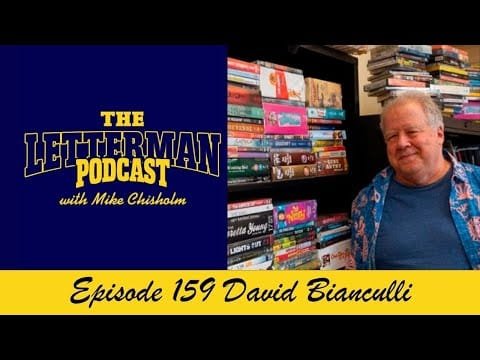
Episode 159: Television Legend David Bianculli Joins the Show
Our first episode of the year features David Bianculli, a man who has been writing about television for over 50 years, appeared on radio, and currently teaches television at Rowan University. He’s the author of The Platinum Age of Television and Dangerously Funny, a deep dive into the legacy of The Smothers Brothers, among others.
David and Mike have an expansive and fascinating conversation, covering a wide array of topics including Saturday Night Live, Andy Kaufman, Fred Rogers, Tom Snyder, and—of course—how all these legends intersect with David Letterman. It’s a lively discussion, and Mike does his best to keep up with his expert guest (spoiler alert: he just barely manages).
And don’t forget to visit Hello-Deli.com, the official home for Late Show with David Letterman merchandise. Rupert Jee is still delighting fans with iconic goodies—grab yours now!
Finally, we kindly ask you to like, share, subscribe, and leave positive comments for the show. Every click helps validate Mike’s hours of obsessive Letterman fandom—and trust us, his ego thanks you.
#DavidBianculli #TheLettermanPodcast #LateShow #DavidLetterman #TVHistory #ThePlatinumAgeOfTelevision #DangerouslyFunny #AndyKaufman #SaturdayNightLive #TomSnyder #FredRogers #ComedyHistory
Episode Transcript
Read full transcript
This is Steve Winer, I used to write for the David Letterman Show. This is Mike Chisholm who spent his entire life dreaming of being on the David Letterman Show, and it will never happen. Watch this podcast podcast instead. Welcome once again to the Letterman podcast. My name is Mike Chisholm. Uh today's a really fun one. We got David Bianculli. Yeah, you know, I've talked about my love for Bill Carter on this show um and and and Tom Shales and some of these other uh people who have written about this art form that is television. Um you know, and David Bianculli is is a guy 50 years he's been doing this. Um an absolute expert. And my conversation with him just as good as with some of these other uh you know, writers um authors who have who have come on here and and had a wonderful wonderful conversation about uh Letterman and then all of the all of the connections around Letterman and um David and I certainly do that today. We talk about all sorts of things. We talk about Fred Rogers. We talk about Andy Kaufman. Of course, the impact that David Letterman made on TV, Saturday Night Live, how all these things are connected to each other. His perspective is nothing short of expert.
Um nothing short of of of of of educated to the nth degree. This guy is uh has been writing uh about television for five decades. He's been broadcast He's been on the radio on NPR uh with Terry Gross um Fresh Air for for decades. And then he has also a professor at Rowan University. And uh you know, that shoutout to Allison Lips by the way. TV historian Allison Lips has been on our show a couple of times. She's the one that made this connection. And I'm just so grateful. Um it was immediate. There was no pre-interview. We just had a phenomenal conversation. I'm going to shut up right now. It's uh oh, the Letterman podcast has one sponsor, one sponsor only, that is hellodashdeli.com. Rupert may not own the Hello Deli anymore, but he has hellodashdeli.com where you can go and get Late Show official Late Show with David Letterman merchandise, mugs and hats and shirts, and all that. You can also go to the Worldwide Pants website as well, where they have different stuff. So, there's two places to get official Late Show with David Letterman merchandise, and the Barbara Gaines Show stuff as well on the Worldwide Pants one. Without further ado, I present to you first off, happy New Year to everybody, and here's the here is our first episode of 2025, my conversation with David Bianculli.
David, I am so stoked to have you here. First off, happy New Year to you, sir. You too. Thanks, man. It's a new year where you are, too, I guess. It's up here in Canada, yes, but New Year's has a distinct maple flavor. That's the only difference. I I This is going to be a lot of fun, and you know, I don't know how much Letterman is going to be in the conversation compared to some of the other things that you've been a part of that I am fascinated with. I know we're going to get to a whole bunch of it. I know that there's going to be a whole bunch on the table left over that we didn't get to. Your career has been expansive. I got to ask you this off the hop. Looking back, three elements, writing, broadcasting, and teaching. Are they all weighted the same? Do you enjoy them all the same? Is there one that is far and away better than the other? What What do you prefer more? I always thought of myself as a journalist first and got into newspapers as a TV critic. First, it's so sad. Now that we are in 2025, Yeah.
I am now officially 50 years as a TV critic, which it Maybe 20 years would have sounded impressive, maybe even 30 years. Even to me, 50 years sounds a little pitiable, you know. Um But, I started as a very young Turk, and I'm going out as a very old fart, you know. But, I don't I don't know what else to do. I I show up on documentaries now and then simply because I haven't died yet. You know. So, Both the writer and the broadcaster are coming out with a response. To get to the crux of your question, I love teaching um when I've got good students. And I started a master's program in television studies, so I get students who are really interested in television. Yeah. So, that's a thrill. Um I sort of fell into the idea of broadcasting in terms of Fresh Air and public radio. I never had any designs to do that, but I try to do it the best I can and had fun with it. And I love writing and love television when it's good. And so, I've lucked out.
Yeah. Well, and talking about that, like like like going back growing up reading I believe his name was Jack Anderson was was was the gentleman in Florida that you would you would you kind of looked at that if I if I if I understand the story correctly, you kind of cracked the code before most most people don't ever crack the code where they look at something and they say, "Wait a second. You get paid to do that? Is there a way that I can figure out a way to get paid to do it?" It feels like that's kind of what happened with you is that growing up you saw something that you liked and said, "Well, no, I would I would like to be that person as well." Is that Is that accurate? Yeah, it is. It It you hear that a lot with actors where they they see something in terms of an on-stage performance or a movie and they think, "I want to do this." With me, it was uh just reading this and and being interested and thinking, "Yeah, I can write about this and I can do it." And it's only because I was so bad at math that when I decided to make it a profession, there were only like, you know, 200 TV critics in the whole country.
Yeah. And I figured that was like four per state. So, that to me seemed like really good odds. That's how bad I was at math. Oh man, see that I love that logic right there though. That is the logic of whimsy going, "Well, wait a second. There's a spot there for me." Yes. Yes. You know, um and and to go back to something that you talked about you know, you and I were were linked together because of one of your students. And I got to tell you from my perspective hosting the Letterman podcast, I love talking to the millennials and below because they have such a different perspective. They don't remember life before the internet and and and some of these other things and and and some of the younger ones even, they don't remember life before streaming. And and to hear their perspective on something that I enjoy so much and I'm you know, I'm I'm very very very down the rabbit hole when it comes to this.
It's fascinating. So, listening to Allison talk about her perspective on Letterman and Conan and all these things to me is nothing short of fascinating and and it's an iron sharpens iron situation. The medium of television, you get to see that evolution from not just the breadth and width of your experience, but also from the new perspective of the young ones who come into your program. That must be fascinating to you. It's also instructive. I mean, Allison Lips was a student of mine. It may have been 15 years ago now. At least 10. And she was so good then that when she went back and got a couple of degrees, I invited her to come in and be an adjunct. Now she's taking the masters and she's going to be teaching for us again exactly because of what you said, the the new perspective that she has, but she has a respect and an enthusiasm for the older stuff.
When I I wrote a book on The Smothers Brothers Comedy Hour back in 2009 or something and I wrote that after I had been teaching about The Smothers Brothers for about 10 years and I realized in teaching it that these kids were like tabula rasa, a lot of them coming to it. And so I had to say, "No, this came out the same year as The Graduate." But I had to say what The Graduate was. I had to say, "You know, uh no, John Kennedy had a brother named Bobby." And then he died and all It's unbelievable, but you do have to do this. And for a short period I began to worry that maybe everybody is stupid and that what's the point of even teaching anybody anything? And then I realized, "No, you're just coming into the pool at a different time. And as long as they're diving in, I get to be the one to introduce people to Ernie Kovacs or The Smothers Brothers or or Letterman." And it's so much fun.
Yeah. And well, you know, and just talking to Allison, it's very, very clear how much fun is a part of it and and and and fascination. The late-night talk show genre in itself, you know, goes down the rabbit hole you're talking about here in its own unique way because obviously with the monologues, with the guests, both musical and and entertainment or of the day or of even human interest, all of them are time capsules. And every year that goes by with these things So so for people who when they do dive into late night, they get a glimpse of what it was like, what day-to-day life was, what acceptable things were, even the most controversial things that happened on any late-night television program at the time, whatever it might have been were elements of that day in everyday life of that time period. And that's one of the things that I I I find uh very enjoyable going back into Letterman's stuff because you know, seeing these current events, some things that are completely different, but some things of course are still repeating themselves or some things that have stayed the same just with a new lens.
Yeah, it's Mike, you're so right. And it goes all the way back um with Letterman. I I loved showing some of his early stuff, some of his daytime stuff, but also the show when he returned after 9/11. You know, as being just brilliant broadcasting and then I would show Craig Ferguson his first show after he's His father died. You know, and it's like, all right, look, they these are real people who can occasionally be serious and help you as a viewer, you know, no matter what your age or where you're from. But the historical continuum of it fascinates me and I started so early as a TV critic that I got to interview you know, Steve Allen and Jack Paar and then in group interviews. Um uh Carson and and and Letterman and everybody else, but I mean, it's like uh it really is a a time capsule that you can't get anywhere else. And when you, you know, Dick Cavett is another perfect example. You really get a sense of what was going on in the country when you have him sitting there talking to like, you know, uh anybody. You know, it's just great.
Absolutely. Um you know, I want to go into kind of the genesis of of of when you start I believe, if I have it right, one of the first things that you were assigned to to write about was Saturday Night Live. Was that is that is that correct? It was one of the first things assigned. That was how I conned my way into the career. Fantastic. Yep. Yeah, I was a I was a senior in journalism at the University of Florida. Yep. And uh instead of I already written a couple of things for the for the student paper and it was like, okay, that's a student paper. I I had my eyes on real journalism, on the Gainesville Sun, a New York Times owned paper. And I thought, if I get into to Gainesville Sun, that you know, the Times is going to see me and a week later they're going to come on up here. You you belonged up here all along. Yeah, that happened. But, um but I went in and I said to the editor, I said, they had this for us as seniors, as graduating seniors in journalism, we got to work in the newsroom. And the second I went into the newsroom, it's another thing like what you said, Mike, about um you recognize something right right away.
Mhm. It was like walking into the newsroom in All the President's Men, the movie. It's not like that anymore. Now it's like a morgue or a or a book haven or something, you know, but it was it was really all energy, excitement, chaos, and individuality, and I loved it right away. And so I got to the editor and I said to the features editor, "Listen, um this is a college town. I'm a college kid. There's a new show that's starting that is aimed at college kids. Why don't you let me write about it?" And they did. And then the editor of the paper called me in and I thought I'd done something wrong. And he he said, "Okay, let's try you out. Four columns, $50 a column." I was I was in gravy. And that's how that's how it all started. But yeah, so I I reviewed Saturday Night Live and I made the same sort of deal with them. I don't know if you have Do you have in Canada a childhood like hockey team that you have watched every game that you can of no matter how bad they are during bad years cuz you just feel so loyal? Is there any team like that?
I'm a gigantic Los Angeles Kings fan. Okay. And it's yes, gigantic since I was a little little kid cuz of Marcel Dion. Like way before Gretzky came over. I'm a huge LA Kings fan, yes. Okay. All right, so the same So I lost many many years of my life watching Miami Dolphins lose because because I was 20 when they went undefeated and I thought anybody who does that, you know, you have me for life. I just didn't think I'd live this long. But with Saturday Night Live, it's the same pledge. It got me my job. I have seen every episode of Saturday Night Live. I don't think Lorne Michaels has done every episode. You know, uh first I'm sure there were 5 years that he skipped, first of all. And then maybe not even some of the ones that he's done did he go back and I've watched them all. And and I'll keep going. Did you have you Okay, so been being in the Northeast, um you know, and then once you get into the business, you you you get a little cachet, perhaps. Have you been able to to to to go do the you know, the Aaron Sorkin behind-the-scenes kind of a move where you get to see the dress rehearsal and see the whole thing and all the behind it or are you the guy that likes to just sit in front and see the presentation and comment on the finished product?
Uh I'm sort of in between. I don't like to ask for favors or to have people in the position that they feel like they have to give me a favor because otherwise I'll say something gross. I have been to Saturday Night Live either once or twice in 50 years. So, I don't think I'm pushing pushing my weight, which has diminished. It's increased physically, but diminished journalistically. Um in 50 years, but uh you know, I just I I do I do like to react to what the art is. Yeah. Um although there are there are like a handful of people that over the years that I've been doing this that I've gotten to be close enough with that I consider them friendly. I'm not I'm not It's not like come on over for dinner. It's Tuesday night. We'll play some poker. But I mean there there are people like like the idea that Mel Brooks will talk to me is just about all I need out of life. Yes. Yeah, he's a great He is such a great man.
I identify with what you're saying with guys like Robert Morton. Or or Cavett. Cavett for example, the fact I can call up Dick Cavett um or or his wife Martha is who I who I who I will usually contact him and again I mean I can call these people and they're Yeah, like like to me again 15-year-old Mike, that does not compute. Like when Rupert Gee retired, I spoke at his at his thing at the Ed Sullivan Theater that was put on by Worldwide Pants last year. And and again, you tell 21-year-old Mike that one day you're going to be at the Ed Sullivan Theater when Rupert Gee sells the Hello Deli and you're going to speak at that Like that does not that's a moonshot. Like that doesn't exist in my world. And and and I appreciate the fact that you have that same enthusiasm for some of these people um you know that that that you have have have covered so honestly but enthusiastically no matter where the opinion lays and you've done it for 50 years. That is a that is a very very cool reflection and thing to be grateful for.
Yeah, I'm I'm I do I just had a class in graduate school. And this is one of the classes that that actually Allison Lips attended. So she can attest to this and whether or not she thought it was a good class. As a teacher, I thought it was a good class and it dives into this. This is not a digression because I decided to do a class about life and death and meaning. Mhm. You know, standard television stuff. And so um I showed appearances by people who were on TV knowing that they were about to die and what they said and a couple of other things like that. So, one of the ones that I showed was was Warren Zevon on Letterman. Yes. And and his whole thing boils down to enjoy every sandwich, you I mean, but I I showed him in his prime and then I on on Letterman and then showed it at the end, the little pieces, and then and then his speech. And then a a British writer, Dennis Potter, one of my favorite TV writers, he did Singing Detective and Pennies from Heaven. And before he died, he went on British television drinking liquid morphine to get through the interview.
And talked about how you should pay attention to the present that he'd always written in his little place in London and outside his window were these blossoms. And he said, "But this year," cuz he knew it was the last time that he would see them, they were the whitest, frothiest, blossomiest blossoms. You know, and so it's like, "Okay, enjoy that." And then Bill Moyers interviewing um uh Joseph Campbell on the on his mythol- Oh, see, look how good you Yes. I mean, Well, I'm a big Star Wars fan, so I got to be a a Campbell fan, right? yes, cuz George Lucas knew how good Joseph Campbell was, but that's that's 25 years ago or more now. And so I showed pieces of that and showed pieces of him deconstructing um uh uh Nietzsche's Thus Spoke Zarathustra introduction, which I then said sort of was the basis for 2001 with with Clark and and uh Kubrick. And then showed pieces of that and then went uh finally after showing some of the of the pieces that uh uh Dennis Potter wrote as he was dying on a literal deadline, the mini-series, little pieces of that haven't been shown in this country nationwide yet, but I showed them.
And then, uh, had one more, finished with Joseph Campbell, and follow your bliss. And and and I realized and I said, "I have done this with my life accidentally." I was already a TV critic for 10 years before I realized I had followed my bliss, but because of that, you know, at one point, you know, I got to interview Letterman, I got to interview Bill Moyers, not Joseph Campbell, I got to spend two days with Dennis Potter, you know, and all of these other people. And so, I was encouraging these graduate students to follow their bliss, and to believe in themselves, and see what happened. And it's like, "All right, maybe that's not the best two and a half hours of teaching ever, but if it makes a difference, you know, it works." I also showed, um, um, uh, Fred Rogers giving a speech a couple of years before he died, Yep. having people spend a minute talking about people thinking just thinking about people that had gotten you where you were today.
The commencement speech that he gave was really for what they'd done, and then to go forward, you know. That makes me feel good. It makes me feel like I know what I'm doing. So so you've gone down so many, uh, places that I can you you've opened up so many doors that we can walk through here. I went through, uh, um, uh, my favorite my favorite person in my entire life is my granddaughter. She's 6 years old now, and she's great. She's all good. When she was 18 months old, we spent 6 months, uh, down at BC Children's Hospital. And, uh, she she went through cancer. She's a survivor now. She's all good. Everything's awesome. She was 18 months old. She had a tumor the size of my fist. Um, that day that that 6-month period, uh, I read a book, uh, by Eckhart Tolle called The Power of Now, and it talks about the idea of living hyper-present, being as present as you possibly can. And and and um, you know, thinking about the blossoms that you you you referred to that that is exactly exactly correct.
Combining that with follow your bliss, um, and and I mean, you really really have two secrets to life there. Now, let's bring it to Letterman for a second. Um, one of the things I haven't talked to him yet. I haven't been lucky enough to talk to him yet. I'm I'm I'm in the world, but I haven't uh, you know, the circumstance hasn't happened yet. I think it probably will. I just don't know when and how. Um, but one of the things that I know talking, feel free to hang up on me. that. I appreciate that. Um, one of the things that he talked about on his his appearance on the Tomorrow Show. And when he appeared on the Tomorrow Show with Tom Snyder, you know, one of his idols as well, you know, the in my opinion, one of the godfathers of long form. Um, one of the things that Dave said was that there's nothing on television that is sacred.
And I cannot wait like I'm not going to if I do talk to him, I am going to I'm not going to talk to him very much about the past cuz he doesn't enjoy that as much unless you're talking about Comedy Store or whatever. He doesn't seem to enjoy that. But that is a comment that I do want to ask him about because and I want to bring it up to you because uh, obviously, he's being he's saying that in a very convenient situation. He is the the morning show is not going well, but yet at the same time, they're still going full force. They're lampooning everybody that they possibly can. And Dave is saying there's nothing on television that is sacred. Um, which basically to me means there's you know, anything can be a bull's eye for them to make fun of if they want to.
But the bigger concept of the idea of there being nothing sacred on television, I don't know about that. And and I and I'm curious when you bring up his 9/11 address to the nation to the to the world, really. Um, you know, after that that atrocity, I would argue that maybe there are things that are sacred on television, and I'm curious if his opinion on that has changed. I'm very curious about your opinion on that. Huh. Okay. I wonder what it is. Here Here we go. We're going to We're going to find out We're going to find out what that is. In real time. Yes, because like for example, Jon Stewart and Jon Oliver Mhm. are two comics working today doing I think some of the best stuff in terms of current events and analysis and actually better journalism than a lot of actual journalist places. But, when you push either of them too hard on that, they'll say, "No, no, no. I'm not a journalist. I'm just a comic."
Well, Bear does the same thing all the time as well. Yep. And I think Letterman also will do the "Everything I do is frivolous. You know, nothing I do means anything." Now, I'm I'm paraphrasing and I could be wrong and and I haven't talked to him in you know, uh decades. I want to talk to him for my next book, but I haven't even tried to do it yet. Um but but we did exchange actual letters going back and forth over enough decades that maybe, but maybe not. But, the idea was I don't want to presume that I'm speaking correctly for him, but the way that I interpret him Yes. is that uh he will say reflexively and um honestly "Nothing I do means anything. Makes any difference. But, I would say then why do you spend so much time uh making so much of it as good as you possibly can. Yeah. And and I think that on on days such as right after 9/11, he knew. I mean, he had to know that he was helping an entire nation. I mean, that's such a daunting idea, you know. Um, Yes.
but it was it was one of the finest moments of television. And it was because it was only partly prepared and it was partly from his heart. Mhm. And, you know, I I I look back at all of these late-night guys and, you know, Jack Paar was best when he spoke from his heart. And um, you know, everybody had their own different approach to things. But I I do think that yes, that there is importance. First of all, the idea that that Letterman took elements from Ernie Kovacs, took elements from uh, Jack Paar and certainly from Steve Allen. And yet somehow either refurbished them or made them his own, but did it in a style of we are going to deconstruct this form. We're not going to destroy it, but we are going to point out that we know what the elements are. We're not going to paint over the grooves. You're going to see how it's put together. And just nothing delighted him more, I think, than real life going unexpectedly.
Mhm. Um, you know, when when he had a guest on who would make him laugh because it wasn't a celebrity guest, it was just some some goofus Yeah. you know, just said something unexpectedly. And he delighted in that. I think that he he we have been living in a deconstructed talk show era for about 20 years now, thanks to Letterman. Do you agree? 100%. 100% because yeah, the idea that he invited the audience to be part of the club. See, I was in high school when Saturday Night Live was like this as well and I do want to go back to the idea that you started writing around the time of Saturday Night Live and Letterman shows up a few years later and to me those two I love the comparison between the two franchises because there's there's obvious links, but there's also a cultural links where they would go away and come back to each other. But both shows were the type where I was walking through the hallways whether it was in junior high or senior high and you would make eye contact on if it was Saturday Night Live Monday morning because somebody did something on SNL on Saturday night two nights before and you see each other and you make that comparison. You say one word or two words. Letterman in in my opinion made that a reality with everybody who watched it who was part of the club.
They were now included in this process that you're talking about which to me I mean, I'm saying this as a 48-year-old man, that was sacred to me back then because it was connection and community. Never mind all of the the higher gravitas stuff you're talking about the things that had massive gravity to them. To me, you know, it is it is sacred and and and the idea that that these guys uh poked the balloon and popped the balloon by saying, "Hey, I'm just an entertainer." Good for them for being able to do that to take the pressure off so they can keep doing what they're doing. But to me it is a very sacred There are moments of sacredness, I I is probably the the better way to say it. Now, when you talked about being a young kid and having that be so important, I have two Canada specific questions for you. Yes, sir. Yes, sir. All right. One is, at the same time that Saturday Night Live was coming out, Yep.
so was down here in the States, uh SCTV. Oh, man. Yeah. Because because it was from Canada, Yep. did you guys diss it like a home a home club and you didn't want to give it the credence or did you value it more? That's my first. Two two two answers to that question. For me personally, it was sacred. Like whenever one of the things if actually if you go on Don Giller's Letterman David Letterman YouTube channel, he's got a compilation that has the entire run of everybody who had any association with SCTV and and and David Letterman all the way from the morning show all the way up to the end of of of late show. And I think it's seven parts and I think each part is 90 minutes. Um I was under that camp. So if John Candy was on Letterman, it was like an extra special thing cuz he was on there.
But that being said, there's also this thing in Canada where um when somebody goes across the border and does well like a Jim Carrey or Mike Myers or whatever, there's this kind of national pride sort of thing where we take ownership and vicariousness and and and and and and put ourselves in the pocket of these people um so we can you know, it's an interesting thing. And so SCTV when you would see that, people would be like, "Oh, yeah, this is pretty good pretty good." But then John Candy goes out and makes a big movie and something, "Oh, now he's made it." But I never saw it that way. I always saw SCTV being um same with Tom Green. Um same with uh you know, Kenny vs. Spenny or some of these other things too where where where where something inventive inventive happened in Canada. Like when The Kids in the Hall, when I realized The Kids in the Hall wasn't just on CBC, but it was actually playing down south as well. Oh my god, did I love that.
So, for me growing up, whenever there'd be some sort of a mashup between SCTV and Letterman, it was a massive thing. So, there's the answer to the first question.
All right. Second question. I'm glad you remember there were two. You're good at this. Um is Now, did I remember what the second one was? Yes. Um Monty Python in the States didn't show up until after it ended in England. Uh so, it didn't show up on public television till '74. It started in I think '69. Yeah, if I've got those years right. When when did you get to see it? Cuz you're part of the Commonwealth. Yeah, so I'm a I'm a '76 baby, okay? But, I remember But, I remember uh Flying Circus from childhood. Just like SCTV, I remember it from childhood. I don't remember uh the CBC played it somewhere along the way. I I I've always known Flying Circus. Like, the Lumberjack song, I've always known that song. Um I can remember it back into being kids at the elementary school singing it on the the playground. Cuz my whole pop culture continuum is I go Beatles, Monty Python, Saturday Night Live, SCTV, Letterman, and and then on.
Yeah. And so, it's like, okay, I see where all that stuff leads into everything else. Absolutely. And and I think that there is a through line and there Yes, I I could could not agree with you more. Um yeah, this is a fantastic conversation. for me. Is this giving you anything that you want? Everything. I I Are you kidding me? I I dig this. I When I do this show, uh and very obviously, I'm not doing it for anybody else except for me. Um and if some people want to join in and it and audience form, that's fantastic. conversations where I come from. That's When podcasting showed up, I had the same exact same See, I was never I never had that aha moment. I probably would have gone into broadcasting if that would have been the case, but broadcasting doesn't it doesn't hit as much as Letterman said, you know what? Uh there is there were no other talk show hosts other than Johnny at the time and and and and the unlikelihood of of him going and doing what he did. Back in the day, if I would have had that moment of clarity where I I want to do what I want to do, it would have been Tom Snyder.
But when Tom went back to Late Late Show and and they tried to um resurrect in a in a you know, on a big stage the art of uh long form, it came across like what people considered to be talk radio. It wasn't the popular thing, it wasn't the you know, it and don't get me wrong, he had an audience and it did work, but when you compare it to podcasting now, where the appreciation of the art of conversation is so on the forefront um of pop culture now, I you know, again, it was just me growing up at that time, it just it it wasn't there the way that it was. That being said, for you at that time, you started with with radio early early early on. Like your affiliation with with Terry Gross started early, right? With NPR and all that. Do I have it right? Yeah, 85, is that early? Uh well, I mean, when you compare it to what podcasting is now, because I would say that NPR certainly certainly uh holds the torch of the celebration of conversation of the art of conversation.
I would I would submit. Yeah, no, I I'm I'm still proud to be part of Terry Gross's show and and that whole thing and I've have waited since 1987 when it launched nationally for them to fire me. I just don't understand, but you know, either they think so little of television or their bar is so low that they accept what I do, but I love it. Did you watch The Morning Show real time? Like were you so um engrossed in being a TV critic at that point where The Morning Show hit your radar or was it uh after it had come out uh and the buzz sort of started? Yeah, sorry. Sorry. Did I say Letterman's? Yeah. of course. Yes. I reviewed the first one for the next day's paper. You know, I mean Fantastic. Yep. Tom Shales, he had a television critic on as a guest. That's how bad that first show was. But but still fascinatingly unique. I mean, he had Tom Shales on not to talk about television, but to talk about how Letterman was doing on television on his first show as it was going on. Like they cut to him every 15 minutes and said, "What did What did you think of that sketch?" And and Tom Shales being like a world-class curmudgeon, you know, Even back in '81. Even back then.
Yes, even back in '81. A young curmudgeon maybe. Or younger. But but no, I mean, what a great idea, you know. So, I was in love with it from the start. Oh, I love hearing that. And I And And guys like uh Actually, I have Tom on here to talk to I want to I wasn't sure about talking about contemporaries or not. So, I have uh Tom with a question mark, Bill with a question mark talking about Shales and Carter. Sure. Talking about the contemporaries. But but Tom Shales, like I I um I love the arc of him with when it comes to Conan. I love the fact that that that that Tom was like, "Conan no man." And then suddenly he got turned and not only that was able to set aside any you know, whatever it was ego or it was you know, the excuse of, "Well, it just needed a little bit longer in the oven to bake." Whatever it was. And to And to give Conan his his his his due. I uh I I love that kind of stuff.
Have you ever had a moment like that in your career where something turned some sort of a full circle and it was elevated in your I will never forget because it haunts me, is we've already mentioned it, the first time I saw Monty Python. It was the very first time. It was like, what the hell is this? I mean, I really, really didn't get it. And but I went back and within a month of seeing different then I totally was aboard. But the first one was like, oh, you know, here, here's caviar for the first time, you know, here you know, but oh, now I really get it.
But I I have I really have a a lucky good track record um for most of the people that um I think are really good at pointing it out the very first time. Even Conan, by the way, his first press conference when he was introduced, um and the one of the first questions was a fellow critic said, you know, what do you what should we think about a relative unknown getting this late-night national showcase? And Conan said, sir, you know, I take umbrage at your question, you know, I'm not a relative unknown, I'm a complete unknown, you know, and I thought, anybody that can do that is going to be just fine. Um again, I'm paraphrasing. He I'm sure he said it more wittily than that. But but that was the basic idea. He won me over first day. Um Letterman at a press conference, I remember, I was wearing some It was like mid-Miami Vice years, and I was wearing some blue or green day-glo jacket, sports coat, and when I got my turn, you know, he he, you know, he said, congratulations on on on placing at the Masters.
I didn't laugh after the question after that. Thanks very much. I oh man and well you know what I one of the things that I have watched multiple multiple multiple times was the the CBS press conference that uh that Dave um you know gave you know when he was coming over when the announcement was made and and and uh Stringer and company were all up there and and and Dave went up and and just basically annihilated the room. Gene Siskel was there and I thought to myself you know what I I totally and Siskel and Ebert were our guests on the show so they happen to be in New York that night but they happen to also be you know accredited journalists and so they're oh yeah we're going to this press conference and they see it Gene even asked a question at the back um you know before the uh the festivities ended and I I remember thinking to myself the first time I saw that and realized that that's what had happened was oh my gosh what a uh what a what a key that you could selectively use sometimes being in the position that you are uh to be part of something that you would just enjoy but also be part of broadcast history.
Were there ever times where you uh you pulled out the David Bianculli card key and and said I want to go to this event I want to go to this uh particular uh get-together? No I mean I I would I would go to thing in the heyday of press tours Yep. where critics would get together for like two three weeks at a time and the networks would take two or three days each and then the the newspapers we formed the TCA so the newspapers would pay for it but the networks would still organize it and they'd have parties every night and so you would go to a party and they would provide you a guest list in advance. So it would be like a video game where you had to hunt your quarry you know and it was like collecting baseball cards you know got it got it need it need it got it got it and then you could start you know looking I I you know I I want to get to you know this person you know right away. And uh but that wasn't using influence or anything.
No, that's part of the gig. That was part of the I can't believe I get paid for this part. Yeah. And and probably because I'm writing a book on the Beatles now, I'm still excited by the fact that one time at a press conference, I got to ask a question of Paul McCartney and he answered it. But he was on satellite, so he didn't see, you know, I mean, it was like it was it was removed, but when you talk about if you if you told little Mike Chisholm that you were going to be, you know, doing this stuff with with Morton, it's sort of like you know, it's the same sort of thing that I would and I've interviewed um, Ringo a couple of times in terms of large group. Yeah. And I had a one-on-one phone interview set up with George Harrison tied in with my Smothers Brothers book and I he had to cancel it with a really good reason. He'd just been stabbed. You know, that was, you know, the home invader that had been, you know, I mean, it's like, well, I've had lots of reasons for people saying I'm not going to be able to be interviewed, but it was like, well, no, he's, you know, he's recovering from a near-fatal attack. All right, okay, that'll Uh, let's let's go down the rabbit hole.
I mean, I would have said that out loud. That's No, no, no, no, this is great. Let's go down the rabbit hole of the Beatles a little bit because, uh, you know, obviously, a good friend of the show and friend of mine now is is uh, where is he? Where is he on the show? There he is. There's Will Lee. So, Will Lee, of course, you know, Fab Fo and and and Jimmy Jimmy Vivino, uh, who was, you know, Conan's uh, band leader, um, you know, forever. Uh, they're part of Fab Fo and and the Beatles is a huge There's obviously huge Beatles connections with Letterman as well, going to the Ed Sullivan Theater, having the the special that they had, the anniversary special on the stage of the Ed Sullivan Theater. Um, never mind McCartney on the uh, on the uh, um, why is the the word going away from me right now? The the awning outside, the marquee, there we go. Performing on the marquee. Um I'm curious about what your Beatles book is about. Where's the take that's coming on this bad boy?
It's called See the Beatles, and it's about the visual artistry of John, Paul, George, and Ringo. And it's it's collecting together their television appearances, the movies, the album covers, the photo shoots, the individual lithographs and drawings and things that they did. Basically, things that they did themselves, things that they commissioned, things that they acted in or took part in to show my my thesis is that they were as creative and as non-repetitive art visually as they were musically. So, Fantastic. that's what I'm trying to do. I don't suppose I I don't even know. There's no Peter Max influence. I I you know, you talk about Peter Max influence and Yellow Submarine stuff. thing that goes down to the um uh the Beatles Saturday morning cartoon show is where Yellow Submarine actually came from. And if you go back and you see bootleg copies of the original Beatles cartoons on Saturday morning as I have, um like the little video that they do to promote Eleanor Rigby has some scenes in it that are very close to what are done in the Yellow Submarine theatrical movie version of Eleanor Rigby. And so, it's like, "Oh."
So, I'm taking deep dives into that sort of stuff. Um uh it's it's probably something I've wanted I've wanted to write something about the Beatles my whole life. I've done a lot of fresh air pieces on them. Yeah. I I still hold out hope that I may be able to get to talk to to Paul and Ringo before my deadline, but but I haven't even officially asked yet because I want to have all my ducks in a row Yep. before I even get that chance. So, I don't know. I mean, I've sold for bear before you see the bear. Yeah, I dig Yeah, I've sold the Yes, I've sold the book without and I'm enough of a journalist to know I don't want to know where the story ends or how it ends. Um but so interesting to me to go down those rabbit holes. And even I have like Judd Apatow talked to me about his Yellow Submarine spoof in um Walk Hard. Yep. Um you know, the Dewey Cox thing. And it's because Yellow Submarine frightened him to death when he was a kid.
Yeah. Oh, yeah. So, he wanted to do you know, his version of that. And I talked to Ken Burns about it and I talked to Ron Howard who's directed You know, I mean, so I'm going to try to get to filmmakers and photographers uh to talk about the visual stuff. The only person close to the circle so far uh that I've talked to was Klaus Voormann who of course, you know, did the Revolver album cover and and has known them since, you know, uh the early days. But as for Fab Four, uh I have to I've only seen them maybe 20 times at this point. I absolutely love those guys. Aren't they incredible? Yeah. Like the idea I've never gone I I would I would went backstage for once, once for like a couple of minutes and that was it. I didn't want to deal and and drove away, but I really think to be able to say we love the music so much we want to recreate it on stage the way they never did. And sometimes there's 20 people on stage.
Exactly. Exactly. We're going to play this stuff that was unplayable and not just play it, we're going to kick its ass. We're going to play it really well. And uh I I dig that so much about them as well. Oh, yeah. So, I mean Will is a Will is a a good friend. I mean um Yeah, yeah. The next time you go see them, hanging out with him afterwards will be a lot of fun if you if you decide to go down that rabbit hole. So, You know, I it's it's my my uh my my sort of fill the moat, raise the drawbridge approach to being a critic. I I don't want to I I don't often think of doing that sort of thing. I get enough enjoyment just from the enjoyment. Sure. Well, and the TV But I I thought about I thought about interviewing him as well. And the engineer at Fresh Air is a close friend of his, too, and has worked on stuff with him. And so, I have an in uh you know, with him. But privately afterwards, if you want to talk to me about we're we're making that happen, for sure.
Wait till you just even see his the shrine that he Do you want to talk about the visuals and the things that he has? Oh, yeah. No, no, no. There's going to be It'll be pictures on the inside of the book, for sure, of some of the stuff that he has. There's no no no no question. Um Oh, this is this is fun. Okay, so let's bring again So, do you think it's a good idea for a book? Well, there There we go. Yeah. Okay. Yeah. Okay. Um the inclusion of the Beatles here, I love that we went down this place because again, everything that you kind of put together, all of these things that kind of are tangentially connected. The Beatles are right involved in that. You look at Saturday Night Live, as well. Like, you know, Lorne and Paul. If if if the public would believe the impression out there, they go they dine often together. Um you know, it's it's um the the the legendary you know, the the Was it a thousand dollars each? If you want to give less to Ringo, no problem. Come on back.
I know. That's definitely in the book. That's definitely in the book. Um let's go back to the morning show. Let's Let's back to some Letterman stuff. Um I do want to talk about Fred Rogers. I'm glad you brought him up. I did want to bring up Fred Rogers again. We'll get to that. Um, my access to Letterman, um, I think it probably started my my my love for broadcasters probably started with Fred Rogers, even though I didn't accept him as a broadcaster. I was way too young to kind of even understand how to dissect these things. Um, Fred to me talked to me like I was, um, the only person in the room and and or my friends and I were the only people in the room and and and he talked to us like adults in a simplified way, but to me he was a broadcaster and a teacher and I loved that about him. Um, so I do want to I do want to talk about him. And and and his appearances on Letterman were fantastic. Uh, you worked in the Philadelphia area like I mean I I I'm super curious.
How often did you encounter Fred in your daily life? It was he knew who you were obviously. Were you friendly with him? Um, I grew up I was born in Pittsburgh. Yeah. And so I watched Josie's Corner where he was a puppeteer locally and then when it launched in Pittsburgh, um, you know, uh, I I was following him and there, oh, whoops. Sorry about that. Live radio, live podcasting. Yeah, yeah, yeah. I dig it. So so basically, uh, I got I didn't get to know him until I was at the Philadelphia Inquirer in the '80s and he came into town and I followed him around for a day and we hit it off and um, something happened in terms of public events while I was still shadowing him in terms of current events and Ted Koppel called him from Nightline and I was in the room and asking him to be on that night show to talk about this issue or that issue. And this is when Nightline and Ted Koppel were like one of the biggest things around.
And he said, "No." And Ted Koppel explained that well, you're in Philadelphia, we can just go to the ABC studio, hook you up. Uh it'll it'll be no problem. And um And he said, "No, um because you're on at night at 11:30, and I am scheduled tomorrow morning to meet a class of preschoolers. And and I owe them my rested self." And I thought the So, I wrote that up. I was like, "Okay, he is not faking. Whatever you seen on TV all those years and we ended up uh um I I I only interviewed him a couple of times, but enough so that uh when he died, his widow um mentioned some of the things that he had said about me and recommended me to be on the Fred Rogers advisory council. And so, it was my honor to do that for for about a decade. And and with some of the people that had worked with him extensively and other people that were carrying on his stuff. Again, I was like, you know, I I feel like my whole life is that drawing of which of these is not like the others.
You know, and I'm like, "What the hell am I doing here?" But But um I think Fred Rogers is one of the most amazing and I teach him now when I teach television of the '60s. Talk about how he saved public television. About how his first week of shows um was about uh King Friday, who was sort of a tyrannical, frightened ruler, um uh building a wall to keep people out. And then uh I show the part when he asked PBS, when it was just public television starting, for an evening show to talk to the parents as well as the kids about something that had just happened. And he does and he has little Daniel Striped and Tiger, the puppet, asking uh Josie, "What does assassination mean?"
Yeah. Exactly. And And those ended up in the Morgan Neville documentary, which I ended up in because of this stuff. Yep. And teaching it and telling Morgan about that clip that I show in class and he got it and he used it in the thing. It's remark- I can't imagine a children's television host or hostess today who thinks that clearly and unreservedly and totally about children. You know, he was a remarkable man. And um I I go back to his appearances appearance for sure, maybe appearances, but I think I the one appearance that I can think of on Late Night. And I can remember the first time I encountered the clip going, "Okay, be nice, Dave." Like Yeah. Because I think a lot of people you know, kindness is my favorite thing in the world. I love kindness I I I unabashedly. But and I have been my mom said I was like that as a baby. I would wake up with a big smile on my face and I would try and be kind.
And but the one thing that I have learned growing up with that disposition is similar to what you talked about with with Koppel. Well, no, no, no, you don't understand. It'll be very easy. Like sometimes kindness gets mistaken for naivete. And and and and I believe that Fred Rogers, when he runs into cynicism, many times that that would be a move that cynical people might So, I remember watching Dave and and and and Fred and again I'm "Oh, you better be nice. You better be nice. And it was such a delightful exchange between the two you know, Letterman was maybe a titan of broadcasting at that time. Fred certainly was, but these two broadcasters at the highest level with completely different orbits mixing and and watching those two interact was fascinating to me. I wish that I could somehow figure out a way to have that interaction with David this age and Fred Rogers. I think that would be a fascinating Oh.
um exchange between these two. Because again, the perspective is just uh it's mind-boggling. now on Netflix I'm going to ask you about that. Yep. Yes, his perspective is is so special. And it is deeper. If you hear any noise now, it's cuz I have a dog that has just come in to let me know. Outstanding. Dogs Dogs uh Dogs trend well. People like watching the dogs that appear randomly on the show more than they like me. So, this is great. Okay. But but you know, you you think of Letterman different with different personality types and at different points in his career. Yes. And one of the things that's amazing about him is he's consistently malleable, which almost sounds like a contradiction. It's like Yeah. I mean, he can be mean to Joaquin Phoenix and it's hilarious and it somehow serves that interview and serves Joaquin Phoenix and what he was trying to do at the time. And then he's so nice uh with Fred Rogers. He lets Share bully him and somehow that's perfect.
He knows he knows what to do. There there are times where just as a viewer and I may be making too much out of this, but but you can like almost point to specific moments and say oh, this is where not only you discover something about them, but but they crystallize something about themselves. I think I show a Johnny Carson with the Ed Ames Tomahawk throw as like the moment that he grabs Ed Ames's uh arm and doesn't let him take the hatchet out.
Yeah. It's like that's when I think he became Johnny Carson. Oh, I love that. He leveled up in that very moment. He leveled up. this do not hasten the end of this. Let it sit. sits there and he just sharpens his two axes and lets the humor build and doesn't say anything for a while and then he's got some killer ones by the time he starts saying stuff. But it's like, "Oh, look. That's Johnny Carson." Yep. You know, really young. And and Letterman, you know, uh with the fruit basket GE. Yeah. You know, he know he's got I don't know what's in that basket, but it's pure gold. Yeah. The the the hump of the camel was one that uh you know, because because again, Letterman the one thing with Dave that he was just so good was being razor sharp. And at the end of his career, I honestly think that the later years of Late Show, you know, that was the secret weapon. He wasn't coming to rehearsals anymore.
He wasn't coming to, you know, but but at the end of the day they just knew it was the superpower that you could just rely on. The person would say the thing and without even thinking he would say the perfect retort that was awesome. But with the hump of the camel back Yeah, that's where he kind of had the idea of, "Okay, let's let it sit." Those moments where, you know, um I think about Conan's last appearance or was I think it was his last his first appearance after uh what I like to refer to as Late Shift too. It was it was after he's on TBS. He shows up.
Conan comes out and sits down and I don't know if any segment producers had anything to do with it. I doubt it very very much. I've been trying to find out that answer. Uh but people are kind of cagey about that one. For whatever reason, to me, in my mind, that's Dave and Conan just going, "Let's not say anything." Without having met each other beforehand, it's just let's not say anything and let this moment just sit. And Conan comes out with, "You know Jay is watching right now, right?" Like and and it was such a perfect moment. But you don't get that seasoning until you've done it for thousands of hours in front of people to find out where you do let it sit versus when you jump in. You're really good at this, Mike. I do think, reflecting on that, that that was not preordained. I just don't think it's like in either of their personalities to do that. I could be wrong, Yep. but I think that when they got there, they both recognized, you know, it it's sort of like when Craig Ferguson did the uncomfortable silences, he knew he knew the people that were really good at doing it with him. And he would do it differently. But I think they both recognized, "Oh, let's sit on this."
Yep. And then they're both thinking, "What do I say? What do I say? What do I say? What do I say?" And and Conan, uh you know, it was the old hit it out of the park one. Absolutely. Um I love that you brought up Ferguson. I appreciate that. We we we've On this show here, we celebrate kind of everything worldwide pants. The tangential connections sometimes to me are even more special than having, you know, folks who work directly for the show. I I I love these things. I love um And and I want to get your perspective on on on on the first late shift. When Dave made the move, I definitely want to get your perspective on that. But we'll fast forward into that a little bit. Uh I mean, Dave really continued the Johnny Carson contract. He came into CBS as powerful Dave, where it took Johnny 20 years to become powerful Johnny the way that he did. Dave walked into it, owned 2 hours of network television in late night. I do not believe that will ever happen again.
It was a It was a It was an albatross. It was one of those unique moments that just It just won't happen again. But it gave us It does. Lorne Michaels will pull it off. Well, oh, you know what? Fair enough. Fair enough. That's a That's a That's a very, very good point. Um, you know, Lorne's probably the closest thing to the example of that. Uh, that's a great point. But Pants having Late Late Show, allowing Ferguson to do what he did, to me, my golden age of late night is actually later on than a lot of people's. I actually really loved uh, Letterman, Ferguson, and Conan. Um, you know, I I my my And thank God for the invention of the DVR by that point because, you know, I was able to kind of keep up with that in real time. Um, but the idea of Ferguson being there and making the joke all the time, you know, the awkward pauses were incredible. Like you say, him coming out and being able to experiment with the idea of, "Okay, do I wear a tie? Do I not wear a tie? Okay, now the monologue's going to go to basically uh, me just riffing on a couple little points here off the top of my head. We're going to again reinvent the format again." As we saw when Conan took over The Tonight Show, networks don't really give a lot of air for experimentation with that kind of time. You know, Leno got it. He had his 18 months and they gave him They gave him room.
But you don't see that very often anymore. Uh, I believe that Ferguson got a chance to become Ferguson because it was a Worldwide Pants Production. Mhm. No, you're absolutely right. And he didn't he didn't just get to invent himself because he hadn't done this before. He got to reinvent himself and then reinvent himself by year three or four on Craig Ferguson. He's got a robot sidekick, uh, you know, Hadassah Josh Robert Thompson, by the way, who's been on this show, who is an incredible guy. Anyway, yep. Yeah, keep going. No, and but they recognized, oh, this is more than just a one-off. We're going to this is a two-off. No, this is a regular thing. No, if they could have spun him off like Max Headroom, they probably would have, you know. Shout out to Morty on Max Headroom. I'm the uh uh okay, so let's go back to when the late shift did happen. And uh and again, I I mean, it's Well, I mean, we can't even talk we can't even talk Snyder if you want to.
I'll talk Oh god, oh I love Tom Snyder. I love Tom Snyder. Yeah. Um well, and and really at the end of the day, part of it, like I mean, we can rope in Tom as being sort of part of the of the late shift, you know, and and I mean, the the echoes um to these things are just you almost can't write it, you know, Dave takes over for Tom, uh Dave walks across the street, Dave brings Tom show up, uh you know, Larry Sanders predicted the whole thing a year previous. Like that that's just crazy. brilliant. Yeah. And and, you know, I think that was Letterman making such like hiding it in plain sight. Like he was thinking that way and said, okay, you know, don't tell anybody. Tom Snyder you know, don't tell anybody except it's on HBO and that's like the great Wow. Baffling. Baffling to me. I still talk to Morty about that. Uh Morty, he has the award cuz on the on the on the show on Larry Sanders, the whole premise was that Larry and Dave were at a similar the same award show. And the award that he has, Morty, I don't know if he showed it on camera when he showed up on the show or not, but he has it. He has the Oh wow.
That's like one of my favorite Oh, I love What a souvenir. What an excellent souvenir that would be. I I did an art gallery thing in New York once. They asked me to curate a history of television, and so I asked a couple of people that were friendish friends of mine from business to to do what artists would do and say, "Hey, lend me one of your your Renoirs or this stuff." So, Tom Fontana lent me the snow globe from the end of St. Elsewhere, and um uh Fred Rogers' widow sent um his sweater and sneakers. They have more than one pair. I would assume. Rod Serling's daughter sent me his typewriter. Ernie Kovacs' son sent me his old scripts. And you know, it was like, this is fun. Oh, I love that stuff. Like Like like I this this little corner of our studio I I have a men's mental wellness podcast that I shoot on the other side, but this little corner of of of the studio here, I literally when I sit back here, I feel the energy. I feel the energy off that bridge, you know? I feel the energy off That's the very first Emmy folder for the for the David Letterman show, for the morning show that they got when it with the telegram inside it and all of that from when they got nominated for the for the morning show.
I feel the energy off these these relics. I don't know I'm certain it's it's it's it's a placebo of some sort, but yet at the same time it still works. You still feel it. I love that stuff. Have you collected stuff over the years that that you enjoy? Not not as much as you would think. I mean, I I don't have I have first editions in terms of literature. When I got to know Kurt Vonnegut, I got him to sign some of my first hit the first editions that he had done. And but I don't I don't I really don't like to intrude on that sort of stuff. And I gave a lot of TV tchotchkes and stuff over the years to charities or to or to relatives. It's it's very weird. I have a few things, but but I don't know. I I I really admire the the the the follow your bliss corner that you've got there. And I and I I realize maybe I should have held on to more stuff than I did. Well, it works like the first Well, in the first crew jacket I got, you know, the letterman again, I love the the letterman jackets, that whole culture, you know, of that. The first one that I got was given to me by one of the staffers and he said, "Welcome to the family."
And and it just and yeah, that's kind of one of those the follow your bliss things that uh That's a Saturday Night Live fifth time hosting jacket. That's what Oh, the five-timers club. See, that's my By the way, that's my They say uh you know, as long as I'm old enough now, they they say that the the cast in high school that you were that you had where you in high school is going to be your favorite cast. That was certainly true with me. That was Carvey, Lovitz. Uh well, see, I kind of had two though cuz I had uh Nealon and Carvey and Miller and and and Jan Hooks and all of them. I had them, but then also uh as a bonus, I got Sandler and Spade and Farley and uh and and them as well. So, I kind of I kind of include them all in my Those were all in my in my group, you And I get to be the original five-year group, which is You do. Yeah. You do. Did you see the movie? Did you see the the the Yes, and I like As a matter of fact, I got to review the movie for Fresh Air.
Um the first movie I reviewed for Fresh Air. And I liked it. I went in as a reverse TV snob expecting a movie not to be as good as the television, but since I teach that first episode, I'm very familiar with every single element of it. And I thought they did a really nice job. Aw, that love hearing that. That's fantastic. Uh very good. Uh I I kind of the same thing. Um I I I you know, I get hung up when I see something it's like, "Oh, it's not It wasn't like that." They Oh, they truncated this. I get hung up. I didn't in that one. In that one I I let it go. Yeah, no, it at the door. Leave your nits at the door. I mean, I just saw the Bob Dylan um movie and it's sort of like, well, no, you you they said that at Manchester, not at Newport, but it's like, ah, it's fine. It's fine, you know. I just saw the Bob Dylan um movie and it's sort of like, well, no, you you they said that at Manchester, not at Newport, but it's like, ah, it's fine.
It's fine, you know. I just saw the Bob Dylan um movie and it's sort of like, well, no, you you they said that at Manchester, not at Newport, but it's like, ah, it's fine. Yeah. And and I think that that movie uh the suspension of disbelief gets you enough where you don't nitpick or whatever. I'm a huge Andy Kaufman fan. Massive massive Andy Kaufman fan and and and uh you know, again, here's another one of those people who fit into this culture that we were kind of talking about is Andy Kaufman. He fits right in there even though he's a part of all of it, he fits in so perfectly with his attitude and what what he did. You You never Did you ever even met Andy Kaufman, did you? No. I Well, we met the whole cast of Taxi, but um uh Andy didn't stay at the press conference. So, he was pulling an Andy Kaufman um even then. Never got to talk I know that um uh I do believe that I interviewed him once or tried to interview him once by phone and uh he would only be interviewed in character. And I said, "I don't want to I'm interested in the actor and um you know, if if he's not going to talk to me as him, then I'll be some other interviewer. Not me, and that one won't write the the interview. Yeah. So, I I don't think I got that one.
That's uh That was me with stupid pride back in the '70s. I'm sorry. Well, so, I have a weird I have a weird connection to the world of pro wrestling. And um and and and one of the things time? Yeah, I I don't know well no, mine's mine's really weird. I ended up becoming a wrestling promoter and sort of backed into it accidentally and through that have become I'm a member of Cauliflower Alley and actually like I'm a I'm a I'm a pretty successful wrestling promoter even though we did it for charity and because I was kind of the business end of it, I got pulled behind the curtain. We had a guy called Jimmy Hart, the Mouth of the South, Jimmy Hart. He came up and he was one of our draws for one of the shows that we did. And when he came up, I was like, I need at least one dinner with him. And and the guys were like, yeah, no problem. This is your show. You can do that. I'm like, great, thank you.
And when we sat down, he thought I was going to talk to him about like the Hart Foundation and Canadian wrestling and all that. I was like, no, no, no. I said, Jimmy, can I please talk to you about Andy Kaufman? And he lit up like a Christmas tree because back when Andy was doing his thing, him and Jerry Lawler getting ready to do their thing, Jimmy was in the wrestling business called he was married to Andy because the good guys and the bad guys didn't fraternize. And there'd be go-betweens and Jimmy Hart was his manager. And so they literally would go up and down the South you know, for sometimes 2 weeks at a time and then they would go back to Graceland and go hang out at Graceland for a while and he had he had so many Andy Kaufman stories.
And Kaufman Yeah, oh yeah, and he was delighted too cuz when everyone people sit down with him, they want to talk about wrestling stuff. I was like, please and for 4 hours he gave me Andy Kaufman stories and and many of them have never been told. Jimmy Hart, the Mouth of the South, loves they were they were good friends and he it does not surprise me at all. This is to go back to your comment, how Andy, when he was in that place in his career, he was just like a pro wrestler back when it was very very very close and his outward character was everything. He literally what they call in wrestling lived the gimmick. Mhm. And whether or not it would have been Tony Clifton or whether or not it had been Andy Kaufman the wrestler or whatever, that does not surprise me at all. He would look at people like you to use as a device to further that agenda or that program. And I believe Andy changed pro wrestling and really is one of the one of the instrumental reasons for bringing it into the limelight. That night on Letterman with Lawler, in my opinion, is one of the most important moments in pro wrestling.
Yeah, that's amazing. Well, you beat the crap out of my only meal with a pro wrestler. I had uh I had lunch at the Arizona Biltmore, a a Sunday brunch um with Classy Freddie Blassie. Oh my god. Well, and Andy Kaufman adored Classy Freddie Blassie. They did my breakfast with Blassie together. You met Freddie Blassie? Freddie Oh, that is fantastic. They were He was He was part of a USA Network uh thing and the publicist had said, "Please, I don't know if anybody's going to come to this. Would you please come and and ask a question of Classy Freddie Blassie because if he gets frozen out here and you know and so so I went to this press conference and and I said uh um I Basically, I forget how I asked the question, but it was something about you know, cuz he wore these rings and everything. Mhm. Uh he was very blinged out and you know, he was classy and he was, you know, all the he said, "Well, I said, once you were in the ring with all this you know, expensive jewelry and stuff, huh?
How did you protect your jewels?" And he he laughed and he, of course, used that to go off. Of course, you gave him you just fed him a softball, yep. Yeah, and so and so afterwards, the publicist said, "Classy Freddie Blassie wants to have lunch with you." And so went to have lunch uh Arizona Biltmore, you know, four-star kind of thing and the waiter comes over. Now, I cannot do any accent without it turning into uh you know, a Transylvanian vampire in about half a sentence, but but imagine a French waiter, a snooty French kind of like John Cleese as a French waiter, okay? Yeah. Oh, you and we have these specials today, and we have these and these and these and these and we will give you a few moments to think about it, and then I will come back to take your order. And he goes away, and he gets about 10 ft, and classy Freddie Blassie screams an obscenity that I will not repeat Sure. on the podcast, but the second word was you.
You know. And the waiter stops moving. I mean, the whole place, loud enough for the whole place. Oh, that's classy, Freddie Blassie. That was very funny. My only story. Yours wins. I adore that you have that memory. That's fantastic. And and again, for those who are Andy Kauf- Andy Kaufman fans, um you know, to me, I run into Kaufman fans all the time when we start talking about it, and they haven't seen my Breakfast with Blassie. I highly, highly recommend watching my Breakfast with Blassie if if if that's the case, where Andy and and Fred share a meal Fred uh share a meal together, and it's just it's it's it's really, really funny stuff in the way that Andy Kaufman is really, really funny, cuz he plays it straight. They both play it straight, and it's I just saw a uh a clip on YouTube yesterday that I had not seen since the '70s. It's Andy Kaufman on Van Dyke and Company um with Dick Van Dyke during the Christmas show, and Dick Van Dyke just sort of turns it over to him.
Yeah. And it must go for 9 minutes. Yeah. And he's just so confident even then. It's just remarkable. Absolutely. And and again, a friend to uh to Letterman like crazy in those early years and and and to the point where you know, the very last Late Show with David Letterman which were it's almost going to be 10 years when you think about it that he's gone off the air. That is crazy that that is the case it's already been a decade. But during the the last show where they're showing clips very similar to Johnny Carson's last Tonight Show. You know, they're showing clips all over. Andy Kaufman, one of the clips, one of the handful of clips that they show in the very last Late Show with David Letterman was an Andy Kaufman clip. And and I mean you know, Andy died in the in the in the in the mid 80s. And yet here we are, you know, 20 years later, 25 years later, whatever it was still celebrating you know, some of these things. I I want to talk about Dave through the years.
You've always been unabashed like I mean I've listened to some of your on with Terry Gross on her show talking about some of the things. You loved him right from the start right up to the end. Were there any dry Yeah, I know. I mean I loved what he did when he took when he did the Olympics with his mom. That was I guess Was that 88? I forget what year that was. No, I think that was when he went over to CBS. I feel like it's 92. 92? Okay. No, 90 96 maybe. Anyway, yeah, one of those or 94 maybe. Yeah, one of those years. But it was like so much fun using his mom the way he would have used, you know, what Calvin DeForest or whatever Yep. Yep. Yes. You know, all of these people I don't think he ever made a wrong move and then you know, you think okay, his career is over and he wants now Johnny Carson walked away and did not come back. Mhm. But Letterman found a way to and the things that he's following his bliss. He's like, I'm going to talk to people that I find interesting.
Yep. And my job is to make them interesting to you or at least to make them interesting speak you because I'm interested in them. Yes. And the YouTube stuff the YouTube not YouTube. The stuff he's doing with Barbara Gaines the Barbara Gaines I know yeah. It's fantastic. So you know no he hasn't there are some people like I I know Ken Burns pretty well. Yep. After reviewing his stuff for 40 years now. Yep. And there will come a time where he will do something that I really don't like. And I you know he's totally prepared to have me say it and his world will keep revolving. You know it's not going to be a big deal. But you know Ken Burns is one of those guys that has never let me down. Letterman's another. Yep. You know just the sensibility What I love about the Beatles so much is that individually as well as collectively none of them wanted to keep doing what they were doing successfully.
Yeah. They always wanted to challenge they always wanted to do something new they always wanted to go to to another horizon all of them. Yep. Um that's remarkable and and I find that that among the artists that I really really love whether it's drama or comedy scripted unscripted whatever it is um they don't just hit the same note you know time and time again. Yep. They keep doing different things. And you think about Andy Kaufman he's going to be Kaufman is going to be still pointed to as an original just the way David Lynch and Twin Peaks is. I have that on this card as well. I'm a big Twin Peaks fan. Yeah so many ideas and when you realize that's that's 90 that's what? That's 35 years ago now. Yep. And still when somebody wants to reach for something that's really strange, they still go to Twin Peaks for the vocabulary. Yep. As a teacher, I now get to show Twin Peaks to the first time to 20-year-olds Yeah.
have a reaction that is very similar to those of us who saw it back then. You know, it's like, huh? You know, there's all these I hate these YouTube videos of here's somebody listening to the Beatles for the first time. Here's somebody watching this for the first time. Reaction shot. Yep. Yep. You know, it's like, all right, I get it. I get it. Everything everything old is new again and but it it's just of course you're going to be dumbfounded if you've never heard, you know, Abbey Road medley before. Yeah. You know. But I don't know that you should make money off of that. Well, I mean, you know, and and these timeless things like I think about my 6-year-old granddaughter, she knows how to sing Hey Jude already. She'll hit sing here here Hey Jude and it'll it'll become the you know, the gorgeous earworm that it is and and and and do that to a 6-year-old now in 2025. Um you know, remarkable and these are these are these timeless things that we're talking about here. Um I I we could do this all day. I would love to do it all day. I want to have you back.
I want to do this some more. Oh, we're we're at the we're at the out. Well, aha, I don't want to be. It's okay. Well, no. Invite me back another invite me back another time when you get really desperate. But thank you. But thank you. I I do want to ask this question though. Um Okay. one thing that uh actually you know, it's a it's a segue from Will Lee actually now I think about it. Um I asked him about, you know, the idea being a studio musician for so long and then and then and then and then doing the Letterman gig for so long and being able to kind of keep up with with with current music. And he talked about how back in the day it was so organized. You had the labels and you had, you know, you knew what was coming out. You knew when it was happening, it was all very, very, very streamlined. Even the indie stuff and the alternative stuff that was there, you could kind of you could kind of keep it all in. You could get and I remember that being a television viewer, um the VCR and the DVR of course became became essential for that. Um I know what you're saying.
it got to the point where you just had to and I still got friends who try and ride the wave. I've got a list longer than my arm of things that I haven't gotten to yet that I want to get to that I have that passion and enthusiasm and I know I will love it, but it's just there's so much and and and and it's good stuff. There's so much good stuff that's out there. Um how are you able to keep up with this stuff? Are you able to? What's the stuff that you're watching now? Let's talk about now versus then when it comes to that. Was it that way with you? Were you able to keep up? Am I I'm just assuming that, but was. I was and then, you know, with the streaming explosion, Yeah. I've had to admit that my my corollary now is like 15 years ago if I was at a dinner party with 10 people. Not that I go to a lot of dinner parties, but just just to say that there's 10 people around a table, okay? They don't have to be friends of mine.
Doesn't have to be social. And we say, "What's your favorite show that you're watching right now?" Yeah. I would know all 10 of them and be fluent. Now I ask that of 10 people, I'm guaranteed that there's one I haven't seen and there's a good chance it's one I haven't even heard of. Yep. That's how fractured it is. I still watch more television than any human being I know and I'm contacting Guinness to see exactly who my competition is globally. Um but the there is no keeping it up. When I do a top 10 list, I make clear it's not the best 10 of the year. It's the it's the top of the things that I've seen. Yep. You know, I have to limit it. And so what I'm watching right now is, you know, I've already seen five different series that are premiering the first week of January. Uh reviewed two of them in a review that ran yesterday, wrote one just before talking to you that'll run next week, a western mini-series called American Primeval by Peter Berg who did Friday Night Lights and Love Peter Berg, yeah.
Yeah. And and then after that there's a PBS documentary and then after that there's the four-part Saturday Night Live Morgan Neville documentary. So, that's those are my next viewing, but I have to be organized enough, talking about the Arista and the different labels, to know what's coming. I mean, that takes me a long time calling from all sorts of different you know, sources. Then I have to get access to them in advance. Yep. And and sometimes each one of these networks has a different password-protected website that if you haven't visited it in two months, they make you re-register for being a non-user. And I say, "Well, make better programs. I'll visit more than once every two months." You know. And that's that doesn't work. Anyway, we we will talk more. I had a great time with this and I love how passionate you are. And my final thought is I had my my granddaughter who is now nine just spent a couple of weeks in the hospital and came out on serious stuff and so she's better now and I know both the relief that you feel and also before you were a grandparent and everybody told you how great it was and you yeah yeah yeah yeah yeah. It really is. It is.
It's the best job ever. And and and her going through what she went through and again being introduced to Power of Now at that point, that's when I really learned how to be present and I mean I say this to people, if somebody would have told me 3 weeks before that they would have put a series of contracts in front of me and say, "Mike, sign here. If you sign right here, you will see your granddaughter at least once a day, at least for a couple of hours every day for 6 months." I wouldn't have even thought twice about it and said, "Where do I Where do I sign?" And you know, you go down there, sometimes a blessing comes. My wife and I wrote a book about the experience and and and one in her part of the book of the book? I'm not aware. Oh, it's called I'll send you a copy. I'll send you a copy. It's called She Changed My Life. I'll I'll trade you book for book. We'll we'll deal with this after.
I would love that. But anyway, one of the things that she said in her part of the book, she she wrote half and I wrote the other half. And it was lessons that we learned going through what we did with with my granddaughter, with Alora. And and one of the things that I learned was to become present because I have this opportunity to see her every single day and I am going to just immerse myself in every single moment. And you're talking about that in as much as I love the Letterman stuff, as much as I love these things the grandparent is the best job that you're ever going to have. And and and I got to immerse myself and be present in those times. And so hearing you, I'm very grateful to hear that your grandchild's on the other side as well. Everything's Everything's good? Everything is great. And on New Year's Eve, did a contest where they had to perform different tasks. I was already in bed, the hell with New Year's Eve.
But but there was a task where you had to spin and then recite a Beatle song a a Beatle title, song title, then spin and do it again and do it again and be the last person standing. She was the last person standing at age nine. There you go. My work here is done. Absolutely. And and one day my granddaughter will be a on here with me and we'll be filming her reaction video to Dave dropping things off of five-story tower. It's going to be great. David, I appreciate you very very very much. I I you becoming a fan of Jack Anderson back in the day and realizing it's okay to be enthusiastic about this stuff and being the Pied Piper leading the charge so guys like me could read that and have the permission to be excited about this stuff the way that you are and 50 years later you're still doing it you're still that excited. Thank you so much for your contribution to the commentary of this art form that we all love so much that in fact you know what I think we answered the question it is sacred because sacred is a is also a perspective and to me it is sacred. So thank you very very much for doing what you've done and thank you for coming on the Letterman podcast today.
Well thank you and right back at you and thanks to Allison for getting the two of us together. Absolutely could not agree more. Thank you my friend. I'll do a real quick outro and then we'll say our goodbye privately. This is why we do the show. I say that so often and it's true. This is exactly why we do the show. The art of conversation getting this enthusiasm together people who enjoy this stuff. Thank you so much. Happy New Year. I got a lot of stuff planned or we got a lot of stuff planned for the Letterman podcast in 2025. Very excited about it. It is we are going to have the 10-year anniversary of Late Show ending Dave going off the air for for for broadcast television anyway for the last time. We're going to celebrate that. We got a lot of good things coming up. This has been another episode of the Letterman podcast with Mike Chisholm. Coincidentally I am Mike Chisholm. Thank you and good night.
Overcoat and underpants.