The Letterman Podcast · Episode 113
Adam Nedeff Know More About Game Shows Than We Know About Letterman
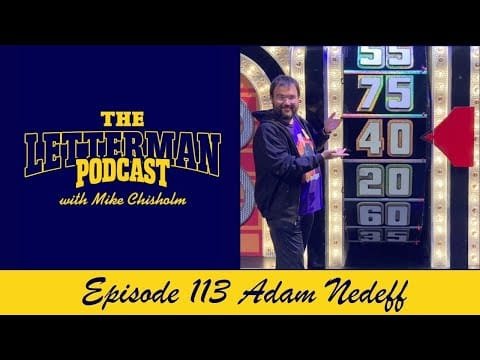
Get ready for a mammoth episode of The Letterman Podcast as we welcome game show historian Adam Nedeff to the mic for Episode 113. Join Mike as he and Adam embark on a deep dive into the captivating world of game shows, late-night television, and the intersection of both.
In this episode, Mike and Adam explore David Letterman’s fascinating history with game shows while breaking into show business in California. From his participation as a contestant to the potential of hosting, they delve into Letterman’s early connections to the genre and its impact on his career trajectory. They also unravel the layers of Merv Griffin’s influence on comedians through his talk show and game show developments.
As one of the top experts on game shows globally, Adam provides unparalleled insights into the history, evolution, and cultural significance of these beloved programs. From classic formats to iconic moments, they leave no stone unturned in their exploration.
Adam shares his meticulous deconstruction of all 540 photos in the final montage of the Late Show with David Letterman finale, offering a fascinating glimpse into the behind-the-scenes magic of late-night television.
And don’t forget to tune in for our sponsor shoutout: The Letterman Podcast is proudly sponsored by hello–deli.com, your premier destination for official Late Show with David Letterman merchandise, meticulously curated by Rupert Jee himself.
Episode Transcript
Read full transcript
I'm Steve Young you're watching the Letterman podcast welcome once again to the Letterman podcast my name is Mike Chisum uh I love today's episode I love all Mike you say you love all your episodes I do this is a lot of fun and I I just enjoy them they're like uh they're like little children 113 little children running around uh this is a cool one because you know we've talked about and if you've read any of the books about David Letterman early on in his um in his uh career after he left Indiana talking about uh his stints with game shows and and and we've got a guy on this episode here um his name is Adam nef and and Adam is he is a historian when it comes to the genre of game shows and I mean you're gonna listen to him and go holy smokes this is a guy world-class mind when it comes to uh the inner workings of of the history of all of the the little catacombs um that are nestled within the entire body of what game shows are uh are now were back in the day how they've gotten to where they are the stories the anecdotes within them and and this is a guy who is just he's a world-class mind when it comes to this stuff it's also a guy who if if for those of you who remember uh the very last Late Show with David Letterman ends with a very famous Montage we've talked about it a lot in this show there was a guy Who The Day After That Montage came out who actually took the Montage pulled the whole thing apart and wrote comments about many of the different pictures the 540 some odd pictures in that in that uh that that final Montage Adam's the guy that did that and he talks about the the history of how that happened we didn't go through the Montage in this episode that is another episode that's going to be coming up he's going to be coming back on the show and we're going to spend an entire episode going through the Montage uh that was that was so carefully assembled with love by Barbara gains Randy graic uh and and and others the people who who created that amazing amazing Montage the sum up of the body of work of David Letterman and Company up to that point in 2015 Adam's the guy that pulled that all apart but this episode here I wanted to talk about game shows because the the idea of of of uh talk shows and game shows actually do have a quite a few cross references um especially in the Modern Age I mean my goodness how many talk show hosts currently have been part of game shows in the in their past uh you know you look at Fallon he's doing it right now you look at a guy like Craig Ferguson who's gone and hosted a game show since his his talk show left Jimmy Kimmel came from the G game show world you know Win Ben Stein's Money And there are many other examples of that uh Adam and I certainly get into many of those in this episode and of course he talks a lot about David Letterman's time with game shows uh back in the late 70s early 80s um actually I think it is just late 70s and I think about it we talk about MV Griffin of course MV Griffin responsible for two of the most successful game shows of all time Jeopardy and Wheel of Fortune but also was a main stay for local Comics had his panel show that local Comics could go on every day lots of different little uh cross references it's a long fun episode it's a hangout episode uh just with a friend of the show I've wanted to have Adam on since the very very beginning of this and uh finally he and I could make our schedules uh to a place where where uh he could come on the show now if you want to find Adam on social media Facebook is the best spot I highly recommend following him he puts up funny stuff he puts up good stuff um so it's Adam knf NE D FF okay um and then also uh if you want to get any of his books he's uh the latest book that he wrote is just on the gong show it's just come out um and it's uh go to be b a r m n o r media.com beor media.com and you can find Adam's books there and uh he he does talks about that a little bit in the show but like I wanted to start the show by saying hey hit on over there check out Adam's books and um just we hope you enjoy this fun episode of the Letterman podcast uh with our ho with our very very special guest Adam Nev Adam I am so happy that you are here uh coming on the Letterman podcast there's a whole bunch of directions that we can go and will go with this episode and maybe even ones uh in the future um it is so cool that we can talk about uh the history of the game show and and and David Letterman AB absolutely has connections to that earlier on and so do many other comics and and and and celebrities uh the game show has such a unique place in entertainment history you might be the king of the Heap when it comes to knowledge about this stuff plus we've got the Montage thing I've talked about the Montage uh the final Letterman Montage that uh I can't wait I hope so badly to have Barbara gains and maybe Randy graic on and some other people um the day that that Montage or the day after that Montage came out you uh painstakingly uh you took it apart and and deconstructed the Montage and we can maybe go into that as well but either way uh you and I have been circling each other for a long time we've both been admirers of each other's uh work on on on social media for a long time Adam thank you for taking time out of your insane schedule to be on the Letterman podcast today well thank you very much I'm very very excited to be a part of this and I I remember at the very beginning of the podcast you asked if I could be on and I said oh sure sure sure and then you began building this guest list and I began seeing the people that you had on the show and I suddenly realized oh this guy doesn't need me anymore um so after everybody from the actual show who actually has something to say about working on the show and being on the show I I'm glad that you were able to Circle back around to me eventually you know what it's so fun how that that's kind of what happened like I had a whole bunch of folks because I mean you know we've said this before on the show but uh you know there's three types of guests that we have on the show obviously people who worked uh for some somehow some way for the company of David Letterman and Company that's that's one number two somebody who's been on the show was featured on the show that kind of a thing and then number three which is equally as important by the way are are folks in the community uh in the Letterman Enthusiast community and and that's all been important I thought first six months to a year of this show was going to be pretty much straight up community members and and it was GNA you know every once in a while we'd get a Steve O'Donnell or a Tom Reon or someone like that to come on then it just the torrent of of of um you know staff that came on I I'm surprised and delighted by it but no there is a a whole bunch of folks that I have wanted to have on the show I talk about that Montage so much it's one of the greatest moments in um you know when you talk about a crown jewel a way to end something that Montage to end the late show and late night run was worthy of the content it was absolutely incredible um when the Montage hit at what point did you make the decision that you were going to deconstruct the whole thing you know here's the funny thing this wasn't a grand plan I had this was a favor to one friend of mine um I have a very good friend uh back in West Virginia his name is Ernie Anderson and uh he is a disc jockey on cool hits radio in Ashland Kentucky so if you're in the Ashland area they also have a twitch Channel and they simoc cast the feed there so you can uh listen to and watch Ernie's radio show on uh uh on Twitch um but Ernie is also a letterman fan and the day after it aired he said you know it'd be really cool to be able to go frame by frame and see all the pictures that they had and I said I'm going to do this for Ernie so this was it was sincerely just a nice thing that I was going to do for a friend and so I posted all the screenshots and I posted what I knew for the screenshots that I knew about and it it's kind of funny how I was given I was given way more credit for what I did than what I actually did because I I think like what Rolling Stone and what all the Press said the next day was this hero Letterman fan has posted and contextualized every frame of it I didn't contextualize every frame there were Sports people and bands that I didn't recognize in the Montage so I was like um I'll come back to those later I'll I'll go ahead but I went ahead and I I took 540 screenshots of that montage I uploaded them onto Facebook and for the ones where I knew for sure what the context was I went ahead and put a thing about the context and it was just a favor for a friend for Ernie and then I had the next day off of work so I slept in uh that next morning and so I woke up late and I look at my phone and I just I have my I'm got dozens of text messages and I've got all kinds of Facebook alerts and messages like what what's happening and it's very strange to wake up and find out that a thing that you posted on Facebook at 11:00 p.m.
the night before has just been turned into an article on Rolling Stones website and Adam While You Were Sleeping the Press blew up and you're getting all kinds of attention right now um so like I said it wasn't this favor that I was doing to the fans or anything that I wanted to do to salute Letterman or anything it was seriously just a nice thing that I wanted to do for one friend and and people went kind of crazy for it um and it's part of this track record that I've developed over the past few years where every couple of years I accidentally get 15 minutes of fame for a while um I've never no just to go over this very very quickly I was I was in a segment on Conan uh right after he arrived on TBS because I was working at Madam tusos at the time and I was Conan's tour guide for his visit to Madam tusos and I got 15 minutes of fame from that there were people coming to the wax museum for months after that just to take a photo with me um so I had that for a while and then this thing happens with David letman and posting the Montage and I got 15 minutes of fame from that and then a few months later the first image came out of the new Mary that they were building for Steven coar now that he was moving into the theater yeah and I made a comment about it on Reddit and Steven colar apparently opened up an account on Reddit for the sole purpose of responding to the comment that I made and then that blew up in the news for a while and then a couple of years after that Betty White passes away and people find out hey this guy wrote a book about Betty White's husband and I went for that and sold a bunch of books so yeah I I've never been consistently famous in my life but every couple of years I do something by accident that gets me recognition for about a week that so fun like that is so fun um I I wantan I want to talk about Madame tuos for a second there because I mean you talking about museums and and and what you do now I want to get into that yeah here how long were you at Madam tuos and is this is the Hollywood Boulevard this is the this is the one on Hollywood Boulevard I was there from its opening day the one on Hollywood Boulevard that opened up in 2008 and I was there for uh8 years and then I got a job offer to work on a game show uh so I gave my notice and it's been very very nice uh game shows are kind of a gig based thing and I got this job offer to work on a game show for 11 weeks and I thought okay I'm going to go away for 11 weeks and then I'll come back to Madam tusos or whatever and it's just the jobs have kept coming so I haven't gone back I it was i l the people that I work with it was a great job but uh I came out here to work on game shows and I've been lucky enough to be able to do that for almost eight years now so I've been working in game shows for as long as I was at Madam tusos now and I want to get into the resume as to as as to what you are because before before we hit record here uh you know you kind of went through the resume and to me it's very very impressive um but but at the end of the day the histori the historian in you the game show Enthusiast in you um you know you were happy having fun at Madam tuos that kind of a thing safe to say that the love for game shows was there before and when you move to this gig it was a giant step up or game show shown up since then this was the entire reason that I moved out to California I was obsessed with game shows from the time that I was a baby uh the game show Phantom was just always there um and so after I finished College about two years after I finished College I moved out to Los Angeles for the purpose of working in game shows and breaking into the business isn't the easiest thing in the world I I had a couple of early shots I was a page at CBS uh for about six months and I also worked in the prize department for Wheel of Fortune and that lasted about six months but breaking in and staying in the game show business is a very difficult thing because it's very insulated um a friend of mine uses the term incestous I I don't want to use that word for it but it really it's a circle of people who know each other and people didn't know me and so uh after I got my 15 Minutes of Fame on Conan I decided okay I I can take advantage of that um I always had the idea in my my head that I wanted to write a book about game shows but okay now I have the opening that I can kind of borrow off this Fame that I got for this little segment on Conan uh and so I reached out to a publisher and I said I have this idea for a book about game shows and I laid out what the idea was and um I kind of plugged myself as hey I got a lot of attention from being on Conan so you know I'm barely famous go ahead and give me a book contract and it worked um so so not have worked so I got that should not have worked dude well I I I will say one of the things uh that happened probably more important than the Conan connection although that that didn't hurt um I happen to find a publisher uh I became aware of a publisher who published the kind of books that I wanted to write it's a company called bare Manor media Y and they are a small publisher but their whole thing is just chronicling the history of show business in all its forms so that's cool they were exactly the publisher to reach out for the example that I give everybody is when I first got my book when I got my first book published yep the other book that they had come out that month was a biography of Jay silver heels tto from The Lone Ranger and it's just wow who what Publishing Company yeah what publishing company in 2013 was going to publish a book about J silver heels but they did and that's that's what they specialize in their whole thing is the history of Show Business um so I started writing books the first was General history of game shows called this day in game show history which was a four volume set and uh my elevator pit for it at the time was if you're familiar with Uncle John's bathroom reader I wanted to write Uncle John's bathroom reader for game show fans it's a collection of short essays about the history of game shows and then from there I began writing biographies of the hosts uh I wrote a biography of Bill Cullen who is somebody we can revisit if we're going to be talking about David Lan's career uh Gene Raburn the host of the match game uh Alan Len who I feel like we're going to be talking about a lot by the time we're done here uh mty Hall Dennis James who was basically the first game show host Dennis James was the host of the first Network game show when Network broadcasting became a thing in 1946 and also relevant to your interest because uh I know you've mentioned a few times being a wrestling fan and Dennis James was the first pro wrestling play-by-play guy on television wow um and uh game shows FAQ which was another General history of the game show genre and I always say that's kind of my entry-level course that's your 101 class in game show history if you're looking to buy one book about game shows um and not only did that lead to me working full time in game shows because mission accomplished what ended up happening was my name did become known and my books were obtained by the people who work in the game show business and do the hiring and so I got a job offer from somebody who was familiar with me and uh gave me that chance on a show called idiot test Aaron Solomon is his name and bless him for it um and that's uh how I broke in and that's how I managed to stay in so I've been doing this work for the past eight years uh working full-time in game shows and for the longest time I overthought how to explain what I do in game shows and then I found out my roommate talked about me at a social Gathering and she I said so what did you tell people about me and it turns out my roommate had an amazingly simplified way of describing what it was I do and I I realized you know I really did put too much thought into trying to explain what I did I I my roommate said here's how I explain who you are uh when I meet Folks at party she says have you ever watched a game show where a contestant gives kind of an iffy answer to the question and the host turns around and says I need ruling from our judges on that she says that's my roommate my roommate is judges so yeah after all well I research I research the questions and I verify and I look for issues with other with also accepts and blah blah blah as it turns out no no no that's my job I'm judges I'm that guy at the game show taping so that's my job um now like I mean okay so you're sitting there okay let's let's let's do an example of a game show that you have done this recently let's just throw one out there really to to throw what the judging part okay yeah uh so uh masterminds was a show that I've done for a long time for Game Show Network uh we've done uh six seasons of that I think total and just an example of what my job is um a question that comes to mind and I can I can say this because we used the question it would be a problem if I described a question that hasn't been played yet but we used this one and what the writer originally wrote was and I'm doing this from memory so I apolog I may even screw up the question as I'm doing this from memory but the writer wrote the question uh what type of auto racing is named for the list of rules that the drivers must adhere to and the answer was Formula 1 racing y now I don't know much about sports but what I dug into and what I found out was there's not just Formula One racing there's Formula 2 racing Formula 3 racing formula and they're it's all the same idea they're all named for the list of rules I would have assumed if I had never read this trivia question and not being a sports guy I always figured Formula 1 referred to like whatever whatever gasoline they're using in the in the car or something like that yeah but no formula refers to the list of rules so I looked into this and I realized oh wow formula there are lots of different formulas that they that this could be referring to so we set it back and we said okay there's a problem there's a lot of different formulas so there are a bunch of different answers that a contestant could give to this and on some shows that's okay but there's also this level of thinking that you don't want a question to have another correct answer because that's a courtesy to your audience one of the things that people get that fix from I knew the correct answer I the corre dopamine hit exactly yeah um so like for example if you're asking the trivia question what president was born in Virginia you know the contestant the viewer at home is saying Thomas Jefferson Thomas Jefferson is the answer Thomas Jefferson and the viewer uh is seeing the contestant say the answer is George Washington poost says correct and the viewer at home is thinking well yeah but Thomas Jefferson was correct too I would have been correct too you want to lock that question down enough so that the the thing that the viewer at home is shouting at their TV is the answer that they'll hear on the screen because like you said dopamine headit so that's the reason you want to lock down what the question is for that reason um you sitting so I want to know the so on Mastermind are you sitting there kind of like uh you know a producer would on Letterman or something like that with a clipboard and you're just sitting there and you're you're going through all the questions uh as they as you go through them and then and then you're an assistant basically if necessary basically the the way the television production and game show production especially has changed over the years because Jeopardy still works this way for example but it used to be game shows had a day in the studio every week and then the rest of the week was office days the way a lot of game shows work now the way that uh our game shows work uh when you're doing a show for Game Show Network is you do eight weeks of question preparation yeah and you're just building and building and building piles of material we call each game a stack You're Building stacks of games if you're doing 65 episodes you bu build 66 Stacks 66 70 um and there's a reason that you have extras which I'll explain in a little bit um but then what you have on the taping day is you decide what five games you're going to play that day and as I'm watching the taping I'm watching the game and I've got this list of all the questions we're going to play and the order we're going to play them Y and I have a list of correct answers I have a list of also accepts which are the things that they could say instead like for example if the correct answer is like a chemical compound we'll say not just the common name of that chemical compound but we'll have the like the nac3 or whatever n for T table salt or table salt yeah I gotcha got uh so we'll have also accepts like that and we'll also have what we call DNA which are do not accept so things that we thought of that we looked into and it turns out yes this is definitely wrong if a contestant says that and it's answers that we try to anticipate that they're going to give um and as much as you try to every now and then I contestant will say something that just gives everybody pause and it's the it's the sweatiest experience if you're a game show fact Checker like I am because what happens is everybody kind of turns to you and says what are we gonna do with that Adam we're gonna stop tape for a minute and a half hold on and so I mean you just you just you very very quickly Google around and you look for some kind of information and you just this is one of the things that you have to be careful for Googling around sounds like you're not really giving a lot of careful but that's the next thing that you have to do is you around and you consider the source of the results that Google is bringing up for you and you try to figure out okay can we use that can we use that and we also have a few books that we draw from and we have a few specific sources of information that we get things from um but uh yeah that's that's the job there now to finish the point that I was making earlier about Formula 1 so in the case of that specific question okay uh what style of auto racing is named for the list of rules that they have to adhere to and we find out there's a slew of also accepts so what we did was we re wrote the question to with such races as the Monaco Grand Prix what style of auto racing is known for because now okay you have this one fact that applies to all kinds of auto racing right but Monaco Grand Prix is one specific thing that's Formula One and it's not anything else so Formula 2 Formula 3 all those suddenly become wrong because we've specified a race in there so that's the idea um you do learn a lot of things from the job uh just from writing all these questions and researching them and factchecking them uh one of the things that we discovered uh one of the first questions I ever had to research was what sport uses a shuttlecock a piece of equipment called a shuttlecock um and tricket right what is cricket uh badminton oh it's badminton God damn it all right yeah 99% of contestants here hear that question would say oh that's badminton what we found out in question research what I specifically found out because I was the one assigned to research it was the list of sports that use something called a shuttlecock is shockingly long I think I ended up coming up with like 12 or 13 different answers to this question holy smoke so we ended up having to do a major rewrite to it um and I bet you Cricket wasn't one of them either yeah no um so that's my job and it actually oh my gosh yeah and so that actually is the nature of it is you just spend eight straight weeks going through trivia question after trivia question after trivia question trying to pick them apart looking for nitpicks that the contestants can make looking for any kinds of issues that may come up and making sure that everyone is just tightly secured and tightly written so that it can only be one possible correct answer and then once we're in the studio I'm the guy sitting at the other edge of the stage to make the really tough decisions if a contestant gives an answer that's not exactly what we had in mind unbelievable um you bring up so many other questions and we will get to Letterman everybody but hey I'm fascinated by this it's a rabbit hole I want to go down um and and and uh and it's our show so we're going to do whatever we want um okay so talk about the culture of questions for each game show like I mean and I mean it's it's like how English has so many different dialects in the different places around the world that speak English that that that are English speaking countries that you go to the variations um there must be a culture for the different types of questions depending on the show and and and I mean it feels like you're a guy that could really go deep on that subject as well is that uh am I accur on think that um no there there is there are styles of question writing there are different types of shows that want different types of approaches you have shows like uh the Chase and shows like Jeopardy which are heavy Academia with a dose of Pop Culture uh or for example there's another show that I'm I there's another show that I've worked on that I can't really give the title of yet but it was pretty much the opposite where it was heavy on pop culture with just a little bit of Academia right um and it just depends on what the producers want the show to be what we want the identity of the show to be what the what kind of the purpose and the selling point of the show is um and there are lots of different approaches and philosophies about why certain shows should have a certain type of question um like for example one one theory that I've heard and this is true of a lot of shows is if it's a show like Jeopardy where the idea is that it's just straight trivia you can get away with having hard questions for that but if it's a show where the correct answer allows you the chance to do a thing like if you give a correct answer you get a choice of one of the playing cards or something like that if it's a show like that you want the material to skew easy because if it's a show where the question allows you the chance to do something and you go for a minute to a minute and a half and that thing hasn't happened it becomes kind of tough to watch um you're watching for that action and the question is how you get to that action so like a show like high rollers where correct answer gives you the chance to roll the dice and try to knock the numbers off the board you want those questions to be easy because you want those dice to be rolling you want to see the contestants having to make those decisions with the numbers um so a show like that you want to skew easy material if you're all about the trivia and the challenge and just look at how smart these people are go nuts with your trivia material go nuts with finding all kinds of stuff and uh trying to challenge and trying to get new information to people um one of the fun things about the job is every now and then you you really do stumble upon things that you didn't know before and you uh my job is not to write the questions my job is to fact check what other people have written but there have been a few times where I've kind of flagged the head writer on questions and said hey I just found something really interesting that I've never heard on a trivia show before and I think this would make a great question and I'll give you an example of this yeah um somebody had written a question about the R Brothers and in researching the R Brothers I came across this biography and I found out the wri brothers years before they built their first airplane published a newspaper for the black community in Dayton Ohio um it was either Wilbur or Orville had a black friend who was a writer and an aspiring writer and he was kind of lenting to one of the wri brothers that there's really no forum for black writers to get published because it's the late 1800s in America yeah and so wil in Orville basically just set up a printing press and said okay we're going to start a newspaper for the black community in Dayton and we're going to call it the tler and you're going to be W the writing staff you're we're going to go ahead and St so Wilbur and Orville what yeah Wilbur and Orville published a newspaper for the black community in datton Ohio and then went on to get the first airplane off the ground great flight yeah yeah so I flagged out my and I said did you know this about the R Brothers and he saw the fact that I was looking at and he said no I didn't know that and he said so we made it the $10,000 bonus question for a taping of masterminds because he was so delighted by the fun fact he's like we have to use that on a show oh that's fantastic yeah oh that's really cool okay so and and then I I'm curious as to the um you know why ladybugs are called ladybugs no why there there was uh an infestation of a um basically a predatory group of insects uh on uh farms in I believe Mexico I want to say me uh Mexico uh it was a Spanish speaking country and that's relevant to a thing um but uh they began saying a prayer to the Virgin Mary uh to send something that would get rid of all these insects that were eating the crops and a swarm of red and black beetles begin showing up and eating all of these insects while not touching the plants that were being destroyed in the crop and because the Virgin Mary was depicted in red and black artwork in this in red and black uh in the artwork in this part of the world uh the farmers began referring to these as the Beatles of our Lady which turned into ladybug so there's another thing that I learned from fact checking a question about ladybugs it was completely unrelated from what we were asking about ladybugs and I was like that's amazing so so you're you're okay I always have something to tell people at parties now oh you you're just you took the words right out of my mouth Adam like yeah it's like Okay so we've got um you know the the the the inside almost Arcane if not so fascinating knowledge that you have about game shows but a part of that also has to be the Arcane if if it would be Arcane if fascinating little facts about everything in life and you have this mind that just keeps them all um I gotta say I tip my cap to you sir I mean I can I can certainly relate um not nearly as broadly as you but like I mean I got a like you know when I get some of the some of the Letterman folks saying to me hey I can't believe you remember that or did you how did you know that or like that is a good little feeling right there to a very small slice of of of specific po culture that's the tricky thing I I appreciate the praise but what I always point out to people is the mind that I have is equipped only for the work that I'm doing and nothing else like if I apply for an executive position at Starbucks what do I say in that so Mr neiff what exactly can you bring to the table if you're vice president of marketing for Starbucks well you see Farmers set a prayer and then the ladybug showed up and that's why they're called ladybugs have you ever done standup Adam I bet you'd be great at it I did I did stand up three times and uh why did I do stand up why would you why do you do it for any reason I was trying to impress a woman that I like sure of course yep and I I will say I didn't bomb um but yeah it went well the three times I did standup but also I I didn't realize and this was kind of a lesson that I learned from being around her while she was trying to do it was uh people don't realize what a grind it is when you're first starting out in standup yeah um because they kind of the clubs kind of expect you to bring the audience uh which is a weird bit of pressure yeah and yeah there's just there's a lot to break in there and I was I just very early on I decided okay it would be cool to make a career out of this but I do not have the patience for this ah yeah yeah yeah I get gotta I get you um you pick out four ladybug facts and you got four bits there that you could do four stories that you just pepper little things in that's endlessly fascinating um I got to ask a question so so now we've got game shows that are like um you know game Centric and you got game shows that are like you said trivia kind of centric that sort of thing over the history of uh of of the game show genre I would think that more heavily weighted on the trivia side of things than the actual games correct I would say it's the opposite um I think what happened there is as a result of and you probably know the story the quiz show scandals in the 1950s yes sir and you saw a hard Q&A go away for quite a while and that gave birth to shows like pass and shows like video village where the contestants were na navigating a giant game board on the stage um shows like that where it was mostly game with some knowledge element to it um and people like that and also I think I think Jeopardy casts such a Giant Shadow that I feel like I suspect there are people in the TV business to some extent who look at Jeopardy and say that's our hard trivia show right we don't need another one we're good that that's we have Jeopardy let's do something else with our show uh and it's it's rare to see that in a field where let's face a television as an area where success breeds imitation but I I really do I really do feel like Jeopardy has this reputation of sorts where people look at it and say that's the hard quiz show we're going to do something else when we develop our game show yeah yeah looking at um Ellen and Fallon um and what they've done in the last I mean Call It Whatever 10 15 years or or or whatnot um I guess for you you see something like that and you're like oh my my genre that I love so much is alive and well uh would you say that the that the genre is you know it's got their own network as you you mentioned they've got uh not just their own network but I mean we've we're in this era now with fast channels and we have 24hour channels dedicated to reruns of specific shows we have a 24-hour Wheel of Fortune channel on a 24-hour Jeopardy channel on a 24-hour prices right Let's Make a Deal Family Feud has its own 24-hour channel so you have all of those plus the general Game Show Network and buzzer uh and you're seeing Prime Time television depending on game shows in a way that they never had before and we have more Primetime games than ever um as everyone is trying to navigate whatever it is that television is turning into in the next decade and we know we don't know what it is but we know that the next 10 years are going to be a hell of a time for the TV business we're trying to figure out what it's going to be but as they're trying to gain those bear get their bearings about that you're seeing the networks kind of turn to game shows as something to put on the a in prime time um and in many cases doing not just well but unusually well surprisingly well compared to what else is offered on Prime Time television at this point um so the genre still exists the genre survives the genre thrives uh and there's a bright future for it I hope and you've just kind of touched on something interesting uh about the genre in the last few years you're seeing Jimmy Fallon doing game show segments on The Tonight Show which is you can't do a talk show that's that's got game show elements or Ellen doing the same thing and meanwhile uh down in Chile you've got sabido higante which did that for 53 years before suddenly American television looked at it and realized wait wait you can do a show that's both and so now honestly Yeah it's you're seeing Jimmy and Ellen doing something that somebody already figured out in another country in another language is you can do a show that has talk show and game show elements and make it a pure true variety show um and bit of Americana in there as well because you get the every man or the Every Woman as a contestant interacting with the celebrity in the setting of A game show you're kind of it's a Melting Pot of of of many of the things that people tune into these things for all into one yeah and that that is one of the great things is when you when you have a contestant coordinator who is able to find people from all different walks of life it is very gratified to watch a game show and watch three people who would never ever be in the same room together otherwise and bring them together for this common purpose and you know have them rooting for each other have them competing against each other have all three of them having a good time together and it's it's a warm fuzzy feeling about my business um before okay so so uh the contestant coordinator and the uh the idea of of celebrities being a part of of this stuff perfect segue to go back to the Letterman of it all and and to talk about that time in game shows um that time period in game shows but before we do let's talk about your books Let's talk about because the latest one let's go into that one and and and talk about that because you're about you're you're on a on a book tour for this right you're actually gonna like is this the biggest book you've ever released or you know so far it is I can't really give you uh it's gong this book now on sale uh at uh finer websites everywhere um it's uh it's a wonderful history of The Gong Show uh with interviews with the people who were involved in it people who worked on the show people who were contestants on the show um I spent about 5 years tracking down contact information of people that appeared to have been contestants on the show and I would just cold call them and say hey my name is Adam NE if I'm writing this book were you a contestant on The Gong Show in 1977 and there would just be this hesitance of yeah hi I'm here to dig up this thing that you haven't talked about in 45 years do you have a moment so a few of those phone calls Adam I I know where you're coming from I I know the I know the pause that you're talking about oh uh just getting to chat with these folks yeah getting to talk to uh count banjola about his experience as a banjo playing Vampire on The Gong Show and just just the fact that nobody had ever reached out to him for an interview kind of stopped him in his tracks when I called him uh I yeah I sent out emails to I want to say maybe a 100 contestants and some of them got no response uh I heard back from a few and without disclosing an identity I I got one email from some basically saying it's a carefully guarded secret that I was ever on the gong show please do not put my name in your book or mention that like there there was one person who was definitely embarrassed and it was like I was asking about their their past and porn from the way that they reacted to this but yeah um but uh yeah and it was it was great talking to the staff at Chuck bars Productions um Chuck is a guy that did not get a great amount of regard or respect uh during during his life or during his career uh people considered his shows trash people considered his shows offensive and you look at what he did and a lot of it is a precursor to what we have on television now not just you know the dating game gave birth to so many dating shows the newly W game kind of showed the world that you can actually get an audience by getting married couples to open up about their secrets and just let it all hang out on National Television a reality television for sure there's no question to me in my mind about that and there's and then there's the gong show which wasn't exactly an original because there was a show that was a precursor to The Gong Show major Bose's uh Amateur hour on radio in the 1930s which was the show where Frank Sinatra Got discovered and it was exactly the same thing it was the it was the host in charge of the gong but the host would Bang a Gong a Gong if he wasn't impressed with the contestants um and so truck simply revitalized this idea but he put such a distinctive stamp on it and gave it such an identity and as much as may not have been the innovator in that concept I think it was certainly the show that led to America's God Talent American Idol X Factor that realm of television shows yep uh without a doubt uh um have you have you had some good Adventures because of this book like I love I love the uh the uncertain uh stuff that happens when we do things like this like like the things that you'd never ever ever would call happening and you're like oh my goodness this led to that what are some a couple of things that happened to you because of this book yeah um in putting together the book uh it was a matter of hunting people down and getting a chance to talk to them and one of the great things I discovered was so many of these people who were contestants on The Gong Show in 1976 or 77 7879 so many of them one way or another are still performing they're whether it's gigs at coffee houses or just you know at a county fair or something a lot of them are still actively performing in some way and so I reached out to a guy named Michael Sherman uh AKA Mike the vik whose act on the gong show was he wore a Viking helmet and Groucho glasses and he lips sync to a song while reacting in Terror to rubber snake that he was holding in his hand um I promise he what's funnier than what one guy can describe um but uh I reached out to him and I said can I interview and he we were figuring out a time and he says yeah uh come to this nursing home because I have a gig at this nursing home on Monday uh and come interview and he he does Impressions and it's since it's a nursing home he has it very tailored to the audience he was doing you know George Burns and Jack Benny Impressions and just all these old show business Legends for this nursing home audience and so he did the set and I came up and introduced him introduced myself when it was over because we had only talked by phone and he says oh oh hold on come up onto the stage because the audience hadn't left yet and he says ladies and gentlemen this is Adam he's a young man who's writing a book about the history of The Gong Show and this 90-year-old man in a wheelchair in the front row waves his hand and says I was on the gong show so and so I go down there and I said oh you were on the gong show what's and he says my name is Nikolai but when I was on the show my name was Captain hoppy I was a clown and I did a dance in Moon shoes and I said how did you end up on the show and Nikolai begins going into his whole life story he was an immigrant from Russia and he moved here in the 1950s and he had like he became aware that detectives were trailing him for the first few months there because they were incredibly suspicious of this Russian immigrant who just suddenly showed up in America and was was wandering through the country but the interesting thing was he had been an orphan in Russia uh and he had grown up in the 1930s raised by Americans in the section of Moscow that was called America town because a lot of Americans had moved to Russia after the stock market crash in 1929 so there was an American immigrant section in Moscow and he said he had grown up there and so he moved to America uh in the 1950s I think and by the 1970s he was working as a janitor at UCLA and Chuck Baris was on the campus of UCLA one day and they began having a chat and I think Nikolai was like a clown at Children's birthday parties or something on the weekends it was it he it was like some kind of s side gig for him being a clown and Chuck said well then you ought to be on the show and that was the kind of story that I loved was what really got me about this was nobody's story of being on the gong show was just I called up and said I have this IDE for an act I want to audition everybody had this zany series of Misadventures that led to them being contestants on the show and so it was great sitting down and hearing all these stories about here's what happened to me and here are all the events in my life that led to me being on the gong show for 2 minutes in 1977 everybody had a unique journey to that show um my favorite story contestants were on that show um they usually did nine per taping nine I was to say there's a lot like that's a hungry be the gong show is a hungry Beast a lot of them and among the people that I got to talk to um for the book were Chuck's chuck had cute nicknames for a lot of his employees and the people that I interviewed among others were Chuck's shock troops and the shock troops were the three employees who were in charge of the contestant audition for The Gong Show and Chuck called them the shock troops because they saw everything I bet they did yeah um and one of them had a mind-blowing statistic which was for every one act that made it on the show they rejected nine so if there are nine acts on the gong show that means 81 got rejected for that and if you watch an episode of The Gong Show and you see those nine acts and you just process these nine Acts were better than the 81 that they said no to there's a lot to take in about that you we're gonna go to your favorite moment I want to get to that in a second but but you've touched on something here that I um I find uh fascinating and I have also seen it very recently so we just had our first stupid human trick contestant on the Letterman podcast Chris Clark great guy and he has led me to two or three other folks who have been uh who were featured in stupid human tricks on on on one of Letterman's incarnations and the thing that I love and and and you touched on it earlier and I just I I love it so much it just it's so charming and adorable is many times these people are still performing on a regional level at nursing home at school assemblies at different different things at at local car shows things like that they are still they just so badly want to perform and love it and get that charge that feeling from it and when you just talk to them about this stuff they light up like a Christmas tree and it's it's such a a delight to them um it makes so much sense that a lot of the people that you talked uh to uh you know in in in the prep for this book feel the same way I love that I I I love it when people are chasing a dream I just it's a great feeling I'm one myself uh I feel like I'm in present company included like you know it's really cool to watch people chase a passion that they have and and to see whatever level of success that looks like but just to see them doing it and being able to exercise that it's such a great feeling I just adore it well I think and we touched earlier about being uh wrestling fans and you know it it's surprising to think of the number of wrestlers from when I was a kid who were still at it somewhere in high school gyms and it's the same sitation there I it's not Financial insecurity but I think it's just that matter of when you have a job that involves getting 2,000 people in a room to react to you that's got to be a hard thing to walk away from so you just keep chasing that and chasing that as long as your body will allow you to do it um and that's got to be a good feeling um what I was about to say my favorite story from yeah assembling this book uh again uh the banjo playing Vampire count banola um he uh he's in his 60s now and he had gotten married only fairly recently just in the last few years when I first interviewed him um and he started dating his now wife when they were in their late 50s Y and so they were chatting and you know when you when you begin seeing somebody in in your late 50s there's a lot of stuff to discuss and somehow the conversation came up of stories from our past what's something in our past that we should probably tell each other about what's something that we don't know yet and he kind of as if revealing a big secret he says okay you need to know this I was a contestant on The Gong Show back in the 1970s I was a banjo playing Vampire and he said his girlfriend now wife kind of rolls his ey rolls her eyes at him and she says I know and he says wait how do you know that and she says you don't remember me I was there with my mother who was one of the other contestants that day and I kind of crushed on you and I never forgot you are you kidding me Miss count banjola is the all-time grand champion of playing the long game she she was 19 years old she got a huge crush on this guy who was dressed as a banjo playing Vampire never forgot him and they ended up getting married decades later what the hell went through his mind when she told him that like that is just oh that's spectacular um okay let's go to another part of the uh of game shows I think about Hollywood Squares growing up yeah um I think of John Davidson I think of Jim j Bullock I think of Joan Rivers Shadow you and I are the same generation because yeah it's you you don't think of Peter Marshall you think of John Davidson I think of John Davidson yes absolutely and and uh uh I don't I think you know Darren Cox I think you were on were you on irritable n syndrome yeah okay so so he's had Shadow Stevens on and I mean I've been you know voraciously jealous about that since then because I want to have him on talk about Late Late Show but also because I want to talk to about like Hollywood Square so I got a question for you about that because watching Hollywood Squares as a kid you'd think every single one of the people who were panelists on that show in whatever Square they were in might have been comedians because every time a line came up they had a they had a you know it's like a setting the volleyball okay they got a spike that kind of a thing um how much were writers how much did writers have to do with uh game shows throughout the years in trying to make more entertain to create uh to create lines for either contestants or people who are involved in the show yeah uh the Hollywood Squares what you're describing there are the zingers which was on Hollywood Squares very often the question was followed by a joke answer and then they would give the real answer um and actually one of the things that's been entrusted to us at the Museum project that that I'm working on that we can certainly talk about later if not on another podcast because this one could very well run six hours um so here's what happened um NBC uh put together this legal document about 800 pages in 1968 and I believe what happened just from reading the things in this legal document was they had an absolute disaster of a day with a show called PDQ which was a game that involved uh soundproof isolation booth for the contestants and something glitched and from what I can gather reading this legal document uh basically none of the games played out fairly because of this glitch with isolation booths which led to this legal team putting together this huge huge monstrous book of how all the game shows are put together how they go about preventing cheating and how they atone for it if anything goes bad with taping yeah and so there's a section in this book about Hollywood Squares and how Hollywood Squares was put together because several celebrities who were on the show in its first few years sent concerned letters to the network saying you know before the taping started we were pulled aside and we were told what kind of questions we'd be asking the next show and told what kind of answers we want we might want to give y um and we don't know if that's okay or if it's normal for game shows because again this is a decade after the quiz show scandals right so they went to Merl heater and Bob Quigley who were the bosses of Hollywood Squares the co-creators of the show and the executive producers and asked them hey are you giving the celebrities information in advance about the questions and heer Quigley responded with this notorized docu and it's part of this 800 page book that we have at the museum that we're trying to turn into PDF so we can share it but they wrote this notorized uh form with a an attorney overseeing it and they explained yes we tell the celebrities the questions they're going to get in advance on Hollywood Squares and here's why we do that um first of all it's not the contestants don't earn X's and O's by the celebrities giving right or wrong answers the mechanism of Hollywood Squares is after the celebrities have given their their correct their answer the contestant must decide if they believe that answer or not believe it and agreeing or disagreeing correctly is how they earn the square so it fundamentally doesn't matter if we give the cont if we give the celebrities answers because it's still up to the contestants to make that decision so that's the first point they made yeah the second point they want to make is okay the contestants have to decide if they believe the answer that the the celebrities are giving or if they think it's a wrong answer right if we ask these cont if we ask these celebrities a question they've never heard before on the air and they sit there and think um uh uh and they sit there for 45 minutes for 45 seconds going uh um I'm gonna say the answer is France sure well the amount of time they spent thinking about it kind of tips off they're pulling this answer out of thin air probably say I disagree yeah yeah yeah so on the other hand what Hollywood Squares does is they pull the celebrities aside and they say okay you're going to be asked a question about a country in Europe here's a funny answer you can give and if you don't know what the correct answer is just say France right so now when it goes on the air Peter Marshall asks the question and the celebrity goes France and now it's a dilemma for the contestants because they don't know if they've actually if they actually know this correct answer if that's a bluff they said that's why we give the contestants that's why we give the celebrities information in advance um so yeah Hollywood Squares did that and they did have a team of writers that put together the joke answers for you you you took the took the words right out of my mouth so are we talking comedy is this is this a gig that aspiring comedy writers would have had back in the day uh that they would go and write for a game show was that a gig that was available for a comedy writer back in the day oh yeah uh definitely were and there were shows that did employ professional comedy writers um uh Match Game uh one of the other famous comedy games show from that era had uh several professional comedy writers writing the questions including among them dick D Baro and writing the questions for Match Game was always his Moonlighting job his actual job was he was a writer for Mad Magazine wow um so the perfect guy to write questions for Match Game uh Hollywood Squares had a team of multiple joke writers and question writers and they were writing the same things they were writing the questions and the jokes um and the celebrities got this pre-show briefing and one of the great things in this book was it transcribed the pre-show briefing that they got and that's where we got the example that I just gave you um but the celebrities would be briefed and this was the important thing the only celebrities that got jokes in advance on Hollywood Squares were the ones who had comedic backgrounds they would never if they had like a soap opera actor or if they had like George C Scott was uh on the show one week and it's impossible to imagine George C Scott on a game show but he did Hollywood Squares once and like for example they did they didn't feed jokes to him they gave him the hear the questions and hear some possible Bluff answers but they didn't give George C Scott jokes because George C Scott isn't a comic right and basically the logic was we don't feed comedy lines to people who don't have experience delivering them got um so that made the people who did have comedic backgrounds come off brilliant because not only were they getting these great lines on Hollywood Squares but they had the right way to deliver them um and you know it it's very funny that they had this disclaimer at the end of the show where they basically said we've it was just a wall of legal ease but the gist of it was the celebrities were given this stuff in advance um but all of them got these reputations for being Master ad libers for delivering the lines that they were given in advance Paul ly actually said that I think in a People magazine profile that he was blown away that people thought he was genous with adbs and he said no I I need a script I need those jokes for Hollywood Squares um and in fact they had a disaster of a taping once I learned this from one of the writers uh Harry Freedman who went on to become the executive producer of Wheel of Fortune and Jeopardy for about 25 years uh there was a day where Paul Lind bungled the order of the jokes he was going to give he went on he went on stage thinking okay they given me lines for four questions that I might be asked during the show and basically he gave he gave joke number two for question number one and then joke number four for question number two so all of the jokes just got just total death and he was mad at the writers he was like the writers gave me bad lines and they had to explain to him no you screwed up you gave you made two jokes in a row that didn't make sense so oh that's fantastic that's oh you talk about Letterman Letterman would have pounced on that he would have just loved to have seen something like that now uh fun fact uh Paul Lyn was with the show as a regular panelist for 12 years 1967 to 79 Paul ly left Hollywood Squares in 1979 do you know who the Center Square was for the first week that Paul Lind wasn't there no sir our pal Dave there it is there d letter was the center Square when Paul Lon quit Hollywood Squares and now we're now it's a perfect segue we've talked about we've talked about this let's talk about David Letterman's um background when it came to game shows you know he jumps in the truck uh famously from move moves from Indiana to California the idea is uh you know maybe I have an agent out there maybe I don't I think I know somebody but either way I know that I'm going to The Comedy Store because Johnny talks about The Comedy Store all the time on The Tonight Show I'm gonna go and integrate myself into that world and he tells everybody he's going to be a maybe a writer um spends his time doing St stand up uh writing for certain people like Jimmy Walker and and and a couple other things as well uh the project on the the the the short lived Mary Tyler more variety show but also lots of game show stuff lots of game show stuff uh Dave has indicated uh over the years that he was a game show fan when he was a kid um I I believe that the two of us would be the very worst per people for him to be seated next to on an airplane because oh yeah he's indicated that he was at least to some extent a wrestling fan fan when he was a kid yeah big time wrestling absolutely and he's also me he's made a couple of references over the years uh to early game shows from television that lead me to think that he was watching a lot of game shows when I when he was a kid um because he's mentioned uh he's talked about Gary Moore he's made references to Dr IQ uh which was a popular game show in the 1950s and then there was a game show host in the 1950s much longer career than that he hosted shows through the 1980s his name was Jack Nars and I'm uh friends with his son David now and David heard uh David Nars heard Dave Letterman telling an anecdote on the air one night and he said you know he said it in a jokey way but I'm I've always wondered if Dave was serious about this Dave told an anecdote on the show one night about a family vacation to New York and gathering at the theater exit to see Jack Nars walk to his car and it sounded like a joke but he like Dave told the story about shaking Jack nars's hand or something like that it's like you know did my dad shake hands with 10-year-old David Letterman when Dave was on a trip to New York or something like that and uh I think in uh one of the Letterman biographies out there one of the stories told was Dave went to New York for a college trip when he was like 20 yeah and the whole group was all excited about what sites are we going to see in New York are we going to go to the Statue of Liberty let's go on a tour of the Empire State Building or Chrysler Building Dave wanted to see the match game yeah like that was the only thing he cared about he went to a taping of the match game at 30 Rock um so so yeah Dave was a game show fan and the early break that he got in his career as much credit as Johnny gets for giving Dave his big break and that is a deserved bit of credit for sure Johnny does not get the credit for discovering Dave the credit for discovering Dave goes to Alan Len the host of password this guy um the password is um Alan Len was in Indianapolis in 1974 for they've never in hearing the story it's never been clear why Allen was in Indianapolis I suspect he was there on a promotional tour for password Allstar because they were doing this big thing in 1974 where they were Reinventing the format of password and it was going to be this thing where six celebrities every week played the game for charity and it was going to be called password Allstars and I'm guessing he was there as part of a publicity Blitz for password all stars but Allan agreed to give an interview on David Letterman's talk radio show uh as long as he was in town and Dave introduced him by making some kind of joke about Allen was there to uh dedicate the entrance to the new Allen Len wax museum that was opening up in Indianapolis and that Allan did kind of a double take there and uh so he has love so much I love Dave so that is fantastic 74 on his radio show that's what he does that is yeah perfect and Y he really kind of catches alen's attention with how witty he is and how engaging he is and you know Allan the daytime Network TV star from Los Angeles is kind of expecting yeah I'll I'll come in and do an appearance with the local guy but Allan was just really struck by how entertaining this guy on the am talk radio station was so after the interview was over Allan asked Dave so what are your plans for the future and Dave confides and alen Len I'm thinking about moving to California the next year and trying standup and Allan gave him some contact info and says if you make that move get in touch with me and Dave made the move and saved that contact information and Alan Len remembered him and Allan got him some early gigs doing this was a time when game show production was alive and well and very productive because all three networks had just wall toall game shows and also syndication was thriving there were a lot of syndicated shows and so a lot of new ideas were in development from people trying to get on that gravy train and Allan got Dave a lot of gigs uh in what were called run throughs which were before you do the pilot stage you assemble Executives and a few other people in an office and you play the game just to demonstrate what the game is and you don't want to Shell out you don't want to Shell out $1,000 for George Kennedy and Eva Gore to come down to the office and play your game so basically they had comedians come in because comedians were witty and off the cuff and could function in that role that you want celebrities for and these comedians who worked for Far Far cheaper would come in and play the role of celebrity guest for this run through while everybody got a sense of how this game was played and how would look on television and if it was worth pursuing yeah so he got bookings there and as Dave built more of a more of a reputation for standup and built more of and more of a resume Allen had grounds for getting him on camera gigs uh Allen hosted a pilot produced by Bob Eubanks uh from the newly W game Bob Eubanks opened up his own independent production company and came up with a game show format called the smart Alex um which was as as funny as it sounds it was a very early form of Shark Tank it was the same idea people came on with their inventions and a group of three judges would discuss how much financing give them and David Letterman was one of these sharks on this nent form of Shark Tank um where we'd kind of basically all over the inventions and then say Okay fund it anyway well we we'll we'll give you $500 to develop it yeah um and so it's it's not it may have worked who knows we certainly see that there's an audience for Shark Tank now um so the pilot never aired but it's one of those things that's gotten out there in this era where everything is shared on YouTube um and Dave is very engaging and very funny and the next thing that Allen does is he's hosting a show in syndication called Liars club and he gets Dave booked on Liars Club honestly quite frequently and I would say if you're familiar with your 70s game shows this analogy will make a lot of sense but it seems to me that Allen Lon was trying to turn Dave into the Richard Dawson of liar Club Richard Dawson was the regular panelist Richard Dawson was the regular panelist on Match Game who even before Family Feud He was known for you know kissing the women and the the women would say oh I'm so excited about meeting Richard I can't wait to win the game and play the bonus round with Richard and they would kind of swoon over him and if you watch Liars Club it's very very odd to hear Allan say this about Dave but you know the cont if a woman contestant says I'll go ahead and bet $80 on David Letterman Allan would say something like oh there you go that Veronica here was drawn into Dave's eyes those eyes of Dave's got Veronica's attention and he's trying to he's trying to play up Dave as this dashing funny man yeah it's and it's very strange but I think that's what Allen had in mind was he wanted Dave to be the rich Dawson of liar Club um so Dave had a lot of turns on liar Club y um and uh as we now know from again all the biographies and all the Articles written there it was apparently his first date with maril Marco was a Liars Club taping yeah you know as we recording this today it's the uh the debut of of of uh Stupid pet tricks on TBS you know Sarah Silverman uh taking over this this this storied franchise you think about Dave and Merrill and and the ideas that they had um and and and really how much game show and talk show actually do have combined those two certainly certainly influenced by uh by by that by by the culture of game show and and you know it's really really interesting to hear uh that that is you know the first date that they had and and and and some of these did Merill have any uh game show experience as well to my knowledge no I uh not before but oddly enough and it's so out of nowhere uh after she left uh late night she did a week on win- loser draw uh on NBC yeah and dra that is interesting um the the Quick Draw game that everyone can play I Pictionary had a game show everybody I don't know I I believe it was the daytime version that Vicky Lawrence hosted and I think she was there to plug Merl Marco's guide to Fabulous living if I'm whatever books oh that makes sense okay okay okay yeah she didn't do it as a gig as a writer she did it as a as a a contestant she she was a celebrity guest okay okay that makes more sense okay that makes a lot more sense okay but it's it's absolutely it's the only game show connection that I've ever seen and it's just so out of nowhere to see her in that environment I'm not saying that she couldn't or that she shouldn't but it's just this sore thumb in Marl Marco's career because it's the only one that she's ever done to my knowledge um so I I'd kind of like if if we can go ahead and call her up right now and ask her how that gig came about do you have her number wouldn't that be great wouldn't that be so great all all I can do is recommend uh Merl's substack she's writing uh and writing constantly um and when I say constantly I mean you know predictably I think once a week or once every two weeks she puts out uh some some amazing comedic writing uh many times combined um almost into like a graphic novel or a comic book type uh presentation it is fantastic I highly recommend everybody look at Merl Marco substack it's fantastic she's just one of the funniest human beings on the planet with that aew that we just love so much um you know Ju Just an absolutely fabulous fabulous person uh talking about Dave back then um so he didn't he didn't necessarily write on any of these game shows he just did he just did on camera stuff or help he just did on camera stuff there's um one of the things that Shell's given me which was a fantastic treat she's and I I don't have this photo ready to show you but I have it physically here um but the the way Shel has described the tapings to me for liars Club was Ralph Andrews who was the executive producer uh would come out and do what he thought was a good warm-up and Larry Hovis who was the other executive producer of the show would gather up the celebrities and say let's do something better to try to fix what Ralph just did out there so Larry Hovis would kind of coax the other celebrities into coming out and doing their own version of warm-up and I have photos of Dave doing audience warm-up for liars Club I have a photo of him with the microphone doing hi where you from and just kind of entertaining the audience before they all walk up to the stage and begin playing the game um so that's that was the extent of Dave's involvement was on at least the occasions when he did Liars Club he would concede to doing audience warmup otherwise he was just a panelist I don't I doubt that he ever actually full-fledged worked on the show I know he's talked about writing unsolicited sitcom scripts y it wouldn't shock me to learn that he wrote a question packet for Hollywood Squares but I've never heard anything like that about him trying to get a job on a game show um but everybody kind of had their eye on Dave because he was a a great comedic Talent who was good at playing these games and that's what led to him doing uh um he eventually hosted a game show pile he hosted at least two uh one was called ask a silly question and that has never escaped from any Vault that I know of I have no idea what ask a silly question was I just know the title uh and then he did he hosted another one called the Riddlers which gamer Network Unearthed and aired as part of the thing and um the story there as Dave tells it was they were they were supposed to shoot multiple Pilots that day and the reason they were going to shoot multiple Pilots there are two schools of thought in the game show world about how shoot Pilots while the show that heirs must be played on the on the level and you cannot rig it and there are federal laws against rigging game shows y because a game show pilot is never intended to air uh reason being that sometimes they change the rules between the pilot and you don't want a show that has different rules from the rest of the series so game show Pilots generally never air and because game show Pilots never air there's one school thought that you rig a pilot for a game show to show all the things that could happen if your game is involved if there are a lot of things that could happen you basically script a game where every rule of the game comes into practice at some point during the show and put it on Rails to show exactly yeah y the other school of thought and this is what Mark Goodson did and this is what a lot of other producers did was they would produce literally five six seven eight Pilots for a game show yep and they would all be played on the level and the logic was if we tape eight Pilots for this show one of them will be something that we can show the network that covers everything that happens during the game so we throw the spaghetti against the wall and which everyone sticks that's the one okay um so the Riddlers was supposed to be a show like that uh and as Dave tells the story um and there's some indication that he might be remembering this wrong but Dave's memory of this was they were supposed to shoot multiple Pilots that day they shot the first pilot and then Bob Stewart who is the creator and executive producer walks on stage and says okay I think that's enough and he just s everybody home and he had kind of this disappointed tone of voice when he said that and the Riddlers didn't take off but basically yeah it's if you ever get a chance to watch it it is kind of a dead fish um yeah um so I can see why it didn't go on the air but Bob Stewart was a guy who was and by the way the whole reason that Dave got cast to host that pilot was because Betty White recommended him because now as a result of being a friend of alen Len Dave got to know Betty White who was Allen's wife yeah and so Betty had learned that Bob Stewart was developing this comedy game show that involved uh celebrities asking riddles and by the way everybody this is that Betty White yeah that Betty White the Betty White that celebrated you know when she hosted SNL and and and we celebrated her at the end of her life the golden girl that's the Betty White he's talking about yeah Y and uh so Betty White recommended to Bob Stewart that he hired this guy named David Letterman this young comedian to host the pilot and so that's how Dave got that job so that was one of the stories from the Riddlers Joanne Worley has told told this story Joanne warley was uh of Laughin was one of the celebrity guests for this pilot they shot uh called the Riddlers and you need to understand something about the television environment because it's changed very very much you now see Prime Time game shows So Jamie Fox is hosting a Prime Time game show you have an Oscar winner hosting a game show which would have been Unthinkable this was the era of the professional game show hosts yes where it was it was the generation where it was the same Five Guys hosting all of the game shows on television and Peter Marshall has spoken about this and Jee rurn talked about this during his life about the fact that once you hosted a game show in the 1970s that was what you did on television yes um because that was that was how the audience was going to identify you if you hosted a show and that was how the networks would decide okay that's your skill set that's what you do you're not going to get considered for the lead role in a prime time sitcom you're not going to get considered for anything else if if you were a game show host in the 1970s you were a game show host which is Dave was very very careful not to get into that business and he's talk about and Joanne Joan Worley kind of takes the credit for this she said she pulled Dave aside and she she she had a sense of Dave's career at that point and she could tell he was upwardly Mobile in the world of Comedy he was going places and she pulls him aside and she says you know good luck but just so you know if this pilot sells and you host the series that's going to be your career there you go and she said you could tell from the look on his face that he was really thinking about that yeah and uh as Hal gurnie said you know Dave's career Arc if Dave had become a game show host Dave would have hosted something that would have been a big hit and it would have lasted a long while it would have lasted a while it would have gotten SE several years Dave would have made a good amount of money while that show was on the air and then once it was canceled he would have disappeared forever um so how gurny said that yeah as much as I love game shows I think I would say based on the environment and based on the way the game show world worked at that time Dave did dodge a bullet by not getting that gig yeah um things did work out better for him so by the way H gurny uh just turned 99 happy birthday to H gurnie oh bless throw that how Hal has a a game show story he told this in his archive American TV interview he guessed it a he guest hosted a game show in the late 1940s um hosted by Dennis James like I said the first game show uh okay mother and for some reason Dennis was indp indisposed that day and they couldn't even call they couldn't even call in another to fill in there because the Rolodex was so small at that point so basically how gurny got pushed in front of the camera and hosted a game show for one day um but uh yeah so Dave ends up not hosting game shows but he continues being a guest on uh pyramid which is a show host uh produced by Bob Stewart um and pyramid was probably the show that he did the most of all the game shows in that period he did he did pyramid quite a bit um and was not great at the Winter Circle bonus round I don't know that anybody ever won $20,000 with uh David lman as their partner but he was very very good at the main part of the game um and Dave was living in Los Angeles that at that time and commuting not commuting but flying into New York whenever they wanted him as a guest on Pyramid and the memory that sticks out to me of all the Letterman appearances on Pyramid that I've watched there's an episode where Dave walks on stage to start the game well first of all there are two Memories One Is He Walked on stage in this New York game show wearing a Dodgers jacket and the audience booed the celebrity guests making their entrance as a result of that which is something you don't want for a game show but that's that's how Dave was um but the other memory was there was an episode where the celebrity guests walk out Dave and his celebrity opponent for that week and they take their seats and here's your host Dick Clark and Dick walks out and Dick kind of has a smirk on his face and he says uh Dave before we begin the game uh Mr Stewart has asked has everything been worked out with your hotel room and Dave smiles and says yes everything's been worked out with the hotel room dick says do you want to go ahead and tell America this story and he says well I flew in from Los Angeles to be a guest on this show and since I'm flying in from Los Angeles Bob Stewart Productions agreed to put me up in a hotel for the night and uh about two hours ago I gave Bob Stewart uh a call after I checked in the hotel and I told them listen I cannot stay in this hotel you have to book me in another hotel find me another hotel right now and Dick says what was the problem with your hotel and Dave smiles and he says no bathroom they booked him in pretty much a hotel motel that had no bathrooms in it because the thinking was you were only using that room for about two hours so they had to find a nicer place for Dave to stay while he was taping pyramid um and that's a true story that's not that's not a little anecdote they would feed them you know before that's a that's a that's a real um oh man so uh Bob used him on that show he used him on another show called The Love experts which was a strange show it was uh contestants come on the show and explain personal romantic problems that they were having and then celebrities would give them guidance on how to solve that problem um to be honest of all the episodes that ever aired of this show Dave was the least interesting element the most interesting piece of video that survives of this show a 19-year-old Jam Lee Curtis describing the night that she lost her virginity to Bill Cullen whoa who for anyone who needs mental image of Bill Cullen Bill Cullen was the warm friendly nice old man hosed game shows thick glasses had a limp from polio so he didn't even walk he he was just this friendly old man in a chair hosting a game show and well Jam Lee what do you think of this uh this woman is interested in using a water bed what do what do you what do you think of water beds and jam Lee Curtis all of 19 years old says I lost my virginity in a water bed I just want to be very very clear because the way that you said that uh originally opened with the story uh someone may have misinterpreted what you said is that that jam Lee Curtis lost her virginity actually to Bill Cullen no no she recounted the story to bill the story to Bill Cullen yes about the waterbit adventure that see which was a fascinating full circle thing because the impending birth of jam Lee Curtis was announced on a game show with Bill Cullen 20 years earlier Tony Tony Curtis announced he was going to be a father on I've got a secret um but uh yeah uh Circle of Life uh but yeah it just shows it shows the width and the breadth of and the depth of of game shows and and how connected they are to uh you know they they they are a part of Television right from the very beginning right in the fabric all the way up till now the evolutions that they have had um I want to throw in a name too because obviously deeply connected with Dave as well but also game shows and that's MV Griffin oh yeah um when did MV Griffin get into the the game show business and I mean I mean that there's a guy that really really uh had a lot of uh the the massive success and profits that he he has had seen in his life came from game shows yeah MV got into the game show business with a show for Goodson toddman called uh play your hunch uh Mark Goodson Bill toddman Productions had this interesting business strategy where every time they had a show that became a hit they would immediately introduce another show that was fundamentally the same idea they would rip off their own idea and the logic there seemed to be if we rip off our own ideas we're staying ahead of our competitor who would go ahead and rip off our idea anyway so goods and toddman had a hit show with to tell the truth which is three people all claiming to be the same person and the celebrity's cross-examine them to figure out who the real person is and then they vote on who they think the real one is and will the real person please stand up and that was to tell the truth and so very shortly after they introduced a show called player hunch which is to tell the truth for people with no attention span um they would walk out they they would introduce three people and they'd say okay one of these people is a New York City Cop the other two are not they're just actors that we brought in for the day just on sight alone which one of these people do you think is a cop and I think person X is the cop no I think person Z is the cop all right the real one is person Z you're correct and that was player hunch was they would just bring out this rapid succession of three people here's one fact pick the one that's true and you're good to go and so that was player hunch and murf Griffin was a success on that show to the point that NBC looked at him and said you know we think he's got shot here as a talk show host and this was right when all the turmoil happened with Jack Nars and Jack Nars gave his notice and also as strange as it sounds looking back on it knowing the success they had a lot of people at NBC were not sold on Johnny Carson a lot of them did not think that Johnny Carson had What it Took but everybody really thought highly of Merv Griffin and his performance as uh a host on player hunch and thought that that was transferable to talk shows so they actually signed m Griffin for a very strange Plan B thing that they were doing which was they hired Johnny Carson to do The Tonight Show but they also gave MV a daytime talk show at exactly the same time and not only a concurrent talk show but using the same set which imagine being Johnny Carson and seeing not only are they giving this show this guy a talk show at the same time but they're having him do it on my set kind of the implication there is we're ready to plug somebody in if you're if you're not working out and so MV Griffin was hired to be NBC's back up in case Johnny crashed things worked out with Johnny which led to MV going into syndication and then briefly being on CBS and then going back into syndication yeah and MV is just one of those people where if you describe him to somebody who didn't know who MV Griffin was and never heard the name before it almost sounds made up real MV Griffin was this singer who became a real estate Tycoon while hosting a daytime talk show and also dabbled in creating game shows while he was building his real estate Empire okay um so yeah murf Griffin got this idea he began creating game shows uh shortly after he began doing his talk show he created one called uh word for word which I have a lovely copy of the home game here naturally and it's a very entertaining game um and he also uh he created a show in response to the quiz show scandals basically because again after the quiz show scandals nobody wanted to do game quiz shows for a while nobody wanted to do hard Q&A trivia uh they only wanted to do games like hearted games along lines of concentration or video Village or password not there's anything wrong with any of those games but they are hard trivia shows but the networks was steering clear of hard trivia and uh MV was kind of lamenting there hasn't been a good hard trivia show since uh the quiz show scandals happened everyone's afraid that somebody's going to give the contestants the answers and his wife turns to him and says why don't you make a show where that's the premise and MV says what and she says make a game show where the premise is you give the contestants the answers and MV says I'm I'm not following this and she says the answer is 1600 Pennsylvania Avenue what's the question what's the address of the White House White House and she nods her head and she says F the answer is 5,280 what's the question and how many feet are in one mile and she says that's your show give contestants the answers and they have to give the questions and that's how we get Jeopardy and then MV follows Jeopardy 11 years later with this idea that's as he describes it it was stitched together from two different childhood memories one was uh his family went on long long car trips when he was a kid and to stay entertained in the backseat he and his sister would play Hangman on just scratch paper and with a pencil and the other memory he had was he loved going to a county fair and there was a game involving a wheel of the county fair and he said he would just stand there for the longest time and not even play it but he would just stand there and watch the wheel spin because he was mesmerized by that so he took the wheel and he took the Hangman game and he combined those and he made Wheel of Fortune and the funny thing about that is if you look at mv's entire body as a game show producer and a game show Creator really those were the only two successes he had Wheel of Fortune and Jeopardy were the only two successful ideas he had but they're two of the most yeah what other two did he need he didn't need any others yeah the two most successful game shows in the history of Television were MV Griffin's Creations so uh things worked out well for MV anyway so so he was in the game show business when when all of Dave and all of his Comedy Store standup friends who were you know Moonlighting doing game show stuff you know trying to get their their careers going but then they would also do panel on MV show all the time MV was already in the game show business at that point yeah M was already uh full-fledged in the game show world and really by the time that Dave would have been on MV show MV had already pretty much sealed his reputation You Know M yeah MV had already Jeopardy had had an 11e run by that point and Wheel of Fortune was just starting to take off so MV already had that name and that reputation for the game show world in addition to all the talk shows and right everything else that was going on um I'm not sure that MV can take any credit for kind of shaping Dave's career other than a gig is a gig and I'm sure yeah yeah it gave him another venue and gave him more exposure um so that's M's role in Dave's career uh another guy that we ought to talk about if we're sticking with the late 70s is uh Robert Morton um who you've certainly had on the show and I don't believe you brought this up and I don't believe he brought it up were you aware that Robert Morton created a game show no no idea no idea so this is a great story and this is something there are several deep Dives about this story on YouTube message while I'm listening to you dude you created a game show I'm going to do that right now go right ahead um what I had no idea Mor P out on us yeah so just to give a thumb because this really is an interesting story in TV history in Columbus Ohio there was a cable system developed in 1977 called Cube and the idea of cube was it was a 30 Channel cable system in the days where you know most people at best had five channels on their TV so that was already exciting was the fact that oh if we sign up for this cable service in Columbus Ohio we'll get 30 channels but also what one of the big selling points of cube was you had a special remote control that had five buttons on it for voting and the idea was the shows on Cube would have interactive elements to it and you would vote on certain aspects of the show so they had a show that was like the gong show called Talent search and it was you could press your button to say whether or not you like the Act and the host would bang the gong if you weren't happy with the act that you were seeing at the moment um they did a live broadcast once uh in a Maternity Ward and the audience voted on what these couples would name their babies right after the baby was born so that was the idea you had this remote control with five buttons on it that you could use to cast a vote and in the cube Studios your vote would register instantly there was no tabulation there was no waiting or counting or anything like that they would just instantly see how everybody at home was pressing the buttons on their remote control so uh Morty and a gentleman named how Howard Blumenthal who I'm now working with on the National Archives of game show history at the strong Museum uh Howard Blumenthal was the son of Norm Blumenthal who was the producer and the Rebus puzzle artist for the original concentration for 14 years on NBC and Howard moved to uh Columbus to be a part of this project and they decided you know a game show would probably showcase the voting element and Family Feud had just gone on the air so they said okay maybe a game should like Family Feud so they came up with this idea where the premise was basically Family Feud being done live um they would ask a survey question and you would see five answers to that survey question on the screen and the audience would vote instantaneously on which of those answers they wanted in the survey Y and then the contestants of the studio would try to pick the answer that was the number one answer in the survey that was just being taken right at that moment this is the late 70s right we now we've got America's Got Talent now and and and and these you know voting shows where you know they got a 24-hour turnaround this is the late 70s and they were promoting this interactivity that is astounding to me yeah so uh they they developed the show and they called it how do you like your eggs and because Howard's dead had been at NBC at 30 Rock for 14 years Howard flew back to New York City and went to a taping of to tell the truth and stopped Bill Cullen on the way to the exit and said hey I'm Norman blumenthal's son um I'm working on this game show in Columbus and he explained the whole idea to Bill and they said would you come to the Warner offices in New York they they still had an office in New York even though all this stuff was happening in Columbus and they brought bill in and they described the game for him for 10 minutes and Bill said okay yeah I'll do it so they flew in bill cullin because the idea was for Columbus Ohio that's an A-list star absolutely that's a that's a so bill cullin came in for uh four episodes to host this thing called how do you like your eggs that Robert Morton created uh and it was a live version of um like I said Family Feud yeah and it's not it's not terrible the setbacks of the show are basically because it's new technology and they haven't figured out how to make the technology work perfectly yet a so so there are Technical clunks and glitches throughout the night but the actual game is actually kind of an intriguing game it's not a terrible idea that Robert and Howard developed together um but uh it ran for four episodes and to hear and I've never heard Howard's account of this but to hear uh i' I've never heard Robert's account of this I should say I've heard Howard's account Howard's account was there was a guy at Cube named Steve Carlin who had been the producer of $644,000 question in the 50s and Steve Carlin just did not like Howard or Robert and didn't want anything to do with their ideas and just basically junked how do you like your eggs on the principle of because it had been their idea um so how do you like your eggs yeah so how do you like your eggs didn't go past these four episodes and the cube experiment limps along for about another four years but they cannot gain any traction it's not growing the way that they thought it was going to grow um people just were not interested in interactive television and as somebody said kind of in the postmortem I think people just don't want to get involved what watching television is a passive activity and nobody nobody wants to do anything while they're watching TV that was that was one of the theories of why it didn't work but here's the postcript cube okay so they were touting it as the beginning of interactive television and that was the big deal that they wanted to make was you can interact with the shows you're watching nothing gets accomplished there but in those 30 channels that they were selling as part of the cube package they had developed one channel uh called pin wheel and that was kind of an enticement to parents to make it think this is good for your kids this is watching TV is good for your kids because we've got this channel called pin wheel that's just going to be 24 hours a day of educational good for your kids programming and then they had this other thing called sight on sound which was you could watch music on television it would be like the sound waves that you would see on Winamp but there would also be a disc jockey talking during the song in between the songs so you could actually watch music on your television and both of those ideas end up being developed into something bigger pin wheel becomes Nickelodeon and S on sound is one of the elements that gets reshaped and turned into MTV so the interactive element of cube completely fails but these two channels that they came up with as part of the 30 channel package were two of the most important cable channels of all time yeah never mind the remote control and the and and the power of what the remote control could do down the future because I mean this is an AR that's an archaic version of a remote control back then compared to what it's turned into now um and then and then of course the interactivity I mean really at the end of the day the way that you just described cube a whole bunch of ideas that were ahead of their time that just couldn't catch up like uh you know Nintendo released the uh the VR boy uh you know all those years ago right you know the you know the Virtual Boy all those years ago but now VR is becoming a thing um that's fascinating about Morty doing and it is it is worth it if you if you like I said there are several people on YouTube and there are several websites that have done deep Dives on it and it really is good reading if you're a TV history fan because I say this with a straight face and it sounds like a backhanded compliment it really is one of the most important failures in the history of Television because so many so many careers of people who went on to do bigger and more important things started off with this failed experiment at uh in Columbus Ohio yeah and like I said two critically important cable channels came out of it so it it really is worth delving into if that's something your listeners want to check out definitely um I do want to get into da more if there is more Dave uh uh uh game show stuff here in a minute but but at the end of the day I something just occurred to me uh you know it's so funny um when you look back on history and and and what you described you know if you became a game show guy if you came became wink marale you're gonna be wink marale and that's what you're gonna be known as forever you know if you're in a movie ever it's gonna be because we need Wink marale in this role uh you know like B you think about Bob Barker in uh in in in uh Happy Gilmore you know things like that but now though uh when you fast forward to where we are right now how many talk show hosts or former talk show hosts have gone and moved over and created some sort of a game show uh you know that they're involved in now you know I think about Jay Leno I think about Craig Ferguson you know Fallon doing it you know concurrently he's kind of doing I mean it's it's a business venture it's it's how you get LeBron James executive producer of the wall or thing things like that it's game shows have become and it's really interesting to see how this not very respected genre has sort of become become accepted in a lot of circles um was Regis a part of that or did it happen before that it probably happened before that I would think well before that Reg just had two game shows in the 1970s he hosted a show called The Neighbors and he hosted a show called uh almost anything goes and neither one of those really gained traction but what's interesting to me is you know and this is what you learn from having to go through newspaper archives to research books about what was happening in the game shows of the 1950s 6070s oh my God the newspaper columnists and the critics who had WR about game shows just hated them so it's so it's the one tiresome thing about writing books about the game shows about game show history is you have to get that history from people who just hate what they're writing about and they're crapping all over this thing that you're passionate about while they're giving you the information that you need for the book that you're working on that's kind of fascinating about wrestling you talk about wrestling I think it's similar I think it's a similar uh kind of a a stereotype almost I think that that might be comparable you see mainstream Sports resources covering pro wrestling now like a normal thing and the same thing has happened to game shows where instead of the generation that just looks at it as an outlier like H okay we'll cover television but also I guess this is on television now we have a generation of people who they see game shows and wrestling as more of a fact of existence they've just always been there and they see them the same way that they see basketball the same way that they see sitcoms the same way that they see football the same way that they see they're all a part of the same stew and they're not seen as weird outliers or something that doesn't belong or something that doesn't fit in um and as a result you see more respect and more acceptance for them I'm not saying you have to like them but there's a place for them now um but uh so that's what's happened with game shows and you've seen the same thing happen in wrestling um and so that's what leads to again that's what leads to Oscar winners and Oscar nominees hosting game shows is these are people that grew up watching Match Game and people who grew up watching Hollywood Squares yes and instead of thinking oh man people are going to think my career is dead if they see me on the panel of match game it's more like oh yeah Match Game I've watched that yeah that'd be fun let's go ahead and do that and it it doesn't it doesn't mean the same thing to them that it would have meant years earlier it it it's not some sort of it's not something to be concerned about y Godfrey there was a great story that he told once on his podcast about when he was doing a week of uh Hollywood Squares in the early 2000s and that the time frame here is important for the story here he was on Hollywood Squares in the early 2000s and in the Square next to him was Dom deloise and Dom deloise had this concerned look on his face as they were coming to the stage and sitting down and getting ready to start the taping and Gilbert turns to him and says are you okay and Dom Delise says do you think being on a game show panel is going to hurt my Gilbert oh yeah God God God God uh be with Gilbert godfried we miss him and and he had some game I I I wish nothing not taking anything away from you but I I wish he had lived long enough to get me booked on Amazing colossal podcast I would have loved to have been on that yeah oh You' have you'd have some fun on that you'd have some fun on that uh that is such a funny line oh my God that's a funny line because when you were saying Dom DeLuise you know in the in the early 2000s I'm thinking wasn't he there in like he was there he was there in 85 too wasn't he was there um I feel like Dom deiz would have been a fixture yeah of of of of that show for a long time yeah um who was the longest Center Square for Hollywood Squares uh easily Paul Lyn for about 12 years we actually hold on you know what if you're willing to wait for me to open up a Word document I'm actually I'm in the middle of working on a potential Book Project nice um see hold on we got to do contr F thing contr F to find the exact thing in a 400 page document that I want to tell you about you are very much the da the da Giller of uh of of of game shows aren't you yeah okay here we go this is your alltime Hollywood Squares panel uh I I this is something that I'm putting together for the book and it's the idea is it's the nine celebrities who were on the most episodes of that show oh I love it uh and a friend of mine Brendan mclin helped me put this together um Paul ly 3,361 episodes of Hollywood Squares um now okay so that's that's your number to give you a sense of perspective of how big that number is second place Charlie Weaver 2028 episodes Paul Lind had over a thousand episodes on him uh then we have uh George Goble uh excuse me no Rosemarie is third Rosemary is third with 1,772 George Goble 1,748 episodes Wally Cox 1,715 episodes uh Joan Rivers uh I was gonna say she was she she was my one who I thought would be up there for sure excuse me uh Karen Valentine is uh 920 episodes for Karen Valentine then Joan Rivers 860 episodes wow uh and then Vincent Price 817 episodes whoopy Goldberg who was a regular panelist on that show for three seasons 690 episodes so she barely makes the top nine for that show all time wow and a lot of people would think of whoopy there for sure like I mean I think uh um you know a lot of people would would say that that was a kind of a Hoover in her career was when she was doing that she she was there a lot um that's insane yeah Joan Rivers I one of the ways reasons I fell in love with Joan Rivers you know growing up was because of that show you know that's it's one of the funny things is where you know people from first and having get a sense of perspective on their career later my story is the same as yours I knew Hol I knew Joan Rivers as Hollywood Squares lady before I knew anything else about her yep and now being able to look back and appreciate what she had been prior to that it really it feels kind of special and kind of wonderful that she was a regular on Hollywood Square she it's it was good to have her there and I feel like like like looking back on it and I've never had this discussion with anybody about Joan other than like putting these two things together I feel like she was on Hollywood Squares because it was after she The Tonight Show dried up yeah I think yeah she became she became the she became the Center Square after the fox debacle happened and the very next season she was the center square and what's funny about it is if you watch and I didn't realize this until I began cataloging stuff for game show history her time as a regular in the center Square was actually very short I think maybe a year and a half at best y um just a very short tenure and it was just a way for her to kind of rebuild and I guess collect her bearings after this very dis disastrous unpleasant year of bad press for her um and I would say it certainly worked and there are a lot of fans that remember that era of Hollywood Squares um a lot more strongly than they remember the Peter Marshall version oddly enough because the the Davidson version got a few extra years of life as the result of reruns you know there's a moment I'll never forget on that show uh when they pranked him and they and they pranked him and they threw one of the contestant threw the other one off the yeah now to just to go into a little bit because that sounds so strange to hear you describe it basically they they brought in two stunt people to play the contestants uh for Hollywood Squares and you need to understand the 1980s version of Hollywood Squares had a very unusual set design for anyone who never saw it because it wasn't like the contestants were on the floor looking up at the game board as had been on the original show they did this very strange thing where the contestants and John Davidson were on top of this Tower basically for Hollywood Squares so they were facing the celebrities directly in in that giant Square Arrangement so the contestants on The Hollywood Squares in 1980s version were way up high and so these two contestants stage getting into a fight and John Davidson freezes John Davidson is just looking at the camera and going I have no idea what to do and one they looked at his card they he you know he looked at the card and he said oh I'll disagree I'll disagree and the other contestant said hey he just cheated he looked at the card and they got into a scuffle they got into a scuffle and the woman punched the man off of that Tower where they're where they're both going the game it's I've never gotten a sense of that but it's it's just a really weird set design um and I don't think that was a work like like with David like I don't his his acting is top shelf If he if he was in on that at all I don't think they pranked him they they pranked Tom buron similarly years later they had they basically had two contestants turn in the worst game ever played of Hollywood Squares and it was just it was just to watch what it would take for Tom burron to crack and and give up on this show by having these two people just be so terrible at it um uh yeah uh did you ever see Larry on Hollywood Squares Larry Larry Bud Melman oh gosh yeah oh yeah I've seen footage of it I don't remember you know they had a guest they kind they kind of trolled The Audience by having John sit in the square and Larry is there and they have you thinking Larry is going to guest host the whole show and they're doing one of the things that I appreciate about the the gag is somebody else outside of Letterman's World got the joke yeah um because a few people have talked about this how when people try to do Letterman style humor it doesn't quite work and that's why the marketing that CBS did initially didn't work very well and it's why some of the TV Guide ads that NBC did were not great ads because they were trying to do Dave's humor with yeah and it was off the mark to the credit of the people making Hollywood Squares of the 1980s they got the joke with Larry Bud Melman because they decided to do the segment where they're teasing that Larry is going to be hosting the show for the full half hour and it's very clear that Larry has not read the the Q cards in advance so they're getting that same stilted delivery and that same awkwardness and it's Larry trying to Bluff his way through the segment uh and it's it's a very funny very entertaining first couple of minutes on that show so uh one of the highlights of the Hollywood Squares for me was watching Larry guest host three minutes of it is that out there I don't know is is that out there on YouTube can people find uh it might be and if it's not I can certainly send it to you on Dropbox because I know I've got it on on my cloud here all right well that's that's that's good to know maybe we could throw uh yeah maybe we could throw some of the uh even without the the audio over top of the video here while we're doing this sure I'm I'm expanding Adam I'm learning how to do this sort of stuff here good um so is there a game show podcast and why aren't you hosting it there's not and you know I I applaud people like you and it's it's going to sound like I'm I'm insulting the genre but it's the thing about podcasts is there are a lot of it feels like a crapshoot sometimes yeah um there are so many where it really does feel like you know it's people shouting into the void and there are so many and part of that has to do with the fact that anybody can make them and so we have this era now where anybody can do anything on Discord anybody can do anything on Twitch anybody can do well the problem with that is if everybody is doing it then that leaves you trying to find an audience who wants to watch the thing that you're doing yes um so there's the plus and the minus doing podcast the fact that you've been able to do what you've done with this podcast is extraordinary and admirable and I don't know if I could pull off what you're doing if I tried to do a game show podcast okay let me tell you this you you you absolutely could and I'll tell you why you could um because you when you described uh you know nobody's doing something and shouting into the void you described me aptly perfectly in fact uh it was it was a perfect description of of of who I am you you are not that guy you are the guy who has already written books on this who already is uh is somebody who has has infiltrated that uh that very very tight Circle you know wrestling is the same way it's a closed Circle and when you get invited into it yeah um you know you you have the ability to to to talk about things with a with a level of expertise that is um you know different and and you have that I like is there another person on the planet that that that does this the way that you do it that knows the things that you know like or do you have uh oh yeah I mean there and I mean that was why the internet was such a breakthrough and a mindblower for me uh when I first got internet access in the 1990s was I think every game show fan prior to the 1990s was under the impression that they were the only one um and then to discover that there were other people like you and that they all had the knowledge and they had all read up on things and remembered articles that they had read remembered interviews and just being being able to assemble that knowledge that I got from other fans who were posting on message boards or other fans who had their own websites in the 1990s and that was really the beginning all this was what I was able to learn from other people and I've been fortunate enough to have mentors uh among them uh just going back to a project that I talked about earlier the National Archives of game show history at the strong national museum of play it's worth bringing this up right now because it does answer your question and it gives me a chance to promote something important um the strong National Music of play is a wonderful wonderful Museum in Rochester New York uh dedicated to the history of play in all its forms it's the home of the national toy Hall of Fame it's the home of the video game Hall of Fame uh there are exhibits dedicated to the history of model trains exhibits dedicated to the history of story book characters and superhero characters uh exhibits dedicated to board games dolls uh it's just the history of play in every sense that you can use that word um and one of the things that uh they are now developing with my involvement I'm happy to say is the National Archives of game show history which is going to be a museum Wing that we are hoping to have up and running by 2026 that's going to be all kinds of relics from game shows props and set pieces um behind the scenes documents used question material uh photos videos um and part of the project is we're doing a series of oral histories very similar to what the television Academy has done where we're sitting down with people who have worked on game shows in all different Realms and all different jobs and we're just interviewing them for four and five and six hours at a time to mind them for every story and every experience they ever had working are you doing this are you the one interviewing these people I am the uh I I'm the credited producer of these interviews it's a gentleman named Bob Bowden um Bob Bowden is one of the key answers to your question of is there anybody else who could do this um Bob is a game show Super Fan going way way back uh he was an executive at CBS in the 1980s um who was involved in supervising all the taping and game shows that happened at CBS in the 1980s he was the first uh director of programming I believe for Game Show Network he helped launch Game Show Network when on uh went on the air in 1994 and he's also been involved in producing game shows he's also been involved in running game shows um and he has I would say not even exaggerating I would say 10 times the stuff that you see back here Bob has in his wow Bob has this incredible office in his home that's just the entire history of game shows crammed into uh a dozen bookcases um and you do work well together yeah we sometimes when you get two Uber you know we get we get along but I'd love to hear that you guys we get along fabulously and because Bob has worked directly in the industry and because people who have worked with him uh have liked him uh Bob has had access to some pretty neat stuff Bob has Bob has one of the cubicles from Hollywood Squares crammed into this room of his house he has the faceof podium from Family Feud He has one of the first pricing games from the prices right in his because when they threw it away in 1986 Bob said well wait a minute if you're getting rid of it can I just take it home so he has uh if you watch the first episode of The Price is Right the any number board Bob has that in his uh and he has and I love saying this because it sounds it sounds so ridiculous but he has this Bob has the J from the 1990s Jeopardy logo yes he has that in his home but it's just it's this incredible beautiful wonderful fun to dig through Labyrinth of game show history uh and all of that stuff is eventually going to go to the museum but Bob has all that stuff in his home and he's happy to give tours to anybody who's never seen it before but it's just it's mindblowing to see all the stuff has place he's he's here in Los Angeles he's in the van area uh and he's just been actively working in the game show business for as long as I've been alive and slightly longer um he he was one of the contestants for Alex TC's rehearsal of the first game of Jeopardy he ever hosted so that's how far back that's how far back Bob goes Bob must have been so happy um because I've gotten this I've gotten this a little bit from some of the Letterman staffers yeah um and I mean I'm 47 at the time of this recording but I've had I've had some people talk about how excited they are to see somebody younger uh who is kind of if there's a baton to take I don't know or if if it's if we're creating them I'm not sure but but but the enthusiasm when you see Bob must be very stoked that somebody of your generation is uh going as deep yeah and I I mean I mean I'll tell you what I'm I'm only 40 right now but I've already oh my god I've got the problem my parents have where they forget their age I'm 41 now okay yes I've reached you've just seen a milestone moment this is the first time in my life that I've forgotten my age um I'm 41 now and I just had my this experience at my age because uh a few months ago I got a chance to meet a game show fan named Jacob Jacob is 12 years old yeah and Jacob I I I will be bold enough to say in the year 2024 Jacob has more functional knowledge of the history of What's My Line than any other 12-year-old in America What's My Line This classic game on CBS from 1950 to 1967 and Jacob at age 12 just knows this show and its history backwards and forwards and knows everything else about old classic game shows I mean it got it got to a point the first time I met him where I was looking for stuff to stump him or surprise him and nothing I said made him blink Jacob knows this stuff and so it's really exciting at age 12 to you know to look at this kid and realize oh cool you're going to be who I work for when I'm 70 uh so I was happy to meet him and I'm I'm exced excited to see what he ends up doing with his life but yeah it's I'm already having that experience that you're talking about as Bob sees me I'm seeing it with youngans you uh you bring up something very interesting that he would know that uh from a game show that's so old you think okay well yeah YouTube and footage and and all this sort of stuff he has the internet is a is a beautiful uh you know condensed periodical if you just go through that periodical you'll see it all that being said though I mean I think about um well this happened with uh you know with dick Cavin it happened with Johnny Carson Johnny Carson's first uh season of the of The Tonight Show uh first couple Seasons maybe even lost because they Tak over this stuff uh there must be a a plethora of that in the game show world where where where there are original episodes that just were lost because of shortsightedness and taping over things right oh plenty and I mean longer than I think even the most devoted fans would realize um like for example a friend of mine were and I were just talking about a show from the 1980s called sale of the century oh I love s Cy i s of the century ran for about 6 and a half years and of that six and a half years maybe two years are accounted for on video uh because they just even even by the 1980s nobody appreciated the aftermarket for game show rerun so NBC wasn't saving the tapes for most of the Run um and it's it was the same thing across all the networks Mark Goodson was going to sell reruns of the 70s version of password after that show got canceled and didn't find out until he began putting these plans in place that ABC had been erasing the tapes for the last four years he didn't realize that um there were some instances where we got lucky like uh there's uh we were just talking about What's My Line which ran for 17 years and there was a period of two years where CBS was racing that show and then Goodson Todman had to run in and say stop erasing them we're going to save those episodes and they did and so we still have most of What's My Line um and there there outliers and there are shows that are surprisingly still very very intact um about 20 years ago um I believe they were searching for Dark Shadows somebody was looking for the soap opera Dark Shadows in a vault and they accidentally found 2,000 episodes of the original Hollywood Squares from the 70s oh no kidding yeah which were thought to be erased um same thing happened with the Joker's Wild I think so something else was happening where they were looking for another show in the vault and they found 500 episodes of The Joker's Wild um so every now and then these Treasures get Unearthed where it just shows that people have Lo track of what's in the vault um there's a show from the 1970s Alex rebeck's first hit game show was called high rollers and was thought for years and years and years to have been erased and I found out from somebody who's in a position to know that they're very very sure that MGM has the entire run of high rollers Alex re's first game show which would span about two years and they think what's happened is MGM has just kind of lost track of where in the vault or in which Vault they're keeping it but they said we're we're certain that the tapes are there but we just we were not sure where there is we they've forgotten where the tapes are and in some cases that's uh Bob Barker's other hit game show Bob Barker's entire career over 50 years was basically two shows he had the prices right for 35 years and then for 15 years he was hosting Truth or Consequences and Truth or Consequences was accounted for and then there was a snafu when they were moving from one office to the other and now nobody's sure where the Truth or Consequences tapes are so there's there's treasure every but there's also we don't know for sure what's lost and what's just been forgotten about we're hoping that there's a lot of stuff that's just been forgotten about um but even then the next trick even if you unearth something the next trick is so many of these things are on Obsolete format and unfortunately the bad news about television is it's a business so the next step is you have to convince somebody that it's worth the trouble of converting these shows yeah spending the money to convert the tapes um there's a show from the 1960s called you don't say which ran for 6 and a half years years and I only just learned recently all of that still exists all six and a half years if you don't say it still exists and the reason it still exists was because it was owned by desilu and Lucille Ball was fierce about hanging on to tapes um so she made sure all of that was accounted for but now the next hurdle is okay convince somebody that these episodes of you don't say spanning six and a half years are worth salvaging you convince them to spend the money on it and that's a roadblock a lot of the time is there are all these shows that still exist but do you want to do something with that yeah what's the application other than preservation and other than you know again you'd think that you'd think with the with the benefit of hindsight knowing that there is a reason that may not be have revealed itself yet but it's still probably worth you know holding on to not uh you know not getting rid of it but yeah and I mean that that is that's one of the things that makes you appreciate the shows that were salvaged was somebody somewhere in the 1950s was saying you know let's go ahead and hang on to I've got a secret let's not throw these away let's go ahead and hang on to password let's not throw that away and so we have enough there's we certainly have enough to sustain a TV channel now uh multiples um so enough people saw foresight that you can't grieve the LW stuff too much but there is there is stuff that you look back on and you're curious and you think oh you know it would have been nice to see this it would have been nice to see that celebrity on that game for we see how this game was played but yeah I mean we certainly we live in a time where content is is you know they tell us content is everything and yeah and and whatnot it it just it you'd you'd think that there would be some sort of a a play there but we're in such a time where everything is such shortterm thinking yeah you know we gotta make not short-term thinking but also and this was something that I've learned from talking to Bob Bowen about the way that the reason so many game shows got erased was because a lot of the people in charge of making that kind of decision didn't understand the appeal of a game show um the excuse given for racing game show so much was the executive would say well there's no reason to watch a game show again because you know who's going to win and as Bob has very wisely explained when he's had to talk about this is you're not exactly watching a game show to see who the winner is you're watching a game sure to see the quality of the game you're watching a game to see you know you're watching the game to see how the celebrities interact with the contestants and see how the contestants interact with the host you're watching for the quality of the thing you're not watching it the result as strange and as counter as that sounds you're really not watching a game show to see who wins that's that's kind of the icing on the cake but it's not the main thing that's bringing you to the show yeah if I see an old an old school uh Price is Right Price is Right it's probably if I had to if I had to say the one that was nestled closest to my nostalgic heart and I mean I mean how many times have we heard somebody say yeah I was SI homesick from school so I could watch the prices right or or that's what I did when I was you know homesick from school um you know that's one that's probably nestled really close to my nostalgic part when it comes to game shows I look back and watch those shows um if I see one or I see footage of one and to me it's the Time Capsule it's the Time Capsule yeah it's the price the the the you know the old school Wheel of Fortunes are like this too the old school Wheel of Fortunes that um um um you you didn't win money you won money towards you know there's a living room and you got to pick the the items out of the living room that and there are some people that are like what are you talking about no that's how Wheel of Fortune was first they would they would have all these uh these these rooms filled with prizes with a with a monetary amount on there oh wait what do you have there what do you have there Adam I have the famous the famous Wheel of Fortune ceramic Dalmation again to contextualize the point you're making and it sounds absolutely alien to people who didn't see it before because uh I went home and visited my family for Christmas and another friend of mine did the same thing we would we showed each other Wheel of Fortune from the 1980s just to show our younger relatives this this is what they used to do on Wheel of Fortune and they would have these boutiques all over the stage with different prizes in the boutiques okay you won $3,000 by solving that puzzle go spend your $3,000 yep and you would have the contestants facing this Boutique of merchandise and okay for $799 I'll buy the console TV uh for $1,200 I'll buy the brass coffee table yep yeah so and but watching them now yeah you get the sense of what style was then like what the contestants are wearing you know you get a sense of it's a it's a beautiful time capsule and you get a sense of what style was you get a sense of what people valued because of the prizes they're interested in what they're invested in and also the game material the game material can be an interesting time time capsule because you can see what's relevant to uh that era what was relevant you know if it's a history category you can see stuff that you did learn in school decades later and it's still being taught but also there are certain things that just ended up not mattering that much so they slip through the cracks of History I don't even remember the name now but I just remember watching a 1970s Wheel of Fortune the category was person and it was a name that I had never heard in my life and I just I went on Google and did a Google search for the name and it was somebody who was making a lot of news in that moment who was very widely known in 1978 and got their 50 I think I think some kind of athlete but it was somebody whose name was known in 1978 and then there sport career ended and they went into that dust bin of History so you're seeing this name that has no meaning to you watching it in the year 2024 and it's it was somebody relevant enough to be a puzzle on Wheel of Fortune back then and they solved it they solved they knew who it was yeah yeah yeah yeah um let's go with announcers for a second here too uh Alan calter Bill Wendell did they ever have any game show experience that you oh yeah a lot uh Bill Wendell uh not just as an announcer but as a host uh bill was one of the hosts of tic tac do um no kidding yeah Bill hosted Tic Tac do came after Bill when came after Bill uh tic Taco had started in the 1950s on NBC and it was one of the game shows uh involved in the quiz show Scandal and Tic Tac do had an interesting history in the quiz show Scandal because this is what happened and this is how Bill ended up being the host Tic Tac do airs on NBC and it's a hit show for NBC and then they find out it's rigged yep and the host of the show was Jack Barry who was also the producer and he was the host and producer of 21 which was one of big notorious shows from that show SC and basically NBC seized control of all their shows uh from Barry and Enright and just kind of fired bar and Enright while hanging on to the rights of their shows and so 21 gets cancelled but Tic Tac do NBC decides to salvage they decide okay we're GNA keep Tic Tac do on the air but we're going to play it legitimately yeah um and that was when Bill Wendell became the host so Bill Wendell hosted the show at a point when they stopped rigging it and started playing it as legitimate show now here's the funny thing about what happened to Tic Tac D after they stopped rigging the show rigging a game show involves doing some slight of hand with the show's prize budget um because the way the old Tic Tac D worked was after you won the game you had to decide if you were willing to Wi to risk your winnings by playing another Challenger yes and if the Challenger won the next game their winnings were deducted from what the champion had won and so you could opt to not play tic tac do anymore or you could yeah play on and uh risk your winnings against another opponent so what would happen was whenever they decided they wanted to have a champion go on a big run they would have a string of games where the Challenger won over and over and over again and that way they were paying out very little money because that money kept getting deducted from the Champions winnings right so you'd have a champion who only won $200 and then a champion who only won $300 and a champion who only won $100 and then a champion who was wiped out and then after you built up a surplus of money in the prize budget then you would put on your charismatic handsome andame and $12,000 because you saved up $12,000 from your priz budg well the problem with tic tac do is because of a rule that they had in the game that the champion always goes first and because you're playing tic tac toe the champion has a built-in advantage to that game so once they began playing tic tac do legitimately the show just hemorrhaged money for NBC because now you had a genuinely good champion who could not be defeated by anybody and once you've amassed $112,000 okay do you want to do you want to risk your $112,000 and possibly lose $400 to your next opponent yeah sure okay fine fine so you had all these Champions go on these massive runs and NBC lost a fortune doing tic taac do and playing it legitimately oh hilarious so how long would Wendell have been there a couple years Bill Wendell hosted it for about a year and a half uh and Bill uh was also an NBC staff announcer he was not necessarily the guy that you hire to be an announcer but he was a guy that got assigned to whatever shows were taping in NBC and so you hear Bill Wendell announcing a lot of the shows not just on NBC but in the NBC Studios so like for example the 70s version of to tell the truth was a syndicated show but they taped in studio 6A of all places and so Bill Wendell is the announcer for the show's taping in studio 6A because he's the guy assigned to the show that day Y and then eventually bill is not announcing to tell the truth anymore so who do they hired to replace Bill Wendell as the announcer to tell the truth Allan culter uh Allan was on his way actually to be to being a real game show guy Allan announced a lot of game shows in the 1970s he had a good look if you get a chance to look at Allen in the 1970s he's a good-look guy absolutely classically a classic good-look guy good guy could have been a movie star in the 50s almost like he just goodl looking guy with a great voice and had command of the game he hosted several unaired game show pilots and I've had a chance to screen him and you know Allen is a pretty good host but what Allan said years after the fact was he got out of the game show business because there are these contracts that you're signed to if you host a game show pilot and basically what it does is it locks you down to that game show pilot and you may have to wait a year and a half to see if NBC is going to buy that game show pilot and while you're waiting that year and a half you are not allowed to accept another gig from a game show so your career can be kind of put on Ice if you commit yourself to game shows so Allan decided early in his career I'm not going to be a game show guy I'm going to do commercials and voiceovers because you have a little more flexibility and a little more freedom so Alan left game shows behind and I understand his reason for doing that but Allan could have made a career out of game shows and looked like he was going to for a while and was pretty solid at it absolutely he would have been incredible at that uh no question um not you know again tangentially related to Letterman but you think about Saturday Night Live Don Paro also uh Game Show game show stuff not just in weird out songs either oh yeah the okay and fun fact going back to uh my friend Bob uh who uh has the massive collection of game show stuff Bob was hired to write the script for Don paro's announcing copy in that song are you kidding me like they weirdal had the gist of what he wanted Don parau to do but he hadn't actually written it so uh Bob became known to Weird Al somehow Bob Bob's thing was he was a tape collector at a time when tape collecting wasn't a thing yet because it was late' 70s early 1980s so Bob bought one of the first VCRs on the market and just recorded everything and collected videotapes and everything and when Weird Al Yankovic decided to do this music video I Lost on Jeopardy they needed a reference tape for what the Jeopardy set looked like in the 1970s and somehow they found out somehow they found out that Bob had a copy of an episode of Jeopardy from the 1970s so they got that copy from Bob and weirdal hadn't been given much of a VI a budget for the video so he said I can't pay you much what would you what would you take for the video and Bob says well rather than paying me can I just be in the video and Weird Al said yes so my friend Bob uh plays the role of a stage hand in this music video for I Lost on Jeopardy and that was his reward for supplying the reference tape for building the set and for writing Don paro's copy um but yeah Don parau had been the voice of the original prices right with Bill Cullen when it was on NBC um and uh had he had been the voice of Mr Mischief which was this giant wallmounted puppet on a show called choose upsides which was kind of a children's version of beat the clock and it holds the distinction of being part of the first Saturday morning kids lineup NBC was the first Network to do to decide okay Saturday morning is going to be kids time and we're going to do a whole Pro program programming block for just kids and choose upsides was part of that and Don parto was the voice of Mr Mischief who announced to the kids what their penalty stunt was for blowing it on the first stunt on shoose up sides um and he would interact with Gene Raburn who was the host of the show and they would banter back and forth um so don Paro had a long career in game shows um I'm unfortunately I have to say I was not able to interview him for any of my books while I was alive I was I certainly attempted because I got my hands on his phone number and I called him on the phone and it was the most awkward 60 seconds I've ever spent on the phone in my life because Don Dawn to the very end managed to perform on Saturday Night Live but let's not lose sight of the fact that this was a guy in his upper 90s absolutely so I had to call this guy on the phone and hi my name is Adam Neff I'm an author writing a book about Bill Cullen what yeah I said my name is Adam nff and I'm writing a book about the history of game shows I'm writing a book about Bill Cullen I was wondering if I could interview you about this book no and he hangs up the phone so those were the two words that Don Paro said to me on the phone what no okay I had a I had a I had a similar experience with how uh with Hal Hal gurnie um and and and and I knew I would because there's there's also some eccentricity there as well and and uh but I still cherish that as I'm sure you cherish the call with talking about it today that's uh that that's something you can bring up on a first date oh yeah absolutely we could do this so we could do this all day I'm just gonna I'm just gonna just tease because we're not gonna we can't do it today but but we could do this all day I'm just going to tease to everybody one of the things that uh that Adam and I are going to do at some point um we're gonna you know show there's oh look at this there he is there's Calbert right there the very very first shot and here's the like literally it's F 540 you said 5 yeah you know so here's the uh the Montage the final Montage of Late Show with David Letterman broken down frame by frame and um boy oh boy was this a is this ever a masterpiece so so there there we go we could we could do that but we're not going to do that today uh we're going to do that another day you're coming back because you and I are good at this this fun you're yeah I can tell uh but I do want to get into something because this is something that Letterman would always do of course uh to parody game shows they did such a good job on late show and late night uh parody and game shows and and and some of the little eccentricities that they had the idea of the home game um there's so many behind you that I have to I have to ask a little bit about that sure um you know you would see this at the end of a game show in the you know growing up and I don't know how far back it went but I do know that I became aware of it immediately watching certain game shows that people would go home with the home version of whatever show that they were they were a part of how many of these games are good and how many of them like did any of them ever get outside of you know are these like really really big collector's items because they never made it to Toys R Us they never made it to these places or or or are these things that that were available could you have written in and gotten a version of the uh oh yeah these were all they were all commercially sold uh They promoted them on the show but yeah you could absolutely go to an department store um the sole reason that I set up my eBay account years and years ago was to buy Deluxe Wheel of Fortune which is over there um because the reason it's Deluxe Wheel of Fortune if you bought the regular Wheel of Fortune home game the wheel was a cardboard spinner with the plastic arrow in the middle that you flicked okay Deluxe Wheel of Fortune the extra feature there is they it's a plastic wheel they actually built a wheel for that home game y and I was I and it's it was the thing that my parents wouldn't get me when we went to Kmart or whatever so just to stick it to my mom and dad I had to make sure that I got it as soon as I was an adult must scratch that itch yeah and then I upgraded that even further this is something I've shared on social media for a few times but just to show everybody that I'm not making this up this is how obsessed I am uh I don't know how well you can see that but we can tell it's a Wheel of Fortune Wheel that's we can tell that uh a gentleman in Upstate New York built this uh and Shi it over to me I have it's about two feet wide but it's an actual honest to God Wheel of Fortune and whenever I have people over here for game nights people who come over to my apartment know that they are playing Wheel of Fortune and oh that is fantastic we use an actual wheel for Wheel of Fortune because I had to have that thing it's and you have a Wheel of Fortune dust cover for it like it's an actual set piece and it's just that is that is pro my friend but yeah i' I've been collecting these home games for years and years um the Jeopardy home games generally play very well password is magnificent password is great uh the concentration games are some of the best home games ever released and some of the best selling home games ever released um that's the game with the Rebus puzzles um the game shows that were based on shows with celebrity panels are hard ones to recreate for home because so much of the appeal is watching the celebrities ban for back and forth I I one of the worst ones ever made is the home version of match game because the home version of match game is you have a you have a cardboard sheet with your celebrity panel on it yep and then you read the question to your contestant and the contestant gives an answer and the game sheet has what each of the cardboard celebrities said so after your after your contestant has given the answer you say well Norm said Apple Betty said orange Stan said Apple Janice said grapes and you just go through one by one and decide and you lose all of the flavor of match games so the key to match game is to just ignore the home game and use the question book and invite six friends over and have them be your celebrity panel and actually play a match game I got yeah yeah yeah Hollywood Squares I figured out how to make the Hollywood Squares home game because the same thing it's you have nine cartoon celebrities and you're just reading this book with what the celebrities say my way of doing the Hollywood Squares home game is I always assign one of the celebrities to a party guest and I have my I have people at my parties playing the celebrities in the Hollywood Squares home game and that's how we make it work so Hollywood squares you can make work but the trick is you have to have at least 10 friends um so there's your caveat yeah um the Australian prices right game is one of the most interesting games in my collection because of the approach that they took to it normally when you have a game show where prizes are given away and you've got to recreate that for a home game what you have is a deck of playing cards and your deck of playing cards is vacation to Rio De Janeiro a new car yeah dishwasher and that's your deck of cards The Price is Right from Australia the home game doesn't have any of that what the instructions tell you to do is it gives you instructions about gifts to buy at small shops and use those as your prizes so you're playing the prices right for like stationary sets pens and pencils a bottle of wine the idea is the home game basically tells you go out and buy $100 worth of stuff and give it as gifts to your friends as you're playing the home game that's fantastic it's a fun thing to do around Christmas time if you ever want to do that with the prices right home game from Australia but yeah um I began collecting these home games around the time I was in college The Collection really began taking off actually at the start of the pandemic uh here's what I did when the pandemic started basically to justify the fact that I had thrown so much money away on all these things yeah and because all of us were staying inside with no social outlet I just began Gathering people up from my Facebook friends list and I said okay at 6 o' we're going to a zoom meeting and we're going to play the the card sharks home game and I set up the camera and what this was every night every week night uh throughout the pandemic I would just set up a game show home game on a table in front of me I would fix a camera on the table and we would play that home game over Zoom with my friends on Zoom as the contestants and I would just be manipulating the cards or spitting the wheel or whatever we needed for the game and that was how we all stayed sane during the pandemic so this as strange as it sounds and as impossible as this is believe what you're seeing behind me was how I survived a year and a half oh wow yeah that's precious um are there any uh you know because I've Got The Collector bug in me too um are there any games you know home versions of game show games that are sought after in the collector's world like are there any that like yeah okay there's our there's our uh there's our white whale up there one of the white whales and actually um I was fortunate enough to do something not terribly legal but uh just to explain the story um CBS uh screened a game show pilot in 1988 called top secret uh that was created and hosted by wink marale wink has also created game shows in addition to hosting and he developed this format called top secret and showed it to CBS and CBS came very very close to putting it on the air before changing their minds but because they looked really really close to putting this thing on the air wink went ahead and closed a deal with Parker Brothers to make a home game game oh so Parker Brothers began making a home game and then CBS decided okay we're not going to put top secret on the air we're going to revive Family Feud and we're going to put that on the air instead so they recalled the home game so it was only on the market for a very brief period and it was a home version of a show that nobody in America had seen so very few of these home games were purchased my friend Bob again going to bring him up had a copy of the top secret home games he had one of the only ones that came out there um in fact to give you an idea of how rare this home game was because I learned this story later wink had to pay for his copy wink got a copy years later on eBay he didn't even have a copy yeah um but Bob had a copy of the top secret home game and Bob was boxing it up and shipping it off to Rochester as part of this Museum exhibit we're working on and I just very politely said to him Bob before you send off that copy of top secret to the museum can I borrow it for just one week and Bob trusted me so he said okay you can have it for one week so what I did was I perfected the art of putting things into a scanner without looking at them this is how I was using my scanner for the entire week I was feeding the cards in there without looking at them and I made this completely illegal duplicate of the top secret home game oh that's fantastic yeah um but it has uh all the questions all the clue cards all the play money uh yeah I I went ahead and copied the entire home game so I have this very unethically made copy of the top secret home game so if anyone wants to come over to my place and play this unsold game show pilot from 1988 you are to come over to my place and we'll play top secret for the night um oh here's a here's a weird one uh well actually it's not weird it won't be weird for you the audience might think it's weird have you had any John Michael Higgins encounters uh I have uh I was a question researcher for a show that John has uh hosted I was the question researcher for the first season of the new version of Split Second on Game Show Network I've actually not met the man face to face okay um I really I have very few Letterman related Encounters in my credit I I had a chance to meet I I met Joe Fury twice in my life cool um and Joe was a very nice guy very sweet guy uh very very friendly and very welcoming to me at a time when I was a bumpkin and I had just come out here for the first time yeah um but I unless I'm forgetting something I'll feel really bad if I'm forgetting somebody but that's really the only Letterman connection that I've made in my life yeah yeah I would love to have John on this show obviously because you know uh you know actor good at obviously in famously or infamously depending on your your point of view played David Letterman in the movie The Late Shift now of course uh you know I would say big big in the game show world as far as I know you know a very unexpected career turn for him but he hosted a show called America says for gam Network which was a pretty big hit and I I think beyond what gamer network was even expecting for it and has turned out to be pretty darn good at this and has now has another hit on his hands Split Second which uh just finished production on their second season um but yeah multi-talented guy uh very entertaining actor who just he happens to have that knack for interacting with people and for uh keeping a game show moving um he's yeah been a real gift to the game show World um and I enjoyed his performance in in the late shift one of my big problems with a lot of based on a true story things and the lake chift is certainly guilty of this a lot of them Merit miniseries more than they Merit uh movie treatment and really there's a lot of stuff going on in the late shift that that movie understandably had to leave out but makes for such an interesting story Dave and Jay's whole backstory with knowing each other back in the 1970s I think makes this a much more interesting story that you I think there's a lot of drama there that didn't get tapped into with these guys who really helped each other and mutually mentored each other at a time when both of them were just coming up yes and then suddenly they get ripped apart by this argument over who gets to host an hour of TV a night um that's something that the movie doesn't really explore and it should have been and we missed something that way I could not agree more and I think that we have you know where you look at where television broadcasting is going um you know obviously pros and cons to everything but I could not agree more with what you just said you know the the the idea of um you know we sort of got this from the Brits a little bit how how you know they didn't have seasons they had series and it was only six six shows per and many of them had a beginning a middle and an end now we're seeing that when you look at some of these uh different uh you know Netflix treatments or things where there is six episodes to do something like I think about the history of The Comedy Store uh that that that phenomenal phenomenal documentary that came out I think it was on Showtime a couple years ago and and and and it told this the story of The Comedy Store um it did such a good job of going through all the eras of comics that have gone through that place and and whatnot I think you're exactly right The Late Shift you know back when it came out um we didn't really have that as as an option for how series there was the miniseries but it it's different than it is now right um if there was a a game show that you would love to see get you know the docu series type treatment if there was a story Within game shows uh what what would that be is there one or two of them that kind of come to the top of your mind that these are stories that you know I I I will say to their credit when E when E True Hollywood Story was a thing they did several game show episodes and they did some very comprehensive deep Dives that gave a lot of good consideration and gave the show their day in courton covered a lot of information they did some fantastic uh episodes on the history of Jeopardy and Hollywood Squares and Family Feud uh and today drop him again Bob Bowden uh who I'm working with on the National Archives of game show history at the strong national museum of play uh Bob oversaw a production on a documentary called big bucks the Press Your Luck Scandal uh about a famous incident on Press Your Luck the big bucks no whammies game show where a contestant solved the game board essentially and figured out that the light that appeared to be flashing around the board randomly was not actually random and that you could predict where that light would stop and he he used it to collect $110,000 in a single playing of the game and that's uh an extraordinary documentary um so the biggies have been covered um and there's right now Jeopardy is actually doing their own in-house podcast about the history of Jeopardy and that's been wonderful so a lot of this ground is being covered um that really wasn't explored any big way before um I would like to see if I had my brothers I'd like to do a a a minseries version of one of the books that I've written game shows FAQ I talked about how that was kind of my from beginning to now linear history of the game show genre and there are so many little steps along the way about how we got this kind of programming and how this kind of show became popular and that led to that and that led to that and you don't really get a feel for that when you're examining one show at a time so I would love to do just a linear history of game shows um I want you to do it I hope you do do it I think you'd be I think you'd be incredible at it your communication skills are are superior your your knowledge clearly uh you've written a book about it already you know and it's it's funny you know talk we talked to Bill Carter last week actually um and and uh you know he did the story of late I mean of course late shift uh the war for late night and then they had the movie which he wrote that the CNN a few years ago uh put out the story of late night and it was fantastic it was really good you know five episodes Good overview stuff like really good overview but for those who want to do the Deep dive he also had the The Companion podcast you know behind the desk and and um you know that could they give they had more room to stretch out some of the uh this the the anecdotes that weren't necessarily ready for the for the for the CNN treb but yeah fascinating nonetheless I man I know how busy you are like I get how busy you are you're about to go on a big your week's about to get really busy right what you I'm I'm working on a show right now um that I'm not sure I can say yet but I I I I'm I'm working on a show right now that's going to start production uh in late March early April um so just a busy week ahead of me putting together game material for that because like I said it's that's how game shows operate now as you do these weeks and weeks of pre-production leading into actually taping the show yeah um so I'm just staying very busy there and also the oral history project that I talked about earlier uh we're going to be shooting an interview with shelle Herman the writer that I mentioned earlier we're going to be talking to her and Shelley actually has a book out now called my peacock tail about her uh her years as an NBC page and it's a wonderful Memoir about her time working at the NBC Burbank complex during the 1970s uh and the celebrities that she crossed paths with during those years yeah there uh there's a there's a podcast we had um Jenice Panino who was the HR uh for worldwide pants but she started heading up by in NBC she headed up the NBC page program and and um uh she was on a there's a podcast devoted to these pages and and some of the stories that these Pages have and it's fascinating it's really really uh really great um but yeah I see I see there being something here if you have the uh if you have the desire for it I sure see it and and Adam you are you are fantastic at this how can people find you what's the best way to uh uh like plug some of your books your projects that people go buy my books are uh my books are available uh direct from publisher be Manor media.com b a m n o r media.com bar Manor media uh also my books are available at uh Amazon and on Barnes & Noble's website those are the probably the three best places to find my books um also I'm on Facebook my page is author Adam neiff uh NE D FF um and I try to post some things there basically just to remind people that I'm alive and to remind people to buy my book so be sure to check that out and I try to post some fun stuff there every now and then uh and also I understand I'll be appearing on the Letterman podcast here in the near future for a second appearance so be sure to find me on that yeah oh yeah yeah we're gonna do like the next time you come on we've set the table perfectly um yeah there they okay so let's show them no show them a little closer to camera let's show closer to camera what you did so game shows FAQ that's one of them uh there you go that's the general history of game shows that I was talking about gong this book is the new one uh that's uh the runway bestseller uh Alan Lon the gentleman that we talked about earlier who was responsible for uh helping Dave get his start uh book about him yeah um and the last photo ever taken of Betty White you can see that book visible in front of her so that's appears to be what Betty was doing on the last day of her life so that means a lot Dennis James who was the first game show host on network television as well as the first pro wrestling commentator on television that's a book that you may you may want to check out yeah definitely definitely the matchless Jee rurn that's another one uh worth looking into uh and then quiz Master my biography of Bill Cullen but there's a second edition of this on the way so just a heads up if you're thinking about buying it you may want to hold off for a few months because I'm working on a second edition of it so and supplemental material included in that oh that's fantastic uh who's who's your do you have a top five alltime game show hosts uh really it sounds like an evasive answer but really the people that I wrote books about because that's the whole reason that I wanted to write books about uh so yeah Bill Cullen Dennis James Jean Raburn um Alan Len mty Hall those are my tops yeah Monty Hall is the probably the closest to the the modern host I guess if you're if you're a child of the 80s and and that's all you remember I guess that's the closest one to you know the the John Davidson's wink martal of the world the the people like that oh I guess Wink's been around Wink's been around for a long time too actually he was a senior guy when he was in the 80s wasn't he yeah wink uh you know one of the last grades yeah wow I uh Adam I can't thank you enough for doing this and and and coming on here we are going to come back and we're going to do an entire episode just on the Montage because it is 540 photos and just going through them I think is going to be a lot of fun and hopefully that is a precursor to having Barbara and and Randy on if not it'll be a tribute to the work that they did uh in that in that uh amazing Montage um thank you so much for taking time out of your day to be part of the Letterman podcast you and I are missing the Super Bowl right now doing this I'm I'm willing to bet happily just sure no problem um thank you very very very much for taking time to be on the Letterman podcast my friend I really appreciate it I wish you the best of luck with everything going on in your immediate future and I hope a lot of very cool projects come your way um for you taking the time and and brain power to go as deep as you have uh into this amazing amazing genre of entertainment I hope that a lot of really cool projects come your way because of this guys like you and Mark malov and Don Giller guys who are out there that are just archiving the stuff and keeping the flame alive of this stuff I just want all you guys to to win at this I hope you have some really really cool more really cool dream come true stuff happened for you Adam you deserve it my friend thank you so much awesome uh I'll do a quick outro here and then uh we'll say our goodbye privately if that's okay with you sure all right sounds good um this is why we do the show everybody and and you know it's funny you you don't necessarily think about being able to fill an entire Letterman podcast uh with with with Letterman stuff we we certainly could with all the stuff that we did with Dave but just talking about this stuff it's all connected and I just adore the way that um that these things weave their way in and out of uh of this thing that we love the the greatest body of broadcast work in history that of David Letterman and Company now we have one sponsor one sponsor only on the lman podcast that is hello- deli.com don't forget the dash you'll go somewhere else entirely that we cannot speak to uh but hellodd deli.com Rupert G still selling uh Late Show with David Letterman merchandise license the only place you can buy license Late Show with David Letterman merchandise is from hellodd deli.com hit on over there send a friendly note to Rupert this has been another episode of the Letterman podcast with Mike Chisum coincidentally I am Mike Chisum thank you and good night overcoat and Underpants