The Letterman Podcast · Episode 150
Alex Hazard says Jerry Springer was a bit of a letdown compared to working for Letterman
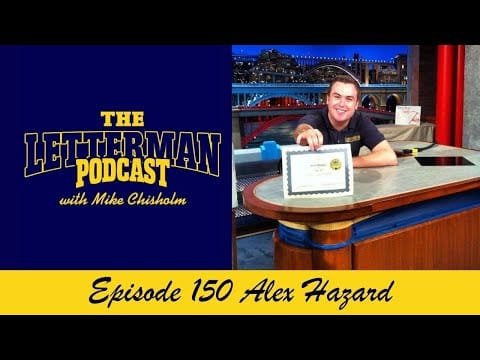
Episode 150 of The Letterman Podcast celebrates a special guest and a pivotal moment in late-night history with Alex Hazard. Alex started as an intern during the final chapter of Late Show with David Letterman, a role that ultimately led to a full-time position in the audience coordination department. For Alex, his time at the Ed Sullivan Theater was pure magic.
In this episode, Alex shares his journey, from how he first landed the internship to the thrill of being brought back full-time. He and Mike dig into memories from dozens of tapings, unforgettable behind-the-scenes moments, and even the Live on Letterman Concert Series. While Alex went on to work on shows like Jerry Springer, nothing compared to the time he spent at Late Show—an era that left an indelible mark on him and continues to be one of the most memorable times of his life.
And now, a note from our cherished sponsor: If you’ve been waiting all your life to own some authentic Late Show swag, wait no longer! Visit hello-deli.com, run by the one and only Rupert Jee, and turn those dreams into merch reality.
Finally, a humble (and only slightly desperate) request from us: please like, share, subscribe, and maybe even leave a nice comment. Or don’t. But if you do, we might just love you forever.
Episode Transcript
Read full transcript
Hey, this is Gabe Abelson and you're watching the Letterman podcast. Welcome once again to the Letterman podcast. My name is Mike Chisholm. All right, today we got Alex Hazard. Alex was he was at the end of the run of Late Show. He came in as an intern, left for a while to go back to school, ended up doing some stuff with the live on Letterman concert series in the middle, but then ended up coming back in the audience coordination department. And stayed there near till the end of of of Dave's run at Late Show. And I just I'm a broken record. This is why we do the show. Talking to guys like Alex and and hearing the joy all these years later spewing out of him and the gratefulness that he has for being part of what we you know, what we happily refer to as the greatest body of broadcast work in history, that of David Letterman and company. Still to this day affected by it. He talks about how to this day, even though he did go into broadcasting on a local level and and and still still has the itch. You can still kind of feel it that he still has it.
You know, I just appreciate the spirit that he has and how much he enjoys talking about this. He says that you know, his his friends and family, oh did did did you work at Letterman? You know, sarcastically they say it to him because he talks about it all the time still. And again, I'm not certain that most other shows there You know, he worked at he talks about how he went to to Jerry Springer and and and a couple other shows afterwards and how much of a no offense to those productions, but a letdown compared to when he was working at Letterman. It's it's it's pretty cool talking to somebody who has this gratefulness and I and giving these people a forum to talk about this stuff. I just love it so much. This is given this is a fun conversation with Alex Hazard. The Letterman podcast has one sponsor, one sponsor only, that is hello-daly.com. Head on over there for Late Show with David Letterman stuff. Uh without further ado, please enjoy my conversation with Alex Hazard.
Uh Alex, I'm I'm really grateful that you've taken time here to come on to the Letterman podcast. You're all smiles right now, and it was it was really great anytime I get to talk about Letterman. Are you kidding me? Well, that that's exactly why the show exists. for having me. No, no, no, no, no. This is exactly why the show exists. Um there are so many people who Oh, wait a second, our bridge isn't on. Let's turn the bridge on here. Let's get the the bridge going. The bridge going behind me. There we go. Um there are so many people who worked for the show, whether it was a cup of coffee or all the way up to, you know, all 32 years, and and they just love the opportunity to talk about it, um but don't necessarily have a venue.
And that's that's part of the reason why when when uh when Chechi and I were talking about the idea of the show, um you know, you know, I said to him I said, "Look, I've I've met a lot of people that that that just would love the opportunity to talk about it, and I'm still trying to discover them. And for those who haven't haven't heard from me yet, it's only because my contact info is bad. I want to give everybody a shot to come on here and like a joke in my family or there was and with close friends, "Oh, did you work on Letterman?" Because I love to talk about it so much. Aw, I love hearing that. Okay, uh where did you grow up? And let's let's let's talk about how you uh made your way into the Ed Sullivan Theater. How did it happen? So, where did you grow up? Did you always want to be in broadcasting somehow? Was Letterman something that you uh you you kind of fell into or was it something that you sought out?
Let's get into the story of how you got there before we talk about stories when you were there.
Okay, yeah. Um I grew up in a really small town called Waverly, New York, on the Pennsylvania border. I mean, literally, some people had their backyards in Pennsylvania and their front yard in New York. So, we were right on the PA border. Yep. Uh and my mom was a single mom. My dad worked out of town. And my grandfather was retired principal and uh found uh a retired cafeteria lady that kind of helped take care of me. And old ladies watch a lot of television. And so, we watched daytime all day. We watched Regis and Kathie Lee. We watched the Rosie O'Donnell Show. It was the '90s. Um and then I would fall asleep on the couch at night um to Letterman. And so, um you know, usually during the top 10 list at some point, you know, I was a little just a little guy. And uh so, my whole life he was part of my life, part of something I wanted to do. And while I maybe didn't know I wanted to be a broadcaster, I knew I wanted to do what they were doing. Right. And um but I was a small-town kid.
And so, uh the fact that I even have the opportunity to breathe the same air as him is like a pinch-me thing. Yeah. And yeah, I mean, all these years later you're still feeling it, you know. Uh I've been I've been I've been preparing um I've been wanting to see if I can do a tribute to the very last show. Um and and and and talking to some of the principals involved and and and things like that. Uh 10 years later, you know, because that's that's really what it is.
In in in a few months, it's going to be the 10-year anniversary of the last Late Show. And yet I'm looking at the smile on your face like it was just, you know, yesterday that you were there. And and and uh there are so many people that share that sentiment. And there was a magic about it. There was just something about it. Um did you study Did you So, you ended up going to Did you go to college for broadcasting? I sure did. And um I actually got an internship. Uh I had you know, like like all of us in college, I applied to a million internships. And I had uh ended up over at the Rachael Ray Show. Oh, no kidding. And I mean, I would I went to a small college called Cazenovia. It's actually closed now. I mean, it was that small. Um and uh you know, people going to these big shows they got got to classic broadcast schools, you know, Newhouse at Syracuse, Ithaca. And so even that was such a huge milestone for me. And then while I was there I got an interview for Letterman and I had to like call my advisor at college and be like, I don't know how we make this happen, but like I'll quit school and do this internship before I don't do this.
I got you. Okay, so what happened and it all worked out. Okay, so you were working how long had you been an intern for Rachel Ray? I did it like a summer internship and then the call for Letterman was for fall internship. Oh, wow. So you went right from one to the other. Where did where where was Rachel Ray where did they tape? You know, I'm trying to remember. So when I when I was with her we were she we actually moved studios while we were while I was interning. So really we were free labor to help move the studio. I was just going to say you moved a lot of boxes then. Oh, let's get the interns on that one. Hey guys, box up and move everything. What was your Okay, so so that was very interesting. So so cool that you know, you're going to this small you know, college yet you get an opportunity to work somewhere that's a big deal. Rachel Ray is a big deal. That's really cool. And I mean at a time and what year are we talking here?
Oh gosh. I would say like mid-2000s early 2000s. Early 2000s. Okay, Rachel Ray at potential like you know, kind of a zenith as to where she was. She was she was really really hot. Still is. But but you know, growing in popularity and and really was the it thing in a lot of ways. You must have celebrated getting that. That must have been really exciting for you. Yeah, you know, I I don't know what I've done but I felt like I had some good karma somewhere cuz it just was all worked out. Any fun stories from that experience that you want to relay? Um, you know, I think the interns from the Letterman show can probably relate when you start there is this I'm talking Rachel Ray here. I'm not talking Letterman I'm not talking Letterman yet. I know. I I I'm I'm but I think interns of television shows in general, I'll say. Um, there is this kind of precedent set that if you see them, you can say hello, but kind of let them be. Yep. And so when I started Rachel Ray show, it was similar. And um, I think that's a precedent set by the staff, not by them. Cuz I have to tell you anytime I interacted with her, she had a million questions. Uh, she one time gave me beer money. Uh, I like got something to her apartment and she said, "Here's 20 bucks." And I said, "Oh, like I I thought she thought I was a delivery person."
And I said, "Oh, no, I'm one of your interns." And she goes, "I know you're one of my interns. You're in college. Here's 20 bucks. It's beer money." You know, like so she's she was really cool and down-to-earth and I have the mouth of a sailor outside of the show, so that was great. Now, did you Okay. Um, you knew you wanted to get into broadcasting and and many times there are folks who uh, like we've had lots of folks on the show who it's it's like a family tradition, you know, their dad was a cameraman or their dad is, you know, their uncle was a tech somewhere or uh, you know, in the control room somewhere. That sort of thing. Did you know what role in broadcasting you wanted to be? Did you know, did you want to be in front of the camera? Was it behind the camera? Was it Did you already kind of have ideas as to what you were aspiring to? You know, I I always have uh, loved being on camera work. I loved hearing people's stories. I loved being funny. I liked making people laugh. Um, but at that time in my life, Letterman was I mean, I know we haven't gotten to actually getting to the to to being at Letterman yet, but for me, once I I kind of landed the page role, I was like, "I will spend the rest of my life here if he lets me." You know, like I'm thinking of Johnny Dark coming out the CBS's oldest page. And he You that bit. He was bitter and old.
That's you wanted to be that guy. It's just so cool to be there. And then like it was like literally days after I started that he announced his retirement and I just was like God. So, you know. Oh, that is crazy. Okay, so um so you do your stint at Rachael Ray. Um you had Did you you applied for the internship? Like did you actually go to the Ed Sullivan Theater and do it? Yeah, did you How did you apply for the internship? No, so I had applied the same time I had applied for the Rachael Ray stuff. So I was like looking for a summer internship. I wasn't looking to be there for the fall. But I kind of got the callback while I was there for for um for Rachael Ray and so I was like you know, sometimes you just make things work. Yeah, and you did. You did make it work. So you finish up with Rachael Ray. It's not like you quit to do it. You just the semester ended. Okay, so now we're going into the fall and um you know, did Was it Janice who gave you the call?
It was. Yeah. And I mean, you know, Janice I mean, we've talked we've She's She's She says, "Do you know? Do you have any questions?" she's happily happily retired. Um she uh times. Where is she? Uh she's in New York still and um enjoying her family very very much. Um you know, she's been on this show. lady. Well, and she so welcoming and so uh provided so much guidance to us. Yep. Uh she she was cool. And she looked at all the interns. It's so funny. When I had her on the show, I I I said I said to her I said I I I tried and threw up a couple of softballs for her to say, "Okay, tell me some of the success stories you had." Cuz obviously you got a guy like Brian Teta. Brian Teta started as an intern and now he's the EP on The View. And it's just like, "Okay, so I threw up some soft Who are some some of the success stories that you want to talk about?" And she wouldn't do it. On camera, she would not do it. She's like, "No, I love them all.
Uh the these interns were like my kids. I just I cared for them all. The last thing I want to do is show any favoritism." Which I just thought was charming as all get out. Um and she does listen to this from time to time the the show from time to time while she's doing her stuff. So but I will definitely make sure I I I send her a quick note letting her know that you were asking about her. Yeah, she's such a so She's great. And I still I mean I still keep in touch with some folks. Some fellow interns. I mean for years until I obviously until he sadly passed away. I mean Alan Kalter and I emailed back and forth which was just such a cool thing like it was like one of those things I'm like you know, like how my pen pals with this dude. I mean it it was just but he again so welcoming and so nice. I mean my family came and visited the show and he made a joke to my mom that like I was his like illegitimate son.
Like you know, like You know, it just like these legends were around and it was you know, it was just cool. Well, Alan you know, it's funny. Alan is actually you know, sadly his passing was kind of what kick-started this show. I was I was talking with Shecky one day and and and we're talking about Alan and he said oh, he would if you do this he would he would be the guy that would do your show so many times. He would cuz he was just the kindest person in the world. He goes if you wanted a voice over for this thing he would have done it for free. He would have done all of these things just to be a part of things. He loved people and was just a really kind guy.
and awesome guy. Oh, that's great that you got to spend some time with Big Red while you were there. That's that's that's fantastic. I mean when you got into the audience coordination I'm sure there was a lot more of that because a lot of people don't realize at the end of the run Alan was the guy that really helped he he helped open the show after Eddie left Alan was the guy who you know, he warmed the audience up and and he was one of the first points of contact. We could talk about Eddie for a second too. I mean as an intern I mean the things that that man would do and say. I mean I think today's world is a different world that we live in. Of course. And even and even then it I think it was kind of when it was shifting as what was allowed and what wasn't allowed. And he just I mean, crazier than a crack house rat, but a great heart. I mean, a great great heart. We love Eddie. Eddie's been on our show a couple of times and and and just Yeah, what is he What is he doing now?
Cuz he You know, he was a At least he told us he could have been lying and he probably was. Uh he was a former ballerina. No. Are you Wait, are we talking Eddie Brill or are you talking about Eddie Volk? Which Eddie are you talking about? Are you talking about Eddie Brill? Big The opening The used to be He's a huge He's a stand-up. He's a big He's a stand-up comedian. I'm not thinking of Eddie. I am sorry. I'm not thinking of Eddie. No, no, no, no, no. thinking of Eddie at all. I was thinking of Hugh Card, um Not Tony Mendez. Tony. No. Oh, you're thinking of Tony. of Tony Mendez. Tony Mendez is what I was talking about. I Eddie was gone Eddie was gone by the time I was Eddie was gone I was going to say, yeah, I was going to say I thought like Yeah, Eddie was gone by the time I I heard stories of him but I didn't know him personally. I'm sorry. I was think Yeah, I was thinking of Tony. Tony was the former ballerina. Yeah, sad to say he he passed away about a year and a half pass? About two two years ago now. Yeah.
Oh my god. Nobody I don't know of anybody in my life that ever made me laugh that hard that quickly. He was so funny. We've had a lot of interesting stories. absolutely crazy, but so funny and loving and you know, immediately was like, you know, he had He actually had a little show for a while. The Tony Mendez show, of course. Absolutely. And I mean, I think he played a puppet in a few times. Uh I don't know. It was weird, but it was fun. It was fun. I'm just talking to There's There's There's a group of people who used to run something called Dave Con every year. And and and and they're doing a reunion here fairly soon and they invited me and I'm very very grateful to to to be a part of that group as well. And and the Dave Con group, one of the people who was their champions was Tony Mendez. Tony was absolutely um he was so accessible and I mean a show that is famously um inaccessible in so many ways. You know, it had to be it had to have a titan the the the hatches had to be tightened up for that show uh just because there were so many people that that that that loved it the way that they did and and and wanted access and you know, the host famously uh you know, would roast show business and and and ridicule show business and it was just a such a unique thing.
But Tony was an access point for people. Um he was a person that and Alan I would think is the same thing, you know, if if you had somebody who was a real enthusiast of the thing, you know, absolutely Tony's the guy to talk to. Rupert of course another one, you know, Rupert was another access point for the show. Uh you I bought my hoodie from Yeah, I mean, just um Yeah, it's it's a weird thing to look back at and I'm sure a lot of people that listen to this podcast and you probably too. It's it's It's something that can never be recreated and even our tiny I'll speak for myself, my tiny tiny tiny tiny role, the fact that I was even allowed again to to be in the same space, to be around those people, it it's it looks I look back at it almost like a dream. Like it was just it's it's it all seems it was such a small portion of my life, but it was such a moment that I will cherish and um I don't mean to sound so cheesy, but you know, you cherish and you and you look you look at it like, what the heck? How was I allowed in that room and those people to your point are the ones that made you feel welcome in the room.
It was the it was the Tony Mendez's of the world. It was the Alan Colter's of the world that said, "Oh, you're one of us, too." And it was like, "I wasn't." But for the moment you kind of felt like you were. Yep. Uh Shecky Shecky did that for me and and and and I that that that's how I feel about it as well. And I just part of the reason the show exists in is because I don't know that there are a lot of people who are saying the same thing that worked for maybe even Leno. I don't even know I like I don't know. I don't see them, but I do see them and interact with them. Um and I long before this program existed, I have seen and interacted with people who have that exact the exact sentiment you're expressing right now where I can feel the energy off of you. And we're 10 years later and you're talking about this magic, this this this sense of awe that you got to be in the room and you got to collaborate with these people and be part of the team because it was. It was a collaboration. It was a family. It was a team. And we're still talking about it to this day. And there are people who still have this thing inside them, inside their heart uh talking about it. I love the fact that you're still there.
Janice, I mean, she said that. I mean, you would So, the orientation was like felt like 10 years. I mean, it was they they was um Did you go from department to department like everybody else? Did did you go from department Talk about the orientation. Talk about your first day. Well, this is the first you have the interview process where you go to every single uh department. You meet with like every person on the staff. This, you know, it's not a small staff. Yeah. And um And then the orientation process was was similar, but the thing that I loved and kind of maybe what what fuels this feeling that we're talking about is Janice. In that orientation, she says, "You are an integral part of the show. You help make the show happen. And we are probably the only show in show business where the show couldn't happen without the intern staff. And then uh subsequently, the the the page staff. And you know, the way they talked about it from the beginning made you feel like you were um part And I do I will say I I did um quite a few internships at college. I I mentioned Rachael Ray.
Yeah. I did like uh that show in particular was different in the sense that they really did rely on you for things. Give me some examples of that. Oh, gosh. Well, research. I was a research intern when I was an intern. Um and so, I mean, they would say, you know, they'd book a guest. You'd It was old school and for people that are are listening podcast that didn't work there that are fans of the show, um when you would walk down the hallways of the upstairs office space of Ed Sullivan Theater, it was lined with I mean, at this point, I mean, the show'd been on like a thousand years uh by the time I got there, you know, lined with just filing cabinets of files. And so, you would have files of a uh you know, a Snooki who probably was on the show once or twice, her her file is this thin. You get when you get to Regis Philbin, uh I forgot it wasn't podcast. Uh so, uh paper thin. And uh No, no, no, we're on video, too. We're on YouTube as well and and Spotify video as well. No, no, no.
So, then you get to you get to Regis Philbin and who had been on the show, you know, 600 times, and his file was like a binder, sometimes two folders. And so, you would as a research intern, you would go through and you would try to find things that that they could write question that the writers could write questions on for Letterman. And quite often, and and this is like really a a cool thing, I would find a weird thing about, you know, so-and-so, whatever whoever the guest was, and then you would hear the words come out of Letterman's mouth. I don't think that happens at other internships. Yep. I just don't. And maybe it does. I could be wrong. But for me, I mean, I I mentioned being, you know, a five- or six-year-old and falling asleep on the couch to listening to the top 10 list yep to being, you know, in my 20s and having something that I handpicked go through the hands of producers and writers and a million people before it gets to Letterman, but watch the show and see something that I found come out of his mouth, that's cool.
Yes. You contributed to it. You absolutely contributed to it and and and the and and you appreciated it and and you still appreciate it to this day and that is again your I I I'm a broken record. You're encapsulating exactly why we do the show, Alex. That's that's that's that's exactly right. Um I'm super curious that being a researcher I we've had lots of researchers on over the years and you talk about you know, the job of researcher used to be uh you know, they're going to public libraries and they're getting you know, books about people because it's before the internet and then the internet comes up and it's in its infancy and they had little you know, at that point um okay, so first off, did you automatically like go into the research role? Is that where you ended up at the beginning or did you jump around from any departments? Um so I interviewed in every department. Yeah. And um there were I'm trying to remember what the two departments They came back and said you can choose research or you can choose and I can't even remember what the other one was.
Okay, okay, so you had a choice, but you chose research. And and I said uh well, I said to Janice, what what is most transferable? And she said research kind of allows you to be it's not as much face time with everybody, but allows you to be this sort of thing that I was talking about. It allows you to kind of be part of the show. Yep. And so for me um I honestly and of course every intern probably says it. I think it was one of the harder uh departments to be in. Yeah. it was real work. I mean just getting coffee. Right. You're not just You're not just doing easy errands. Um whatever. And one of you kind of talked you kind of talked about going to the library or whatever.
One of the cool things we got to do as research interns is CBS actually had a a library that was only open to CBS and they had old articles of Time magazine and you know, like whatever it was and old albums and so I would literally go there and look through all these old magazines and especially if it were like kind of think of a good example of a guy you know like an an an older actress or somebody who had who had been around a long time. And of course in the last season of the show, there were a lot of legends on the show. So it was like going back and trying to find that picture Yep. of them doing their first commercial or their first ad and trying to find it. And um it was even even that in and of itself to have access to that sort of uh place was was neat. Well, and it's cool that you appreciate that the way that you do.
You know, there's a lot of folks who have this uh nostalgic spirit. I'm one of them. And the idea that that that suddenly I could go into a CBS archive like that and and and look at some of these things and poke around and see some of these things that and I'm actually working. I'm actually doing something that will contribute because these insights are the things that are necessary and you can move them up the pipe. Uh that's very very cool that you enjoyed that. Who are some of the people that you worked with? I assume Ted is one of them. Ted was one of them and as a matter of fact a few years ago it was just before COVID. I was a local television host in Watertown, New York. Yep. Yep. Uh for like eight or nine years and um so COVID had and I had like emailed him or Facebook messaged him and I was like, "Hey, um can I can you help me like set up an interview with the ladies of The View?"
And uh he was like super open to it and we were like moving on and then like the the craziness of COVID got away and it just was you know, he had like passed away and like their public relations person something like that. yeah, yeah. Um which was like so nice that he even he But he opened the door for you. Like back to being an intern at other shows, there there are times where like they most people wouldn't remember who you were. Here I am friends with them on Facebook like that's kind of cool even. Absolutely. It's like he was the fact that he responded and put me in touch with the right person was so nice. And then like COVID hit and it didn't come to fruition, but it was again to me it was just the fact that he even responded was was so nice. Yeah. And and not an experience that I've heard from other friends that have worked in television internships has when they'd go to reach back out. I mean, they might be for a job reference or something like that when you're first out, but not almost 10 years later asking for an interview of a new show that you work on that has nothing you like, you know, it's Very Yeah, well, Ted I mean the Letterman connection that's me. Brian is such a kind guy and I you know, I've only I've only met him in the flesh once and we've traded messages and stuff back, but I didn't know he was a writer.
I worked with John Carl. I was going to say, okay, so John, oh, interesting. I met John at Rupert's retirement party. I met John really quick. Interesting guy. Yeah, he's he's I kind of think the epitome of of what you would have pictured a Letterman employee to be like. He is smart Mhm. Um and hard working and funny and also quirky. Yeah. And like enjoy finds the things funny that like he has a Letterman humor. He finds the things funny that only Letterman fans find funny. Yeah, there's a that's that sensibility where we all kind of feel like we're part of like I describe it cuz I mean I've got quite a few years on you but I remember in high school like like like those who were Letterman fans like you'd walk back by each other in the hallway the next morning and if something amazing happened the night before you kind of look at each other and you kind of know it. Like it's like being part of a secret club and I think the Askew sensibility or point of view is something that we all kind of share.
It's it's one of those things and and and a lot of the the the staffers of course um they lived it. That was their culture. That was the voice. That was the the viewpoint that they looked at the world because everything mattered because all that that show was was was everything. So you worked with John and you worked with Brian. Who were some of the other people that you worked with? Uh Sam and I'm trying to Sam's last name is escaping me. There were Okay. I mean there was a research team Yeah. um that was that was great and then once I went on to be a a page, I mean you work with Jennifer Ray who was fantastic And I saw as a matter of fact, I made a post um I can't remember why I posted I made some some post about Letterman again like kind of we talked like once you're there for 2 seconds, you think that you're part of it forever. And uh so are you are just Alex Alex hold on. You are part of it forever. You you are like and I mean we said this before when I was wanting to book you. I said I don't you know, if you were there just for a cup of coffee or all the way to the 32 years, you are a part of it. You are a stone Yeah.
of the the empire the pyramid that is. Anyway, keep going. So, I know what it was though. It was it was when Letterman's new Netflix show he interviewed Miley Cyrus and I just I watched that interview and it I wrote kind of a post about the sentiment of when you when all these years later when you watch him do something like that that was so spectacular. I still pinch myself blah blah blah. And so anyway, Jennifer Ray reached out and she's like, Alex, you know, I have to tell you everything that you said in that post is exactly how I feel. And uh again like we've it's been years since we had talked, but we're friends on Facebook and we stay in touch and it's it's just something special. Uh you know what? Um Jen is actually somebody who has come up in many conversations around as I've you know, as you can imagine doing this for the last 2 years. Lots of conversations about lots of different people. Actually, if you can make an intro to Jen, I would really love to have her on the show here. I've had David I've had David K on the show, but but but no Jen is somebody cuz I mean she's you talk about somebody who's in the trenches the front line. I mean, Jen is just uh you know, she had a she had a hard job. She had a she had a very very hard job. And we'll get to you cuz you went into audience coordination or you were part one of the pages after the internship, right?
Correct. Yeah. Okay, so we'll get to that in a minute here, but I still want to stick to the intern thing. Like even when like talking about the last show I've watched the last show a few times here because I'm prepping for this to tribute it at some point moving down the line. Dave mentioned the researchers um you know, specifically in his last speech he talked about them being I think in a subterranean whatever that people who, you know, it is a it is one of those jobs that when you watch a show like that you don't realize how integral that you are. And and and like you said, I'm just I'm just kind of just putting an exclamation point on your point. You literally if you find something that is interesting, that old commercial of Matt LeBlanc's or whatever it is or you know, that little factoid about somebody. You can literally set apart the conversation that you have on your show versus the conversation that same person has promoting whatever project there is on other shows. You can set it apart. It feels like right from the start you realize the importance of what it was that you were doing.
Yeah, it was um one of those things. I don't I don't have I don't know if I have the right way to describe it, but it it was one of those things. And you were part of a team. It was a it was a team effort. It sounds like you're you're very very much a part of and actually it's funny. Obviously we were I think there were four of us research interns. And then some have gone on to have really incredible careers and they're that's not my story to tell, but there is the sense of there's some of us that stayed in television in different ways. You know, I mentioned I went into local television. There's some that went on to be writers. And then there's some that just look look at it as I do now as just a fun memory of how cool was it that I was able to be there. Yeah, absolutely. Okay, so you did that for the for the entire fall semester and got through that. Now you're getting to the end and you know, is is is the tunnel coming so fast?
Going, "Oh God, I don't want this to end. How can I make this How can I extend this thing?" You know, yeah, so um yes, definitely happened. And um at that time they had a series called Live on Letterman. Yes. Which was uh for folks who don't know that don't know, a live streamed concert series. I don't know if I mean I would imagine they still exist, but at that time it was brand new it's a brand new concept. Yep. And it was usually whoever's ever guest on the show on the Friday Mhm. um would then either do it that night or the following day. Mhm. And so they kind of had put it out to interns that were leaving, if you'd like to volunteer to kind of run be a runner for the Live on Letterman series, you can do that. Um and so I was going back to college and I went to school um outside of Syracuse, New York. Yep. And it was also, thank god, about the time that Megabus became a thing. Oh, no way. Okay, yeah. Yep. Where you like risk your life for a dollar ride to the city. Yep. It was like a six hour ride or something from Syracuse.
And so um I guess I should have I could admit it now all these years later. Um I lied and said that I lived in New York and volunteered to work the Live on Letterman series and would hop on a Megabus and head on down and I got to work some really cool concerts. Oh, yeah. You know what? Um I've talked about this a lot on the show. Like I want to I want to build a sister show to this called live and I want to call it Live on Letterman and I want to focus on the music. Um you know, we've had Harvey Goldberg on, we've had you know, different of course Paul and and the and the band, but you talk about how many unique music experiences for those who are music fans. You know, Late Show with David Letterman provided uh so many unique musical experiences from artists from the most indie of indie all the way up to the biggest of superstars. And and and I want to do a sister podcast on on on that called Live on Letterman to tribute exactly what you're talking about. My favorite was Cake. I love Cakes uh live on Letterman set. It was awesome. Of course the Foo Fighters were amazing, but there are so many awesome bands Right. that had a live on Letterman feel. I think that only worked I want to say two or three, but it was just again one of those things where it's like, if you can do it, do it. Do you remember any of the any of the acts that you worked with?
Yeah, I I Taylor Swift who of course now is like this at that time was not like Taylor Swift. Exactly. See, this is my point. My point is sitting in the archive right now is an entire Taylor Swift set shot and edited and audio the magic of Harvey Goldberg's audio mix, you know, combining a live experience but also with produced music and putting them together into one. There's an entire Taylor Swift set sitting there on the beautiful Ed Sullivan Theater and it hasn't been I think you can find it online like you say, but it hasn't been championed and highlighted and thrown up there. You were there that night. Yeah. Yeah. And and again like she wasn't Taylor Swift was a I mean she wasn't like some new artist. People knew who she was. She was famous. she wasn't the biggest star in the world though. I doubt that she is now, yeah. Yes. Yeah, so that yeah, so then so then I was I went back to school for a semester and God, talk about like you know, like people talk about like winter depression when you when you when you go outside and it's dark and come out it's morning and I was like and um I am not one of those people that feels the way about New York like New Yorkers do. Like I love New York. It's a great city. I love to visit New York, but for me it was about being around show business. It was just like I just wanted to be near it. Yep.
And feel it and see it and for me it it was a show business thing. It wasn't city life and so to go back to a small town really outside of Syracuse was great. I kind of enjoyed the the the slow down in pace and like being able to like drive places and uh you know, have people remember your coffee order and those sorts of things. Um but I just missed being around I mean we we talk about being in the Ed Sullivan Theater. I just missed that feeling. Yep. And so um I like started I actually called uh a Syracuse news station and I said they had a morning show and I was like I had already done an internship with them. I was like, "Can I just come hang out?" And I literally like would just like go and like do whatever they needed at the at the little Syracuse station because I was like, "I just need to be around something." Oh, Alex, you're breaking my heart and and filling it at the same time. That is adore That is precious.
And so they did. They let me come and I would just like I'd like mic people up before they were guests. Yeah. Yeah. they let me do. Yeah. And they were like, you know, whatever. And so then when I got the call to be able to come back as a page, um I was like there in a heartbeat. How long are we talking? Is is is it a matter of 6 weeks? Is it a matter of 6 months? How long are we talking here between you? One semester. So I mean so I was like I was graduating. So I had the fall semester and then I had another semester and then I graduated and and came back. Oh, that's fantastic. Okay, so you um had you had you always been like Did you say, "Please keep my number. Please keep my number." and then phoning and trying to see like or or was it one of those things where you were on a list and you you got the call? I don't remember. I I It was such a It's I don't know. I don't remember. When you came back as a page, was it like coming home?
Weirdly, yes and no. It It was like I know and I I and I appreciate you saying what a what a peg we were in the in in the in the machine of Letterman. Uh I I never felt like that. I I felt very much part of it and very cool to be there and I never stopped pinching myself. So I I uh yes, it felt like coming home because I just felt so lucky to be there. But I never lost the the gratitude, I guess, but the the shocking that like I was like, one of these things is not like the other. Small town boy with zero background and syndrome was alive and well. Yeah, it was like, how am I here? And I just I I never stopped feel feeling that way until I mean so I started the page thing actually I think I got accepted as a page he announced his retirement and then I started. And so, I kind of knew things were coming to an end and I had seen some people that were at the kind of the same stage in their career in the sense that they were like young enough that they weren't going to retire when he left.
Yep. Um that had kind of started to move on. Yep. much higher on the totem pole than I was. Yep. And so, I I didn't stay that I don't have any regrets in life. I think that is probably the only regret in my I should have just waited out and been there for the last show and I wasn't. Janice talked about that. I started applying for jobs cuz you know you you with the living in New York you got to think about paying your bills. Absolutely. Um I kind of wish that I waited out because I think you make it to that last Letterman show. God, there's not few people in show business that would have loved to just have you. Yeah. I probably should have waited it out and I didn't, but Um you know, but it's so funny but I'm glad you brought this up. See, again, this is exactly I love having these kinds of conversations because there's a lot of people there who as the show was coming to an end um there were there were nerves. People were there was scarcity like, oh, what am I going to do next? You know, some of the some of the the long-timers were at the place where it's like, I don't know if I can do anything next. Janice being one of them.
You know, she talked about that. She she's like, you know, when she ended up at I think it was the it was the Turnabout Theater, I think that's what it was or the Round Roundabout Theater. And she ended up doing some very, very cool things after Letterman, but before she left there, she wasn't sure she could have done anything else because she was so, you know, as as as people have been there forever. Yeah, there is like like The Shawkshank Redemption in in institutionalized, you know, you're you're you don't know if you can do something else outside of it. um there was a guy there and again, it's been and I like I I actually feel really bad about forgetting Tony's name because I remember him so um clearly. Yeah. but he was there for a long time though, brother. Again, he was good guy and I and I his name's going to escape me, but he was basically the finance guy. We would go to get petty cash from him when we go pay for things. Yep.
And I think about the way that he did things was so old school. I mean, do you remember learning how to use a typewriter at Letterman? I mean, we literally used a typewriter to hand things up. Yep. Um And I was like, I'm learning how to do this. Uh so anyway, I mean you and you would have like the old school calculator with the receipt that would fly out. Kind of like when I remember thinking this guy can't go work anywhere else. There's not another He's like I had worked at other shows. I was like, this isn't how like you go to another show, they give you a credit card. Yeah. Everything's so distinctly recorded. And at Letterman, he's literally like got a stack of cash on his desk and he's handing you a $100 bill and says, bring me the change. Yeah. It doesn't happen. And that's the other charming part that it's it it it was old school it was worldwide pants. And they put on, you know, and they were in partnership with CBS. Again, we've talked about this, you're never going to see that again.
And and that's the charming part of it. Yeah, it's weird for sure and charming and and and and eccentric and all just like the show. Uh you start working for the um now when you okay, so when you got the job, uh audi- was it audience coordination that you automatically just ran okay. So so you had done the research so you knew that end of the show, the live on Letterman stuff. So you you had an awareness for certain of of of of this part of it. Yet, I believe Dave referred to what your team, David K's team did at one point. I believe he used the word indoctrination. And again, this is another place where like I went and visited Colbert not too long ago and and and a lovely lovely experience. Actually interacted with Steve at the Q&A before the show, which is ironic on a whole bunch of levels. But, I as we were being ushered in and I was there with Rupert's girlfriend actually as well and my wife and and and another friend and we were noting how different it was. And and and and again, I mean, talking to David and how what he set up and he and the team set up, I mean, that audience, the moment you walked in there, it didn't even matter if it was Eddie Brill or if it was Alan Kalter doing the warm-up.
You were jazzed up and you were jazzed up cuz you guys cuz you and that team of people, Jennifer and all those people, boy, oh boy, did you guys ever run a tight ship. It was a It was a very well-oiled machine. I wanted you to talk about being part of that machine and were you one of the ones that got to speak to the people like did you have the the the the the the speech down and and all of that? you had to memorize. It took me a little longer than some of the other pages to memorize. I'm not a I'm not a like that. But, your energy, I can feel your energy through the ones and zeros right now. I can see how you had the energy to do it. I can feel that. so I I said it earlier, I would have done it till the day I died. I to be able to Like so I enjoyed the research thing. I probably gained more life experience from the from the research internship that were more transferable skills, you know, snooze fest stuff. But, the being in the theater and I will say Paul Shaffer was so sweet. He He knew everybody's name. Mhm. Um I I think you would know my name now if I saw him, but you know, cuz there were, you know, through the years, God knows how many of us. But he always knew the people in the theater's name, and he would do that song, you know, "We've got the funk."
Yeah, oh yeah. Yep. And he would then he would and then if you were somebody that was continually stationed up front, he would remember your name, and he'd go, you know, "Alex has got the funk." And it was like, "WHAT?" YOU KNOW, LIKE IT WOULD JUST BE up and then it was like, Yeah, it was Yeah, it was it was it was you're dancing the aisle aisle ways of the Ed Sullivan Theater before Letterman comes out with Paul Shaffer and Felicia and that crew is just there's there's indescribable the the energy. And something weird about being about the Ed Sullivan Theater itself was you again, it sounds corny, but you you could feel the history of the place when you walked in the door. And anybody who has been to a to a taping of the show there, I think can probably I don't know if if the feeling is the same if it's been renovated since Colbert's taken over I haven't been back, but the minute you walked in the door, there was an homage to that of we're here, you know, Elvis Presley was here, you It's got an energy to it.
There's no there's no denying that for those who are sensitive to these types of things or delusional perhaps, there is an energy that that hits you the moment No, it does. And it's funny, you know, it's it's basically a year ago right around this time that we were there for Rupert's retirement. Pat has put on a retirement party when Rupert I saw that on Facebook again. Yeah, yeah, yeah. And so you know, it was crazy because we were in the we were in the the entranceway, you know, the the best the you know, we were we were up front where basically the indoctrination happens, you know, as you you walk through before you walk into the theater. Well, that's where the party was. It was in the entranceway and and and and it was a beautiful venue for it because that's where all the, you know, all the original stuff is still there, and it's just it's it's so beautiful, and you can feel it. Well, a lot of the people hadn't been in the theater since since that last show.
And so, we opened the doors, and we walked into Colbert Theater, and we were where the audience sits and whatnot, and it's still there. You can still feel that energy despite the cosmetic changes that were made. You can still feel it. That that that that building's got It's got ghosts in it, man. There's a lot of history there, and and and you can certainly feel it. Um did you spend a lot of that time watching the show? Like, were you actually a page that was like at the door watching the entire show? Okay. That's what I think is why I loved it so much, to be honest. Obviously, the energy of it, the dancing with the with with uh the CBS Orchestra and Paul was was amazing. Getting to know Alan was amazing. But, getting to have a front row to the seat every day day after day never got old. You like You know like you could watch other shows and kind of like be like kind of tired of it. I just never got tired of it. It was It was And there were some things that we mentioned it was like a well-oiled machine Mhm. that were repetitive, I laughed every time. I mean, Alan Kalter used to have a joke in his warm-up that he said, "This show is going to be better than sex on a Tuesday."
And every time I laughed. And it was like It was It was Maybe the energy, maybe the time, maybe it was because it was Alan. I don't know what it was, but it was like if you had heard that joke 200 times, you probably wouldn't laugh anymore if your dad was saying it. Because it was Alan Kalter and at Sullivan Theater, it was funny. Absolutely. Well, you say the same thing to new people, right? It's It's It's It's not saying new things to new people. It's saying the same things, and it's it's a bit of Groundhog Day. And I clearly one of the reasons you were so effective at it and taken by it is because you could find the joy in that new moment for those new people and and even though you were saying the same script I I find it charming that you had a hard time memorizing it but I can imagine that you once you got it you enjoyed cuz it is a performance. It actually is a performance where you're going through the thing and you're telling the audience how to be how not to be department pages are actors to be fair.
A lot of them are acting as comedians. So I feel like you could be one and and your personality and you did get into broadcast you stayed in you know working in in in broadcasting for a long time after it you've got the it you clearly have it. Now that being said sometimes things go off the rails a little bit were there ever an audience any anything in the audience that you had to you had to deal with or or that happened or was it always like you said the well-oiled machine? It was a pretty well-oiled machine. Every now and again so there was a couple this one of my favorite things as a page was one of our task was we had an old school piece of paper that was a checklist and you could go find stupid human tricks which was so fun and so there was some really weird ones a lot of times people thought their thing was a stupid human trick and you had to be polite and um act amused by it. Sure.
Yeah you got to placate a little bit. And sometimes it was like I can do 10 push-ups and I'm like yeah. That's great we'll send it up you know and um And then one of my favorite things was do you remember P-Man? Yeah of course P-Boy. Or P-Boy that was one of my favorite names but um they kind of So he like got on Dave had gotten on a like a one of his things where we did it once randomly after all many like years of it not happening and then all of a sudden it was like happening and happening and so like the first time it happened with with it was just so caught off guard. Like you're standing there, you're kind of leaning up against the wall, you know, it's the show's going on, you're watching the show. And all of a sudden people people are going through throwing frozen peas. And you're like, "What is going on?" So then like once we kind of knew it was going to be happening again. So that was that was kind of one of the one of the things off the rails. As as far as audience members go, because it was the last season, I think people would would just felt the same way we did. They would felt so honored to be there. Yep.
A lot of nostalgia. Uh what month were you there were you there until the spring or was it cuz it finished on May 20th? Do you remember? You're going to test me. I don't remember. No, no, no. Were you there for Darlene Love? Were you there for Darlene Love's last show, the Christmas? I was there for Darlene Love, but I'm trying to remember because I had some overlap. I Yeah. I'm trying to remember if I was there if I'm remembering it from my internship or if I'm remembering it from Oh, I see. I see. Yeah, the very last Darlene Love in in the Christmas show of 2014 was it was a particular we went of course three monkeys around the corner. We went for Christmas party afterwards and Darlene Love was there. And um you know, she was just I you follow her on I don't know if you follow her online now. Oh, yeah. Uh but you know, she she still talks about this this same feeling that we're talking about. And so I don't know it was you know, she's queen of Motown and there she is, you know, again you listen to that song your whole life and then you're you're you know, using your fake ID to get drinks next door, you know, so You know, that was one of the things Janice always used to say, "You don't want to be the intern that um that you know, is out of control, whatever." And nobody everybody really did respect that.
Um it was again like you would go to internships in other places and there was always And Janice there was this level of respect of you you everybody should have a good time and whatever. Yeah, it was but it was there was never the nobody ever took advantage or anything cuz I think everybody felt that that level of while we're lucky to be here. We're lucky to be here. Yeah. Um you you you mentioned at the at the top of this thing when we started you said, you know, um you've got a place where you can talk about it cuz your your friends and family you know, it's you talk about being on Letterman you still to this day. What are some of the stories that you like to tell? What are some of the things Have you said them all here or are there ones that you like Do you have go-tos that you go back to? There are several. Uh I don't know how many of them you should say publicly, but uh you know, of limitations has closed. We're fine.
We're fine. You can say whatever I mean I still would like to be employed. Um Um These are the off-camera stories I get to hear about all the time. I mean I mean when Willie Nelson was on the show, um I was I was still an intern but my my my job that day was they said we really need he doesn't want to be in the green room. He wants to stay on his bus. On the bus. Yes. And so he pulled his bus up outside and basically somebody had to open the door for him when he walked by and they said I could be that guy. Awesome. The contact high you must have gotten from opening the bus. Yep. And so like there and so then uh Yeah, and there were some funny interactions with the staff and things as as he was in on the show. And so I like to tell those stories. There was one time uh Mick Jagger was there.
Um and I got to run and grab lemons for him and I remember kissing the lemons before I handed them in cuz I was like I feel like it's got to be good luck but Mick Jagger's you know, like so like there's like little There are little stories that they kind of come to mind when you hear the person the celebrity's name or you hear For me I always used to say, you know, like I have a few idols. Regis Philbin was one of them. And to be able to be I remember, um, you know, like research interns really didn't have a reason to be backstage unless, um, you were, you know, I would given a task like that.
Um, and so, I remember finding a reason to be there backstage so I could just lay my eyes on Regis Philbin. Um, so there were there it, you know, I don't know how to describe it. But I I know that people that were in the same boat feel the same way and and probably did some of the same things. Yeah, Alex, you know, to be perfectly frank, um, you know, I've got a little bit of perspective, not not a ton, but over the last 2 years, a little bit of perspective on this thing. Um, you were the type of person Janice was looking for. Like that's what you're talking about, this whimsy that you have here, but yet at the same time, with the skill to go, okay, I need to put it at arm's length so I can stay professional. And, you know, and not just live in the whimsy that you're talking about here. I think is exactly the secret sauce is what what they were looking for. The people who were happy to be there, the people who didn't get tired of that script, um, bringing people the repetitive nature of things, you know, who who still was grateful the whole time. You encapsulated exactly what she was looking for as far as I'm concerned. Um, you know, and and I mean she she would have to confirm that, but I'm certain she would.
Uh, that is that is such a cool it's such a cool thing that you got a chance to do. When it did end, um, obviously broadcasting has stolen your heart. You're still talking about it now to this day. I'm certain if a call came in tomorrow for an opportunity, you would want to look at it at least. It's clearly beaming out of you. Uh, what did you do after Letterman? Uh, you said you were part of a show for 10 years, you know. I, uh, For nearly 10 years. went over to So, I applied for a job with NBC Universal. Mhm. And, um, I thought I was going to end up in 30 Rock, whatever. I ended up doing the reverse commute to Jerry Springer, Steve Wilkos, and Maury for a few years. It wasn't even a few years. It wasn't even a few years. I I didn't last long there at all. No. it was like a fall, you know, I don't want to talk badly about other shows, but It's not the No, no, it was a very different experience.
It felt like a fall from grace. I mean, I went from this leg- And then, of course, Jerry Springer was was legendary in his own regard. I worked primarily on Steve Wilkos, which was like his bodyguard had a spin-off show something. Yeah. Um but it's, you know, you you've seen the shows. I mean, they're they're scream television, Who's Your Daddy, um exploiting people really. Um and so, I went from this legendary person that I had watched my whole life that was being um really honored in his last season um with heartfelt messages and all these things, you know, of course, which Dave Letterman, but was We all felt it. Um to going to, you know, paternity test and and that sort of thing. And so, I didn't last very long there. And I was like, "You know what? Um I really want to tell uplifting And not that Whatever. And And so, anyway, a job uh I had not done any on-camera stuff. And so, a a small a job at a really small station on the Canadian border of New York State was open.
I had a connection. They kind of said, "It's yours if you want it." Uh they hadn't had anybody on air in 10 years, but they said you can do whatever you want with it. And so, I mean, um I I actually recreated some Letterman-inspired things uh when I was there. I mean, everything was like paid for lifestyle stuff. So, like I did a segment with like a local um like hot tub store once, where I did Will It Float? You know, and so, uh You know, like You know, it's I I had to do your you know, you have to do the job of of what local television is. And I did, you know, political interviews and that sort of thing. And I had a long a long interview series.
Um but you never forget what I the thing that I think always kind of set Letterman aside was he had done his homework. Mhm. And he didn't do the interview for the guest. He did the interview for the audience. And I think if there's a if there's a lesson that local broadcasters or anybody that I guess maybe in entertainment can can learn or maybe not even in entertainment and in life. Uh, you you don't you don't do the the interview for for the guest. You you do it for yourself. And I think he made himself laugh more at first before and then and then he did it for the audience. And um, and and and I I speak to that in life in in the sense that you you hold true to to what you know to be true, you know? And I think that Letterman does that even now with his Netflix show. I mean, he he he does his homework. Wasn't the Miley show awesome? Oh, it I think maybe one of the one of the best I I don't I can't say that. But it was one of the best you can. It was I enjoyed I Yeah, it was it was like he has an ability to relate and to think about um, I mean, think about he and Miley Cyrus. What do they have in common? And actually, I even think there were days at Letterman's show he would have hated a Miley Cyrus. Yep.
Well, and there might have been phases there there might have been phases if like anybody who took show business that seriously and whatnot, Dave, you know, roll up his sleeves and went to town on it, right? You know, he he and and that was the one thing. But then when you see somebody like you look at Billie Eilish's episode very, very similar. And I think or or Lizzo's, very, very similar. Cardi B, like okay, we just uh we just doing this. There's four names of four gals who are like immersed in show business and yet he went and found depth that people would not have necessarily known about and his curiosity leads the way to do that and I think it it goes back to what you were saying there. But the Miley one, you know, as of this recording here is one of the most recent ones. I I was absolutely I was beyond taken. Taken isn't the right word with that episode. It was way more than that. I was I was actually in like I was entrenched and really mesmerized by it. It was it was tremendous.
I went and watched it a second time because I thought there's more here that I'm missing even. Um yeah, you know, he people always call him the king of late night and and and I really think yes, he's the king of late night, but I think more than that he was the king of the long form and I think that maybe came later in the show. Yes. Um you know, as he as he slowed down. Yep. Um there's nobody in late night that does a long form interview anymore. I mean, they have good interviews sure, but not I mean, two segments with in-depth conversations with like you said the curiosity leading the conversation. Uh they were funny, but they had I always actually one of um Alan Coulter's things that he would say in his warm up was it'll be funny tomorrow. Um it was it was true. He said he he would say like laugh laugh tonight, but it'll be funny tomorrow. Um And it's kind of true. I mean, that's Letterman. Mhm.
Um what a great spot there. Okay, I I I I just um that was a great place to end it and I don't want to end it. You're awesome. Like I really appreciate you all these years later and again I want to tell your listeners so Please. that when when you reached out I cuz I I so I have a because I did the local TV thing for a while, I have a a fan page on Facebook for whatever and so it actually is me sitting at Letterman's desk and I just think that's a cool picture. Uh we'll put that as the thumbnail. You got to get You got to send it to me. We'll put that as the thumbnail for for your episode here. Yeah, definitely. And so um when you reached out I thought, well, he must have seen that picture and thought that I was that I had a bigger role than I did and so I responded to you. I said, you you said, "Would you be willing to be on the podcast?" And I said, uh I was just an intern and a page. Yep. And you're like, "No, I still watch it." And so uh I just want to say thank you and it was to I I mean anytime I have the chance to talk about uh about that time and and life and I think uh anybody can relate uh that's been through it. It's just uh a pleasure and an honor.
The audience is going to be very grateful because I'm not going to finish uh I'm going to do an outro here. I'm going to move over and and do the outro. Stay on, please, cuz I want We'll say our goodbye privately. But I'm not going to start the outro by saying this is why we do the show because you just exactly encapsulated exactly why we do the show. Uh before I do move to that outro though, we do have one sponsor at the Letterman podcast, one sponsor only and it is hellodashdeli.com. hellodashdeli.com. Rupert may not own the deli anymore, but he still has hellodashdeli.com, the only place to get official Late Show with David Letterman merchandise on the planet. Dave gave him the license when he retired, which is exactly something that David Letterman would do. Rupert G still runs this thing with love. If you want any Late Show hats or mugs or hoodies or anything else, go to hellodashdeli.com and uh Rupert himself will make sure that order gets done and um any any any uh any Okay, so you you worship Dave growing up and stuff. Suddenly you're going to the Ed Sullivan Theater every day. Any Rupert stories of any sort?
Rupert and May? I'm sure you must have eaten there. Yes. I mean I Yeah, I will say the the most special So, again, they probably have met a million interns and a million pages through the years. Again, you walked in they were so happy and you know, and though when you're there every day they they of course remembered your name and I I'll never forget the you know, when your family comes to visit and again I'm from a small town. Um I mean my mom was like Rupert himself could have been Dave. Like you know, like he was that big of a celebrity to her. And we walked in the deli and he hugged my mother and said we love your son and you know, and like to me like What? How does that happen? He watches these Alex just so you know, Rupert watches all these shows and and and and and he's going to it's going to make him feel great. Part of the reason I love doing this show is just how much love he feels because he as you know, that guy was so kind and loyal and had such reverence for all of you. He he you were his family and and to hear you say that is going to make him feel so good when he gets to this episode. So thank you for saying that. I appreciate that so much. I didn't see the picture My mom bought a lot of merchandise. I'm glad to hear he's still in business. I we we bought like I she we I don't she had to have a whole suitcase added on, you know.
Oh, that's fantastic. Um God, I appreciated this so much and and I mean you've you've you've made a buddy for life in me as well. So um and any of the any of your cohorts by the way, any of the people that you're still there there's actually talk of doing an intern an intern reunion on here. We've actually got five or six people that want to do that from interns over the years that want to that that want to do this because there is a fraternity brotherhood sisterhood whatever you want to call it between y'all and I just you really without even maybe knowing it today Alex, you just you you put an exclamation point on so many of the things that the show talks about. I just want to say thank you so much for being willing to come on here and and share your your beautiful energy about this with us today. Thank you so much for coming on here. Thank you. Uh no problem at all. Okay, so I'll do a really quick uh outro.
Um I am really excited about some of the things that we have coming up and uh I'm not going to talk about them right now. I can't do it, unfortunately, but the Letterman podcast uh very very very excited about this project and and and what's happening. Um if please like, share, subscribe. Uh I you know, I I don't want to say I don't say it very often, but it's true. Like, you know, the more that we get this show out there, the more stuff that we can do, but we've got some pretty cool stuff coming up here. Uh this has been another episode of the Letterman podcast with Mike Chisholm. Coincidentally, I am Mike Chisholm. Thank you and good night. Overcoat and underpants.