The Letterman Podcast · Episode 172
The Official Andy Kaufman Historian Andrew Buss Tells All!
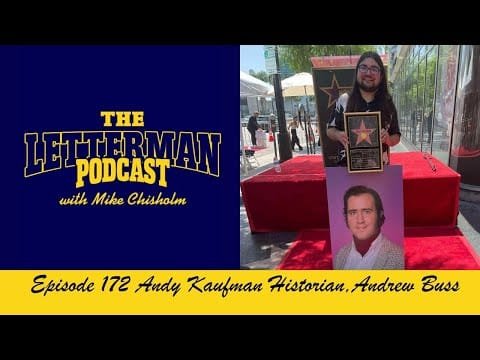
Episode 172 of The Letterman Podcast features the return of writer, oral historian, and the official Andy Kaufman historian, Andrew Buss!Among Andrew’s many creative accomplishments is I Am McLovin, the definitive oral history of Superbad, but this episode focuses on another icon of boundary-pushing brilliance — Andy Kaufman.Andrew and Mike go deep into the newly released documentary Andy Kaufman Is Me, reflecting on Kaufman’s legacy, performance style, and ongoing cultural impact. They also discuss Andrew’s latest oral history in Vanity Fair, where he once again interviewed David Letterman, as well as entertainment powerhouse Dwayne “The Rock” Johnson, and others, about Andy’s influence on comedy, character, and the unexpected.It’s a passionate, funny, and thought-provoking conversation about an artist who blurred the lines between reality and performance — and continues to inspire generations.⸻ This episode is brought to you by our friends at Hello-Deli.com — the only place to get official Late Show with David Letterman merchandise. Say hi to Rupert… and maybe buy a magnet or two while you’re there. If you’re enjoying the show, please like, share, subscribe, and leave a positive comment. It helps a lot… and Mike swears every new subscriber gives him just enough serotonin to carry on.
Episode Transcript
Read full transcript
Welcome once again to the Letterman podcast. All right, this week once again, two intros, an intro that is going to be uh timely, ripped right from the headlines as there has been a lot of stuff going on in the world of late night television and uh this episode is was recorded about a month ago. So uh really what we're going to do is we're going to do a re quick refresh about what's been happening. Uh last week we talked about this late show uh or the late show with Stephen Cobear has been cancelled uh by CBS. Uh when we talked about this uh the intro of uh last week's episode uh with Jed Rosenwig, the uh the founder of Late Nighter, uh I shot an intro that was, you know, the the news was uh about 15 hours old. Um maybe even less than that now that I think about it. I was told there'd be no math. Uh since that has happened, it appears that we might be having a circus-like momentum uh entering the world of late night television again.
I think we might get one last raw if late night television is going down with the sinking ship that is uh television broadcasting as we've known it for the past, you know, threequarters of a century or so. Uh they're going to have one last uh you know, circus time moment, I think. uh the first circus time moment being you know of course you know there were rumblings of it early on with Carson and and some of some of those times but when when when Carson was leaving in 90 92 93 that was when our first circus time was and and and really um it we really didn't get another one until the Conan uh Jay Leno um implosion I don't know what you'd call it cratering at NBC. NBC has always been the um you know the the the network that was mocked and uh bumbled things, fumbled things even. Now it's CBS's turn. And I mean I don't know. Someone can uh again I was told there'd be no math.
Someone could do the math as to see how long the Tonight Show went before it went through its first uh you know circus time. But, uh, boy, CBS is going through it now, announcing the clo the, uh, the the cancelling of Late Show this week. Boy, has, uh, a bunch of different responses come from a bunch of different places. Uh, Co Bear has been I've been watching the late night shows in real time all week. I've been watching them the night they happen, not the next day, not scanning through them while I'm doing other work, things like that. I've actually been It's cool. It's almost like late night has become I don't know if dangerous is the right word but uh late night has certainly become relevant and exciting again and because of itself because you know CBS makes this announcement and you have all sorts of players getting involved and having fun with what has been happening.
Um you know this past week uh it was you know CBS had said it was all financial reasons that this was happening you know an $8 billion merger. I suppose that would classify as uh financial reasons I suppose. But um you know they said a bunch of really classy things about Steven Cobear and then a leaked story something about you know him losing 40 the show not him the show losing $40 million. I again I don't know how this stuff works and how sometimes in a ledger one thing can look one way and another ledger things can look another way. Uh I'm very curious is is if that's what we're talking about here. I've been talking to a few people. nobody who's going to come on camera yet about this and uh for a lot of people it certainly certainly does seem suspect. If you go to latener.com you'll be able to see an archive of many of the uh of the happenings of this last week including another article with Bill Carter talking about um the institution of Late Show going away and and how how badly, you know, 32ish years ago CBS wanted this franchise. And it wasn't that they wanted it. 32 years ago they got it.
They wanted it for a long time. a franchise that would compete against the Tonight Show. And now now it's uh being thrown away the way it is. Protests outside the Ed Sullivan Theater. A petition with over 250,000 signatures on it to keep Colbear on the air. I think we all know it's not going to happen because much bigger players seem to be a part of this. Um you know, is it is it uh the Trump effect? I don't know. I've had I've had a bunch of people, former Letterman staffers, call me this week, you know, some who are proTrump, some who are against Trump. Um, but many uh of these people, regardless of their uh political affiliation or leaning, think that it's something more um than than it being about money. Um, with Late Show with Steven Colbear, uh, it's a very very interesting time to be a fan of this stuff again. And everybody seems to be talking about it. Everything everybody seems to be writing about it.
Uh on Monday night's Late Show, uh a bunch of the other late night hosts were there including John Oliver, John Stewart, Seth Meyers, um Jimmy Fallon appearing on the show, uh Adam Sandler, uh you know, seeing Oh, it was so funny. I mean, seeing seeing Shooter McGavin sitting there with Happy Gilmore in the audience uh before a Steven Cobar show was very, very funny. Steven's lines have been very good. Um, and then today an article I read uh on Late Nighter, I believe, was about um how how CBS had made this decision beforehand because they wanted to give the Late Show the sendoff it deserved and make the announcement before Skyance took over and and and started making changes to Colbear. That's a very interesting angle, too. Lots of stuff out there. It's an exciting time and again um it's been it was always fun uh back when I was in high school reading Late Shift and and and trying to follow this as best I could.
Of course, seeing it happen in um uh in real time uh with with with um Conan O'Brien and Jay Leno back in 2009 2010 and Dave's of course Dave's uh response to it. I think most of the people who love this program first off what's wrong with you? Second off, we're all kind of in the same camp where this is the stuff that we really really enjoy. It's the stuff that takes our mind off of life and and uh and and entertains and and for some of us inspires uh some of us odd folks inspires the idea that this is going to happen again. And uh could happen on as grand of a scale as it did back in 2009, 2010. Hey, if this thing is going to go out, let's go out with a bang. If it's going to change, let's change it with a bang. And I think it's really fun uh that we can all be a part of this. And uh please please throw out your your your your theories and whatnot. Our engagement on all of our channels have been uh up quite a bit.
Um you know, five or six people this week instead of you know, one or two and my mom. Uh the late the Letterman podcast uh Facebook group. Come on, interact with us there.
Leave comments on the show uh if you like. It's just a it's an interesting time to be a fan of late night television again. And uh the story is still unfolding and it's just beginning. Now that being said, um also today's guest uh I'm really excited about and I want to give it a second intro. You know, the hobbits love second breakfast. Don't you know about second breakfast? This is a second intro because I'm really really a fan of Andrew Bus. I I appreciate him so much. This episode is about Andy Kaufman. Um, Andy Kaufman is Me is the new documentary that hasn't been released yet, but it has been shown. It's been shown at the Tribeca Film Festival. Uh, at this point, I even asked, uh, today I asked around a little bit, it seems like there's still no definitive date for wide release. Uh, which is which is a shame. From everything that I have heard and you'll hear it in the conversation today with Andrew, it is an impressive piece of work and very different than any other documentary that has come out um as Andy with Andy Calfman being the subject.
Very cool. So Andrew Bus, uh the historian, we're going to uh I'll I'll repost his article with Vanity Fair, the oral history, uh that included people like The Rock and David Letterman, of course, uh commenting on it. We'll post that in the Facebook group and and and through our channels as well, but I highly recommend it. So, the Vanfair article, Andrew Bus, uh come out about a month ago. Um also an author, Andrew has written I am Mcloven, the definitive oral history about the movie Superb. Um I am Mcloven, how Superb became the biggest comedy hit of its generation. U again told in the vantage point of an oral history with Andrew, of course, filling in all around. I'm so happy that he wrote this book. whose Superbad's one of those movies where I don't know if they could make it again. I think the tides of culture might be turning. The pendulum always swings back one way and then swings back the other. Uh perhaps when it swings back the other, a movie like Super Bad could be made again. But at the same time, so many people, my best friend Mike and I, my best friend Mike, he's he was uh uh sort of featured on the show um that we had a while back.
Uh I've had him on the show a couple of times actually. He's been just sort of in the background. He's my buddy. He's got cancer. He's my best friend. And um you know, so excited. He and I always when we we we finish a phone call with each other, we go boop. And that boop means uh it's what uh um the two characters in Superbad do at the end of the movie. Um when they uh you know, they boop each other's nose, the best friends that just have this camaraderie with each other who had just been through an adventure together and they feel this way. That movie captured that um in one of the most filthy ways possible with one of the best casts possible. And I just love the movie so much. So uh if you pick yourself up a copy of I Mcloven um and the definitive oral history about Superbad and um yeah just really really excited to have Andrew on the show again here. Uh it's funny we talk about Andy Calfman a lot obviously in this episode.
I'm not going to I'm not going to rehash anything, but the day that I'm recording this intro a few hours ago, we just found out that Hulk Hogan passed away. And and and um I believe Hulk Hogan has a connection with this whole thing that we love so much because of a show called Saturday Night's Main Event. Um because of interactions that happened uh early on with Late Night with David Letterman and the WWF, which was changing pro wrestling in in in some big ways.
Dick Eersol involved um you know highly involved with NBC and it's an just an interesting there's some interesting stuff there and we get into that a little bit in this this episode uh but with Hulk Hogan passing away it's just one of the parallels with with Andy Kaufman we talk about this part in the in the in the showy uh when he had his legendary feud with Jerry Lawler in in Memphis Championship Wrestling he actually went to the Worldwide Wrestling Federation or the World Wrestling Federation um and and pitched the idea to Vince McMahon Senior and Vince McMahon Srior said no we don't want any of that entertainment stuff um and which at which time Andy went down south and it was a better decision anyway because of the wrestling culture down south and and whatnot we talk about that in the show another interesting parallel Hulk Hogan who passed away today at 71 uh was fired by Vince McMahon Sr from the World Wrestling Federation because he starred in Rocky 3 and Vince McMahon Senior didn't want any of that stuff And um after Vince Jr.
took over and Rocky 3 was a big hit. He actually brought Hulk Hogan back. And that changed everything when it came to the world of professional wrestling, Hulk Hogan was um you know, for me, he was a comic book hero come to life. That's who he was when I was growing up. I just that's what I saw. I was a comic book fan and he looked like a guy that was ripped right out of the pages of the comic books. And the presentation of pro wrestling, man, alive did I believe in it. And uh that probably started earlier on. It probably started with the infamous appearance of Andy Calfman on Late Night with David Letterman. We talk about that a lot. Uh I'm going to have I'm hoping to have somebody who will make the the the Letterman Wrestling Connection, an expert in the world of pro wrestling from their standpoint coming on. I don't want to say who it is right now, but I'm reaching out to them again and we can maybe talk about that in a future episode, but u you know, rest in peace Hulk Hogan.
Um and rest in peace Andy Calfman, continued peace and and mischief mischievous peace. Um, I'm really excited about this episode and uh all the things going on in late night television these days. Uh, there you go.
So, that's the rip from the headlines intro for the show. Now, please enjoy this episode of the Letterman podcast uh with our very special guest, the official Andy Calfman historian and author of many things, many articles, many books, including this one. I am Mcloven, Andrew Bus. Hey, this is Gabe Abson and you're watching the Letterman podcast.
Welcome once again to the Letterman podcast. My name is Mike Chisum. Okay. Um, Andrew Bus is back on the show and the embargo is over. We can talk about Andy Calfman. We can talk about the documentary because it has premiered. It premiered at the Tribeca Film Festival uh last Friday and um from everything I've heard, the premiere went very well and uh this uh Andy Kaufman is Me documentary is that much closer to getting in front of all of our eyeballs and hopefully that will be sooner than later. Uh of course, David Letterman, a producer on on on and Worldwide Pants, a producer on this uh amazing documentary um by uh filmmaker Klay Twe. Um, The Rock was a producer on it and Andrew Bus, who's been on the show before, of course, we talked about Carson the Magnificent because he was, uh, Bill Zmy's, um, uh, protege, uh, mentee, whatever you want to call it.
Um, and Andrew is also the official Andy Calfman archist, which is, um, what an enviable, uh, position to have for people who love Andy Calfman. My gosh, I can't believe um that that that he gets to sit in this place of entertainment history that he does. And he is that guy. Andrew is a guy who really really um takes these stories of performers who were around before his time, many of them, and and and wants to um uh make sure that the stories are shined up and and and given to other people. And I really appreciate that about Andrew. Uh he and I of course just just get right to it, start talking like like we're old friends again. And uh I just really grateful for him um coming on the show and being able to sit and talk with somebody um and go deep about Andy Kaufman. That is like a highlight for my week. Um and it I could say that when I was in high school. Uh I could say that when I was um you know in my in my in my early 20s building my career.
um you know and and up up to this day in my late 40s um I'm almost 50 years old and I still could go deep and talk about Andy Kalpin for an hour hour and a half we could go so long on this and um and so we both had hard outs this morning so we didn't get a chance to go um as long as we could have but we could have talked for hours about Andy Calfman his place in history of course the letterman of it all and uh he got a chance got a chance he's he's you know he's 2 and0 and I'm 0 for two I haven't had a chance to interview Dave on this show um and talk to him yet. Andrew's talked to him a couple of times this last year is in this last couple years both in doing oral histories for uh the latest one being the Vanity Fair article on Andy Calfman. I highly recommend um you you you look at that go to the Letterman Facebook page if uh the Letterman podcast Facebook page I should say. If you want to see a link to that uh we have one sponsor, one sponsor only at the Letterman podcast.
That is hello.com. Go to hello-delly.com for late show official merchandise curated by the man himself, Rupert G.
Uh, I just want to say thank you very much for everybody who has been reaching out. More shows are coming soon. Uh, in uh, in any case, please enjoy my conversation with Andrew Bus. All right, Andrew, I have been wanting to talk to you about this uh subject from the very very beginning and I've always felt bad uh whenever I would start to approach you uh about questions specifically just about Andy in general
um because I know you weren't allowed to talk about the dock, but now the doc has been shown. Andy Kaufman is me is out uh well it was at the Tribeca Film Festival um last weekend and it's it's it's it's been it's been revealed and so now we can talk about it again. Can we talk about anything now at this point? Like obviously we don't want to spoil the the doc too much but uh can we talk about anything? Are all embargos lifted?
Uh all embargos as far as I know are. Um and um yeah I mean ask me anything. Absolutely. Right on. Um, okay. So, Andy Kaufman. Um, I I think that, uh, I am certainly one of many Letterman enthusiasts who also have this kinship with Andy Kaufman. Um, for me, Dave was the gateway to Andy. Um, even as a child. Um, and it's very interesting. Uh, it's really interesting we're having this conversation right now because I'm literally maybe a week or two out of watching the Paul Rubin's documentary. And when you talk about
Oh, really?
Yeah. When you talk about a couple of performers who um were performance artists in many respects, the idea, you know, I know how much Andy loved um appealing to kids and things like that. I just I always thought that there was some sort of a connection between Paul and Andy. Um, and now this Andy Kaufman documentary is out. It's a good time to be a fan of of of of these things. Um, I'm just curious, what was your role with the documentary? And we can kind of take it from there.
Yeah. So, I was the uh I was the um archival consultant of the documentary.
The You're the official Andy Calfman historian, correct?
I am. I'm the official historian. I'm the official archavist. I've been the official historian/archchavist since 2015 15 I guess we can say. Um so it's been 10 years now that I've been doing that. Um and it's uh brought me on a wild kind of journey uh and doing things I never being places I never thought I'd be and getting to interact with um really interesting people along the way. uh up including to write you know this very moment as we're talking here your article in Vanity Fair just came out um just to drop a couple of names of people that you interviewed for that article for that uh the the the oral history presentation you did the Rock Dwayne the Rock Johnson um David Letterman himself of course again that's number two right
yes for David Letterman yes that is number two
pretty crazy um you know so so so Andy in that in that respect ect. Um, you know, showing a guy like The Rock, uh, and the fascination that he has with Andy, it really shows what Andy and his body of work did for those of us who love, you know, entertainment. I mean, I don't even know how to pick How would you peg Andy Kaufman as a performer? What would you How would you describe him? I as a performer, I would say Andy was someone that was really um that was really interested um in kind of getting a reaction out of the audience. Not and not always bad. People said, "Oh, he wanted the audience to hate him." It wasn't that. He he wanted the audience to like him like any other performer. Um but at the same time um when he was playing like the bad guy wrestler then yeah he would want you to boo because that was the character. The character was the bad guy and um he kind of fed off of that energy. Um, but you know, if he was on stage, he's foreign man.
Obviously, he would want I mean, and the whole, um, I don't want to get too far into the weave with this, but, um, I definitely, as a performer, I would say that Andy was someone that was about having fun. Um, he used to he used to say when he was on stage that it was, you know, that it was like his living room. Like that was kind of um, he was inviting people into his house. Um, and I really think that that's something important to note about Andy is that um, like everything else he did in life, being on stage, it was just about having fun.
Um, the idea about getting a reaction from people. Um, yeah, it seemed that uh, like I've got I think you and I have talked about this on camera before, but certainly off camera, you know, I've got a lot of pro wrestlers in my life. I happened to have a pro uh I I owned a or was a co-founder of a charity w pro wrestling promotion up here um in Canada and and and through that six-year adventure. Um I certainly learned a lot about psychology in the sense of how you can take a crowd of people and you can bring them up and you can bring them down and you can take them to certain places. You can make them feel certain things all the way from, you know, um, you know, blood spitting anger to almost joyful bliss and you can do it in a in a in a very short period of time. Um, Andy had a persona uh that that that he you know Tony his Tony Clifton persona which was in many respects an antagonist as an entertainer. It just seemed like he had this fascination with taking people on a journey. Um, you know, I hate to say manipulation of emotions, but things like that. Now, you've talked to his family like you've you've really really gone down the rabbit hole here. Um, did they see that as well with him? Was that always something that was there growing up or was that something that he explored um parallel to his performing years?
In terms of what exactly? uh the emotional just the idea of human emotion like like like the idea of being able to take somebody and and and and alter how they're feeling and maybe guide how they're feeling.
No, that was definitely very important to him. That's something that they that they saw and um they would tell me about um I mean I mean really and it wasn't just Andy being um in charge of that emotion. if you could really kind of get one over on Andy. He enjoyed that just as much. Um but yeah, I mean, ever since growing up, that was that was a big part of kind of his DNA was um getting um that out of people. And just um his mom had a quote um that I always really loved, which is um his mom Janice Calfman. Uh that was with Andy, it has to be about fun. and he won't do it if it's not fun. And so getting and for him fun was getting those emotions and um just I mean you mentioned the word journey. I think that's as uh great a kind of definition of what he did as anything. Uh even not even just on stage everything with Andy was a journey and um he was always bringing people along for the ride with him even as a kid.
Oh, that's uh, you know, childlike. Like when you would look at his um his reactions on stage, especially as foreign man, you talk about, you know, as a child, the the idea that he could go back to that childlike joy or or or or or s um simplicity, meekness almost, and then could then move over to, you know, that antagonistic type uh type behavior. It just shows the range of of of emotion and the range of uh of of Andy's ability. Um did he ever want to um you know was it was was was performing in front of an audience his sweet spot or or would would if if he would have extended and and and been able to you know explore film and things like that more was that something he would have leaned deeper into do you think?
Absolutely. And um the thing with him is he did make two uh films.
Yep.
Technically, you could say he was in a third one which was um the first film. I guess you could technically say he's got like a very brief cameo in. It was um Oh my god. The name of the film is God Told Me To. Uh Larry, who was director? Uh he was a
You keep going. I'll get you that.
Uh God Told Me. I can't remember off the top of my head, but um so he did that film. He did a Marty Feldman movie called uh In God We Trust. And then he did um in which he played um Richard Prior played God. Andy played like an evangelical kind of like one of the tele evangelists I guess they would be called later on. Played one of those guys. Um but thick southern draw. Um and then he did Heartbeats with um with Bernett Peters. Um, so he had done a couple movies, but really he had some of his own ideas for movies. Um, two of the ones that I know of. The first one was, uh, The Tony Clifton Story. That's kind of most famously the one he had been working on. Um, spent a couple years co-writing it. Um, trying to get it made. The thing that happened was it was at Universal and then Universal said, "Well, first let's see if you could headline a movie before we do Tony Clifton Story." So, he did Heart Beeps first. Heart Beeps unfortunately uh did not work.
And so, as a result, um Tony Clifton's story never got made. The other idea he had uh was to remake the film uh Miracle in Milan uh with with Foreign Man as the lead. That was his other idea for a movie. Um so even with his kind of conceptual ideas and movies, it was um it was kind of off the beaten path. I mean with him, I mean people are kind of surprised. Um sometimes what I talk about he was, you know, a pretty big cophile because he had grown up um in the documentary his brother Michael uh refers to him as being, you know, a child of television and he definitely was. Um he grew up watching, you know, all the TV shows like How Duty was a big part of his upbringing. um of course and they talk about in the documentary but also um with the um but also movies anytime they would there movies um you would watch a face in the crowd um I know was a big um kind of influence on him and kind of um I think at one point he also had wanted uh Foreign Man to do a remake of that.
Um and I I don't know if it was Foreign Man. I think he just would have liked to have done a remake of A Face in the Crowd. And then Fellini was another big uh hero of his. Um eight and a half is a movie he really enjoyed. Um so yeah, I mean he was definitely a cophile and um
well even look you look at Larry Cohen by the way. Uh Larry Cohen, thank you. Yes.
No, no, that's okay. Uh but but 7:15 here so in the morning. So
yeah. No, no. All good. All good. Uh you have a lot of things bouncing around in that head of yours um when it comes to you know this uh you know a variety of of subjects. I I I admire minds like yours being able to pull out quotes like that. But you look at like I mean and you didn't even include as for a film. I mean my breakfast with Blassie to me you talk about remakes. You talk about remakes um and the idea of you know taking my dinner with
it really is
blueprint and putting it on and I mean again back then I loved pro wrestling after like I I found a copy of that when I was pretty young all things considered you know that infamous night on on on late night um was was a gateway but I I I up here in Canada tried to consume as much Andy Kaufman uh material as I possibly could and I remember watching my breakfast with Blassie and he's not playing to an audience. He's got a film crew around him. They're in a diner and and and watching, you know, Glassy Freddy Blassie just do some of the things that he did and Andy just rolling along with it.
Um I wonder if there was a part of him that just liked to kind of make himself laugh inside. I feel like he was putting on a show for himself much of the time. you know, the idea that he's yes, he's this uh, you know, accomplished performer, but he goes and gets a job as a bus boy just to just to kind of have the experience of it. And you got to wonder almost like was he trying to was he putting on a show for himself in his head much of the time?
I've never taken him as doing it. I mean so much look so much of what he did was uh what he enjoyed and he was ve very um he he had a very clear vision um and everything he did did was very calculated in regards to that um and kind of his idea of uh entertainment and what he enjoyed doing. Um, but also at the same time, I mean, he was not I would say he was not the most generous laugh.
That's the other thing about him. Uh the um he would do like a little bit of a sheepish sheepish kind of shy laugh, but um the people uh talking to family and friends, it became clear that yeah, he wouldn't necessarily laugh at um you know, kind of the normal things that most people would laugh at. Um, I'd say, um, one example is he would be in, uh, one of his friends, Wendy, told me they'd be in the, uh, comedy club together, and it'd be comic after comic, and Andy, uh, whole crowd's laughing. Andy would lean over and go, "I don't know why this is funny."
Um, but then when Robin Williams would go on stage, Andy would lean over and say, "I get why this is funny." He still wouldn't laugh, but he understood why Robin was funny. And so that really kind of uh and it wasn't a mean-spirited thing. It's just he was just not he that just wasn't part of him. And the other thing with him is um as you can see demonstrated on David Letterman at one point, this is a very real moment. Uh if you're looking for a real moment, this is very much one. as far as telling a joke, he used to say, "I've never told the joke in my life." And a lot of jokes would kind of go over his head in a way. Um, and I mean, he was, and not to say that, oh, he, you know, he wasn't smart enough to get that's not it at all. He was this deeply intelligent, brilliant, you know, um, kind of um, surveyor of, uh, society in a way. And, um, he's deeply brilliant person. But um as far as um jokes, he just didn't really have much interest in hearing them.
Um but if you look at Late Night with David Letterman, uh there is when he does the um when he does kind of that uh I guess you can call him like a circus freak kind of character. Um where he's in a diaring Rosemary uh which I brought up to David Letterman recently and he was like he's like, "I forgot that happened." He's like, "Boy, how did I forget that?" Um, so, um, and so at one point they're sitting on a couch together and, uh, on the couch.
Andy's on the couch. I don't know why I phrase it like that. So, they're doing panel afterwards and, um, and Dave uh, at one point goes asks Andy about heartbeats and Andy said, "Oh, nope. Hardly no one saw it." He said, "What I want to do," he said, "I'm so embarrassed I made that movie. I want to offer everyone to get their money back. I'm going I'm working with my lawyers. I'm getting everyone their money back. To which uh Dave goes, you better have change for 20. Um typical Letterman joke. Andy just looks
Andy looks confused. He's like, "What was that?"
And then Letterman's like, "Oh, it's nothing. Anthony, I didn't even hear it." And
Letterman says it again. And Andy doesn't react to the joke. He just he says Letterman's like, you know, change for 20 implying that nobody saw it. And Andy goes, "Oh, nobody saw it. That's why the movie didn't do well."
Just complete.
He no sold it completely. And whether he misunderstood it or not, and that's the question. Do you think he misunderstood that? Like did he view life like like would he be labeled today as you know I think I think this is an overused label, but but will he would he be labeled as spectrum? is is like, you know, is it his perception of the world just that different or is he more the you know, Steve Young um you know wrote for Dave Forever, he calls it the broken comedy writer uh you know like Steve Young when he finds something hilarious this is what you get from Steve Young that's what you get from him you know you get a just one little laugh that's it and he calls it the broken comedy writer syndrome is that is that part of it as well
maybe that's a little bit of it but Um, I'll tell you the things that Andy got the most joy of that I've heard on these 84 hours of tapes, which I'm sure we'll talk about, but um, the thing he got the most joy of out of was he's really happy in Alando's tapes when he's doing like kind of theater on the street, I guess he would call it, or just a uh interacting with friends or family. Friends or family could get him to laugh. He was a generous laugher in that regard, just not with traditional standup or jokes or anything. So I think that was I think it might be a bit of a broken comedy writer maybe. I mean you can't spend so much time if you spend so much time in a comedy club. It is hard to hear fresh and kind of original ideas and he spent a lot of time around comedians. I mean that was that really became kind of his um I mean that that's just where he would go. Yeah, I mean he would just spend time in comedy clubs and even though he would spend time in comedy clubs, um it's not very uh he wouldn't necessarily get that close with the comedians, although they all had their encounters and their moments with him of kind of shared experience with him. But
um there were some exceptions obviously like Elaine Booler and him were very close. Um, and there were definitely a couple other comics that he did become close with, but yeah, it's terms of kind of I mean it it was just he was very interested what he was interested in.
Yeah. Oh, I think and I and I love that. I love that that he went he went hard into the paint like something like pro wrestling. And I mean, you know, you and I have talked about this a little bit off off off camera. Um I I fully believe that that um you know when pro wrestling changed to sport sports entertainment um everyone credits Vince McMahon for that and Vince McMahon of course you know built a billion dollar company out of something that was that was typically um seen as as lower brow and and and whatnot. And I and I understand that transformation that he made. I believe if there was a shot that was fired to create uh to morph pro wrestling into sports entertainment, it was it was Andy on Late Night with David Letterman. I think it was and it was not with the Vince McMahon character. It was with a different wrestling promotion because the the the crew that Vince's Vince's group was with World Wrestling Federation at the time, they didn't they weren't interested. They passed on Andy.
And that to me was a phenomenal um I mean I don't think it could have worked out if it wasn't somebody like Jerry Lawler. But the idea that he would lean into something that so many of the masses uh considered,
you know, probably most generously a little secret. I'm a pro wrestling fan, but I keep it kind of secret. I It's kind of a a guilty pleasure. Andy went right down that path and completely, in my opinion, helped be become the mainstream thing that it was. And it was because he, you know, Howdy Dudy, his his interview with Howdy Dudy, again, this is something that's out of the the the cultural lexicon for a long, long time. And yet, as he's talking to Howdy Duty, you almost see see like he's about to the emotion that's there is so palpable. And that's I think if I was inspired by Andy with with with one overarching thing, and perhaps you could say the same thing. It's when I'm into something, I really really go down that path and get into it. And it's pretty clear that's what Andy was like. Absolutely. Um he absolutely was and I do want to bring up you're talking about kind of him wrestling in Memphis I think and with Jerry Lawler I think it was so important for him to have his vehicle there versus um kind of the Madison Square Garden kind of crowd that he initially was going after. Um, so I think Vince McMahon senior turning Andy down, while it was a bit of a blow, I think what he was trying to do,
so much of it is specific and it's very centric to going down south to wrestle. It's the idea of
Holly I and the character that he took on. Um, and we have to call it character because it was absolutely a character. He was a monster.
Abundantly clear.
Yes.
Yeah. He was the heel. Like that was like
a monster heel. Not just a heel. He was heal.
He was the worst kind of guy you could imagine. That's literally who he was playing was the worst kind of misogynistic chauvinist guy. And that was not who he was. He didn't believe any of it. But he that's who he played. And um and that and that's the thing by the way that is so brilliant about him is that he would commit himself to it to the point where people would believe he was that guy and he just didn't
seem to have an issue with it. Like the people around him might have had issues with it, but he never had an issue with people confusing him with that guy because he knew it was so inflated and so ridiculous. And I don't know if he ever was surprised that people took it as seriously as they did, but I mean that's just because he was that gifted because he he made the audience um believe it. And I admire not caring. Like when people say, "Oh, he didn't care if the audience liked him or not." I don't think it was that. I think he did want to be liked like anyone else. But I think where he didn't care was when he was playing that bad guy wrestler.
Um he didn't care if the perception of him was a little skewed because of it. I don't
um
or reading The Great Gatsby on stage and and and committing like you talk about committing to the bit, you know, to the point where people angry with him or whatever and then leaving whatever it doesn't matter. I'm committing to this bit
uh because the bit is more important. Yeah. Yeah. Yeah,
it was commitment. And then I think and then I think a little bit towards the end he did I think one of the regrets might have been because um he was doing all the wrestling and then um I guess the Maharishi found out about it. He was big in the transcendental meditation. I guess the manorishi or Maharishi's camp found out about it and then uh he was supposed to go on this retreat as a teacher something as a TM teacher something he was deeply passionate about. This was something that was so part of his soul was transcendental meditation. He was deep into it. And to get told that I mean he would go on month-long retreats all throughout the the world.
Um he wasn't a guy that would vacation but he was a guy that would go to these retreats and um
to get told that you're not invited because um of the wrestling you're doing. I think that deeply hurt him. And I think that did confuse him. I think that confused him because well, how how can you believe this is real? Like
right,
how can you think that I like you know like I think part of it might have been you know who I am like you know that I'm I've dedicated my I am I'm that he was this purely devoted um person towards uh transit all meditation. Um, going back to the wrestling thing, I think it only worked that he went down south to do it because playing that character, the Hollywood character, um, doing it on the East Coast in New York wouldn't have worked as much. No,
because it had to be so far removed from entertainment. It had to be so far removed. It had to be with re not that people in New York are LA are not uh like real salts of the earth type of people but it had to be with people that don't have encounters with celebrity don't have encounters with I'm trying to pick my words very carefully with it but I it had to be with a certain type of people um middle America people that people down south um that just don't that that just have their things that they enjoy. And then Andy coming in as the interloper. I don't think he could have been an interloper in New York. I I mean he was a New York
guy. I think part of it
to the full extent of that character. It had to be down south and it had to be Jerry Lawler. It had to be a beloved fixture down it. Everything about it worked so much better than it ever could have done than it ever could have worked in New York, I believe. And then
Yep.
He took that energy to New York to David Letterman. And then that's when because people had known about the wrestling and think thought, "Oh, that's something kind of odd that Andy's doing down there." They're thinking, "Oh, he's down south doing something. We don't know what, but he's doing something down there." And then the match on April 5th with Jerry Lawler brought nationwide attention. Especially when Andy wound up in the hospital for three days and uh would then go around with the neck brace on anywhere he could get photographed with the neck brace on. He would make sure he could he had that neck brace on. Um he's being interviewed by Orson Wells when he has the neck brace on. Uh when Orson Wells was on the um Oh my god. Was it MV? Yeah, I think it was MV. I think he was guest. Yeah. And Andy has the neck brace on. Um and so
talk about committing to the bit. Like again,
absolutely that was commitment. Um at one point he even tried to to have LKA on taxi wear the neck brace. And that was that he was told no LKA cannot have a neck brace. And so I think I I think at that point when he had to take it off and you know maybe the people at taxi knew how he just messing around but everybody suspected that the neck brace wasn't needed. I mean Jerry Lawler has that great line where he says I don't know if that's a neck brace or a flea color right. Um great line and we have to talk about that a little bit. We have to talk about what happened on that show I think.
Absolutely. Well, I'd like to do that and I want to talk about the dock itself. Let's talk about that because we're in that vein right now, but then I want to talk about how different this doc is compared to the other material that's out there, but let's talk about that night a little bit because um you know, you talk about people being in on it, not being in on it. From my perspective, I've talked to segment producers, the writers on the show, um you know, some of the people who literally he stormed past to go through the uh the exit doors. Very few people were in on it. Very few people. And I think that's the magic of a of a um a wrestling angle even to this very day when when um you know this art or this company can take an audience whether it's a television audience or if it's just the live crowd and they can suspend the disbelief and and um a big big part of that uh ingredient to that uh doing it well is people not being in on it.
Now Dave famously of course uh you know Mel Marco uh uh you know Dave's original headwriter and girlfriend at the time you know she wanted to play with that because of Dave's wit. She wanted to surprise what she refers to as surprise the host. She liked surprising the host because in this particular case our host happens to be you know one of the greatest rapier wits of all time and and and his reactions are incredible but hated surprises. So no don't don't surprise me. I don't want surprises. Let's not make that part of the show. My reactions will come across like they are surprises. We'll make sure that that's the case. Uh we'll find that common balance. Here you have something where I mean it to virtually everybody something that happened um which was outrageous. Uh headlines everywhere. Um, Jerry Lawler told me himself that Robert Morton used to tell him that they referred to that as the Famous Show back in the day because Letterman was very very young still at this at this time.
Um,
yes, this was this is what people forget. This was not Oh, this was, you know, like he had been on a couple years. This was July. Oh, was it the 27th? It might have been. Um, this was late July, I believe. Yep. And um the wrestling match was on April 5th and Letterman's first show was February 1st.
Yep.
Right.
It was February uh Febru Yeah, it was February. It was early February. Yeah,
early February. Yeah, it might have been the second, but I think I know it was that first week. So that's less than that's less than that's like 6 months like
July 28th 82. Yeah.
July 28th,82. Okay. I was off by day, but yes.
Yeah. You had it. You had it.
I I I had that vicinity. Yes. Um
that's why they called it the famous show. It's the one that kind of put put Letterman on the map in many respects. Yeah.
I mean, think about something like that happening to this young show. And letterman as he told me and he's told a lot of people um the next day in the New York Times um it said you know it it wrote about this as he calls letter laughs about it he said he wrote about it like it's this assault that happened Mr. Kaufman was slapped by Mr. Lawler on Late Night with David Letterman. Like as if it was as if there were no TV cameras there. As if it was like a gossip column like, "Oh, I saw over at Studio 54 that Andy got slapped by Jerry." Like they're writing about it as if it wasn't on television. Yeah.
Like it is wild. As if it was not part of a show that is going for comedy. But the thing as far as who knew and who didn't know, I think it's interesting. I think and I think over the over time people might think they knew or might think they didn't know. So it does change. Letterman when I talked to him he did say that um he knew he said he always knew what Andy was going to do and he said that he told me here's one of the things many things I love about lettering is um some of the is usage of analogies and kind of um with certain things um like you know he he like one of the first things he said was being my band was like spending a day at the carnival that was one he did and then Another one he did was um Oh my god, I'm going to pull this up because I do not want to get this wrong because I love this too much. Um, give me just about
Yeah. No, no, no, it's okay. I love that quote, too. Uh, you wrote that in the Vanity Fair article. That was one of the the Letterman quotes that made that oral history. Um, I'm fascinated with the entire conversations from some of these people. Uh, because you take these snippets and you create this beautiful narrative. But um but but uh you know the the conversations themselves to me I'm the deep dive guy. I would love to hear you know what the Rock had to say about all of this like un unedited. I would love to hear what Letterman said because he does he speaks in these beautiful sound bites. Um you know spending a day with Andy was like a day at the carnival. Spending with Andy was like a day at the carnival. I'm curious about some of these other ones.
Uh yeah absolutely. Um the other one with um letter that I have to bring up that um he said one of the many nice things about Andy is you would get a rough outline. It was like a menu at Denny's. He would tell you what he was up to generally. So there were never any surprises except that the performer had outlined uh that the performance that he had outlined was always interesting and exciting.
Um so yeah I mean I that captured my imagination. I had to shoehorn that one into the piece as well. A menu at Denny's.
I know. Moon's over Miami. You don't You think you know what you're going to get. It's just an outline of what you're going to get here. Here it is. That what a what a
absolutely it. And I I love I just That's one of those things that Letterman does that I love is just little
Yeah.
Just his play on words like um um Oh, is that Yeah. Yeah, I mean his play on words that people have always talked about um that he's really good with and um it's and uh I know he's talked about that. I know Jay Leno has talked about that who um just uh who I was I was having lunch yesterday um at Don Cuckoo and here in Burbank not here in Burbank but in Burbank. Uh I work in Burbank and um I looked up and then Jay was just walking by uh down the sidewalk yesterday. That's kind of what life in Burbank is like. Um,
absolutely.
But, um,
no, David Letterman is, I believe Jay calls him a wordssmith. Uh, he talks about how he talks about, uh, Dave's vocabulary and just how articulate us words in I think he says instead of uh, like a drink, he would say a beverage. I think that's the one that Jay always says.
That's right. Um,
tasty beverage. And And who doesn't deserve a tasty beverage, by the way?
Exactly. And and that's but that's so much of what letter did like his vocabulary like what he would do um um just like so much uh and you can see that in um in that longer incident as well like just that quick oneliner of just um where he goes you know you can use some of those words on television but what you can't do is throw copy I've said it again and again just those little choices that Letterman makes. So, I just I love And so, yeah, even when I was talking to him. I was talking to him. I was sick in bed this day. Yeah, I'm always sick right before I come on your show. Um but I was sick. I was really sick for a couple of weeks and uh luckily I didn't it didn't prolong this um this um uh appearance. But, um I was sick in bed and I remember it was my birthday. I was really sick on my birthday. Sick in bed all day. The only upside to my birthday, the only impactful moment, nothing impactful happened on the actual day except that um I got to talk with David Letterman on my birthday. And
did he remember you?
Yeah. When I brought it up, he's like, "Oh, that's right. That's right." Yeah. We talked for Conan. And then he said in a similar vein of this and then um he did end it by saying he's like you know nice to talk with you again. And um the next time you're doing one of these meaning basically where I'm interviewing him about someone else which is always feels kind of weird but he was a producer on the documentary so he got it. Um he said next time you do one of these um he just said uh please consider me.
Oh my god.
And I thought that was interesting. I thought that was an interesting thing to say. Um,
those are the words I dream of hearing from David Letterman. And you That is That is fantastic. Um, yeah.
And I I want to talk about
Oh, go ahead. Yeah. No, please finish.
You asked me last time if he turns the tables on me and starts asking me questions. He didn't do it so much the first time. This past time he did. He that past time as we're talking he's like so I told him it's my I tell him it's my birthday wishing me a happy birthday and then he's like he started asking me about me he's like so where are you located like what do you do and then when I told him that I'm the archavist he would ask me a question about and and then he asked me about we started talking about some documentaries he started talking to me about the Gallagher documentary which he saw and then I'd asked him and then we started talking about the Paul Groomman's documentary. Um, and he's like, well, that Paul's another guy like Gallagher, like Andy, where they are so they were so of that moment. But, um, I feel like not so much Gallagher, but I feel like Andy and Paul both were able to transcend just the 80s and transcend those moments. Even though Andy never physically made it past the 80s, I feel like his work is still so respected. I mean, there was an Apple commercial. You cannot get more modern than Apple. And there was an Apple commercial that used this song, I trusted you. And you hear it when you watch a commercial. I trusted you. I trusted you. That's a song that Andy wrote.
I mean, it's three words, but the melody and everything. That was something Andy did on the Midnight Special in 1977.
Yep.
Almost 50 years ago. So almost 50 years later, you've got an Apple commercial showing Andy singing or not showing Andy, but you have an Apple commercial with a song composed by Andy Kaufman. It's who would write songs and think he did a couple things. Um he had a soundstage special in the late early 80s but um that where he wrote a song called Wild Wild Loving that was on uh that he wrote it for Elvis and I believe he wrote it so he wouldn't they wouldn't have to clear out Elvis song because it didn't have that much of a budget but um
but anyway um yeah that was the thing I want to bring the trend setting part I I love that you said this um Because again, I look at what pro wrestling is now, sports entertainment is, I feel like Andy saw the vision for that.
Um, what PB's Playhouse became, I thought that Andy saw the vision of that.
Um, you know, and some of these some of these this performance arts stuff, uh, this audience manipulation stuff, I believe, you know, Wayne Gretzky has a very famous quote, you don't go where the puck is, you go where the puck is going. Whether he knew it consciously or not,
Kevin Smith, my my friend Kevin Smith, one of his favorite quotes is that.
Yeah. Yeah. I I really want to get Kevin on this show because I want to talk. There's a Okay, we'll talk about this off camera or whatever. I really want to There's a moment where Kevin
I mean Kevin loves Letterman. Yeah,
I know he does. I know he does. I would love to to to pick his brain about that. Especially one particularly uh infamous moment where he could have been on the show and he passed on it. Uh but but the idea that that that Kaufman whether he knew it or not saw where the puck was going
and and of of pop culture of all pop culture like some of these things that are there the best wrestling angles are the ones that merge reality and whatnot billion dollar company you got these these things that are there and andy was just being himself but he gave us a blueprint and inspiration that like you said we're talking about all these years later a lot of material has been uh written and produced about Andy I am super curious about your perspective. The couple questions that I have to ask about the documentary are going to be of course what makes it different and there are some very very cool things that make it different. The tapes um the the the puppet show uh aspect of it, the way that that that it's presented to us. Phenomenal phenomenal behind the scenes stuff, but then we get this other material that's out there. I'm super curious um Andrew what your what your impression of the movie Man on the Moon was because again
there's a lot of kind of blueprint of facts but then there's a lot of sort of
uh you know um spectacularness to it as well
and it it feels like this documentary that you guys have have all lovingly made um everybody playing their parts um it doesn't seem like it has a lot of that fantastic stuff. It's just the actual material of of what happened and how it happened and it's very straight ahead. Uh compared to um you know uh like like I got Zimmuda's book up here and I mean I'm curious about like I've read this book many times and just like the movie man on the moon I see it and I go okay I wonder how much of this is real and how much of this is actually sensationalized a little bit. And
that's that's the Zamura influence that it's I I I firmly believe in Zamuda's um one of the only people um I will say in Andy's kind of uh orbit that I have not spoken to of the people that were alive when I started um when I started going down uh going venturing into Andy Land. Um
Andy Land
Zum was one of the only people that was not around. Not not not that he wasn't around, but when you I think he's the only person I didn't um I I never interacted with. Um
but um yeah, I mean definitely Man on the Moon and um and that book in particular, they've got a feeling they do have that feeling of um of wondering is it real, is it not? Man on the Moon is like a greatest hits for the mo for the most part. It's a greatest hits of kind of Andy's career.
Yeah.
Um it talks you know you you get to see everything all these things recreated. Um and um it's an interesting interesting thing. Um but there was the spectacularness. Things were inflated. Things were exaggerated. Carnegie Hall did not happen at the end of um end of um at the end of his career. It happened um early on. It happened in 1979.
Um
while Taxi was still in his first season, so he
Lauren Michaels wasn't the one who kicked him off SNL. Um
no, Lauren did not kick him off SNL. That was Dick Eversol. Um, the fact that Lauren went along with it always in Man on the Moon always kind of astounds me. I am kind of astounded that Lauren would go along because the thing is, you know, he's playing himself projecting a narrative that he's the one that said Andy Calfman is no longer funny. And and Lauren's one of Andy's was one of Andy's biggest supporters because Lauren and ironically early on so was Dick Aberol before he wasn't. Sure.
Um
until he wasn't.
Until he wasn't. Exactly. Yes. I mean I And that's the thing, by the way, people forget when they talk about Dick Aberto kicked him off SNL and he did the kind of the Greek tragedy part of it is Dick is kind of the one that found him in the in the catcher rising star. Dick saw him and uh and then Lauren um of course um really they had a very interesting kind of relationship very kind of like uh Lauren's always felt kind of protective of the cast and even though Andy was never in the cast Lauren had a protection protective feeling over Andy um in a way even though they were not too distant in age. Um when Andy said he was going out to LA um Laur and um during a sitcom Lauren kind of had an interesting feeling about that. Lauren was kind of like well he was kind of worried that Andy was going to fall into kind of the trappings of Hollywood and um
yeah he wanted to make sure he stayed pure. wanted to make sure he stayed the performance artist as opposed to
you know uh for lack of a better analogy just getting a sitcom you know
right absolutely you wanted to get kind of the performance of Andy pure because that's the thing um that is so fascinating about Andy is that and in the documentary um going back to the documentary um you get to hear Lauren talking about how important Andy was on uh these tapes um noty these tapes. But um so going back to the documentary a little bit, what sets it apart is the fact that there is so much um is the fact that those tapes allow you to get inside Andy's brain.
And how many hours are you talking? Is it 40? How many hours of tapes is it?
It's 84 hours.
84 hours. And how when did you first become aware of these tapes? Because you've been in Andyland for a long time. When did you know these tapes existed? I had heard that these tapes existed um back in well I first became aware when everyone else became aware which is um when there was a CD that came out a number of years ago called Andy and his grandmother. Um so I became aware through that through that CV and then at a certain point um I got to hear being the archavist I got to start listening to the tapes and um they're fascinating tapes and it is the closest that and it allows people to really understand how Andy was offscreen because the idea of the real Andy I've started my my my mind recently has kind of shifted a little bit into Um, I think Andy was no more complicated than anybody else who was complicated. I think Andy was absolutely like when people say who was the real Andy, what they're really saying is not oh, who was really him. What they're saying is how was he off stage,
right?
And how he was he offstage was he was just as normal as anyone else. Like obviously he had quirks. Um but if so all of us have our own little individual quirks, but he was uh even in the 84 hours at one point he calls someone and um starts talking to a fan who read him a fan letter and he started saying he's like, "Oh, so you really believe that I'm like he's like, "You really believe that?" He's like, "I'm not that no, I'm not like that's a character. That's they were he played he spent his life in characters."
Yeah. And you know, he's like the insane car. He would do like an insane character. He would do this character, that character. Like I mean, some of the characters would blur the line, but at the end of the day, there was a real person that would just call his grandmother and just have loving talks with the grandmother. And I mean, that's the way to tap into Andy's mind is listening to his interactions with his family. and um and on these tapes and in the documentary they do use puppets. They use the uh Huey Williams is a book that Andy had written or was writing and um Andy's brother says as much as Andy's performance uh is reflective of who he was, his writing is where you really get to go into his mind. And so what's interesting is on the 84 hours they found they they I I knew it was there. Uh on the 84 hours um Andy talks about uh talks through the Huey Williams story before he writes it. So he's narrating the story
over audio. And so when they did the documentary, they got to use Andy narrating this book without him having done an audio book. He was narrating what happens in this book that he had written. It is fascinating,
fascinating stuff on those tapes. And speaking of tapes, um I know we I'm trying to cram all this in that you had asked about. Um
speaking of tapes, I also want to bring up Bill Zammy. Bill Zammy who was my mentor. He had written Lost in the Funhouse which I do think is which I would call the true biography of Andy. If you want to read something about Andy, read Lost in the Funhouse.
Yep.
Um and um yes, I I implore people, please read that. It's an absolute It is It's basically um as close as you're going to get into Andy's mind from someone else's kind of um lens. Y
but um but the tapes that Bill uh Bill did over a hundred interviews, Bill and Mike Thomas um who was um in Bill's employee at that point, Mike was is uh I guess Mike calls himself a leg. Um and um my who Mike who wrote uh who was able to co-author uh Carson the Magnificent with Bill. Um
I was just going to grab it's just off camera here as you
off camera here too. Bring it up here. Magnificent. Yeah, that was something that that you know the um epic um kind of owed to Johnny Carson that Bill spent so much time doing and Mike had finished. But yeah, Mike was the original kind of menty for um Billy long before I came to the picture. Um, I when when he first started working with Bill, I think I would have been about 2 or 3 years old as hell. It's kind of my age. This is one of the reasons I'm so fascinated with you though because um
you know and I think I think we're maybe sort of cut from a similar cloth in this regard in the sense that um you know we we for whatever reason want to pass on certain elements of knowledge and we have people that are in our lives that are older than us that that that give this knowledge to us and we sit there like sponges listening to it and we want to project it. We want to pass it on. We want to keep these things going. And I'm so grateful that we have somebody who's young who is uh the official Andy Kaufman archivist because um I believe I believe
because it needs to keep going like beyond a certain beyond the next 20 years it it needs to keep going and 20 30 years it needs to keep going. So, I do think having someone younger, I'm I'm 32. Um,
which when I told Letterman, I have to bring it back to Letterman Rand Letterman podcast. When I told him that, he asked, "How old of a man are you?" And I told him, "Uh, 32." He said, "I am four times your age." Um, and I'm like, "Well, hey, you look great, Dave, for four times my age." He's like, "Well, thank you." But um anyway, yeah, I think having someone younger and kind of there, I I think it I think it definitely helps Andy's legacy in the long run. Um because I'll be talking about Andy until the time of Mie and I'm totally grateful.
Exactly.
I'm I'm never going to stop talking about Andy because Andy I think I you again, we're going back to questions you asked me earlier. Who had a great and a quote The Rock has a great quote in the article that I absolutely loved. Um, and he he was fantastic. I'd never talked to him. We're supposed to talk for 10 minutes. It wound up being 25. He did that thing like Letterman where The Rock starts asking me questions and want to know was Andy happy. Um, so that the fact that he wanted to know if Andy was happy. That I thought was really cool. But The Rock, I remember, uh, told me that Andy was the epitome of humanity because he went down roads that no one else would go down. When he told me that, I thought that is so precise. That is so clear to me and I thought that was so beautifully put.
Um, and his perspective again unique in so many ways like a lot of people don't realize. Okay. So, The Rock The Rock is a third generation
uh uh wrestler. Yeah.
Pro pro wrestler. Yeah. and and and and when he came up he came up early on through MCW through Memphis Championship Wrestling and working with Jerry Lawler and
he yeah he wrestled there I can't remember the name he wrestled under
Flex Cavana was the name Flex Cavana as
Flex Cavani thank you thank you um
a student of the game at that point third generation his grandfather was a promoter in in in Hawaii and I got to wonder like when he finally got some facetime with Jerry Lawler I wonder like it's like when I I I've talked about this on the show many times. I hung out with Jimmy Hart who hung out with Andy. He was married to Andy on the road because back then good guys and bad guys weren't allowed to talk to each other. And so, right,
um Jimmy Hart would many times convey messages between Jerry and Andy on show night and things like that. And I'm super curious if The Rock, who knows all this history and and is a student of this, I'm sure it's probably one of the reasons why he wanted to be involved in this project. I'm wondering if he talked Jerry Lawler's ear off about about Andy because Andy transcended the sport.
We never talked about that, but what he did tell me is he he did tell me he didn't say directly it was uh Jerry, but he did say that he um got to know people over the years u from Andy's circle. So, I'm assuming he's talking about Jimmy and
Absolutely. Um, I'm assuming those are the people, but um, he would he would talk to them and they would talk to him about Andy's vulnerability. And um, you you mentioned Howdy Duty. That's a big part of the documentary. Andy had this ter interaction with Howdy Duty. And uh, The Rock told me uh that that made him emotional. I it didn't make it in the piece, but The Rock told me that was very emotional watching that for him. And um and it is you're watching someone meet their hero.
Yep.
That's you're watching in real time somebody meeting their hero for the first time and it's on camera and the hero is a puppet.
But it doesn't matter. That's not It doesn't matter if he's real life like he's real to Andy in that moment. Andy treats Howdy with so much respect. It is a real vulnerable authentic moment. And so when people say, "Oh, you don't get to see the real Andy Kaufman." That is him. That is real. Nothing about that is conflated. It is completely real. And even Michael has said that is the most authentic probably real moment. Um, you know, that might be one of the most real moments in TV history. And it's with Andy and a puppet.
Yeah.
It doesn't I wouldn't even think of Howdy as a puppet in that moment. You think of Howdy as a um symbol of Andy's childhood. Howdy is a is as real as anything.
Um I hate to end this because I could talk to you about Andy Kaufman for hours, but I know
I could I hope I I hope I didn't ramble and I hope I I mean I did ramble. I hope I didn't ramble too much.
No, no, no, no, no. I like this is the idea for this show to me was always um you know I would have conversations with Shecky or I'd have conversations and Shecky had he I I mean he oh man did he ever put up with my questions about Andy a lot and and and um you know the idea was
Shy Green or
what's that?
Shaky who?
Oh Rick Shman. Uh not like I'm like green that would be a different show. Um,
that would be on everyone's show. I was a little confused. I'm like, Shaky Green, huh? Wow.
When when Rick and I would talk about like he he indulged me so many times uh with these stories. It's just questions that I would ask and we would get into these conversations around and I said, "This is what I want the Letterman podcast to be. I want it to be just a conversation um uh and and and literally the the the the recorder is on, but you forget the recorder is on and we just have a just a genuine back and forth. I honestly believe that this world um you know I believe there's a reason why Dave in his long form is so effective. Long form conversation is so good and it to me it's not rambling. I love every word that has come out of your mouth today and I'm so grateful like I say that you exist and that you're doing your thing. Um I can't wait for the doc
to get its wide release. Um
yes, you know
don't know yet. Um I and by the way I am you know I am very much also on the outside of it. I um um you know I was the archival uh consultant on the documentary. I'm uh I've spoken with the director Clay um uh I I was emailing with him right before Tbeca um and um because he was in the piece as well and um my understanding is that that the who I've talked to that were there my understanding is that the premier Tbecca went well and they are still looking for I don't mind saying this because they've said this um they are I believe they're still looking for distribution if it hadn't sold within the last week since it premiered Tobacco, which is possible, but I don't know. Yeah. So, I believe that they're still looking.
This is the information I have as well. All I know is that when they do release uh the digital version of it, whatever it is. Uh I'll buy a physical one. Uh please put as many uh cutting room floor special features, anything like that, please put as many extras on it as you possibly can. I'll swallow it up.
No say in it. No, I know you don't. I'm just throwing it out to the uh to the Blu-ray gods or the distribution gods right now.
I hope they there's so much there's so And by the way, the documentary gives you a little a little taste a little appetizer of those 84 hours. There I mean what I've written about the documentary is that um it is hard to get to the core of someone in an hour and 40 minutes. Yep.
It would be hard to get to the core of a of someone who wasn't um dedicated and devoted to keeping the audience guessing. It would be hard to get to the core of someone who's just, you know, a standard banker or whatever, psychiatry. It would be it would be tough to get to the core of anyone, any human being in an hour and 40 minutes. But to get to the core of Calvin, it is really hard. But what I will say is the documentary definitely puts you in that right direction and it's definitely
you get to understand Andy offstage more.
Not so much the real Andy because I think it's a little arbitrary at this point. I think the idea of what is real and I think the idea of you know because Andy was real.
Yep.
And and I mean Andy was very real on stage. Um I think Yeah. So, I think when people say who was the real him, they're really saying what was he like when the cameras were weren't rolling. Um, that's all.
Oh my god, Andrew, you buttoned it up. You went you went back to the beginning and you brought it around here. Like, it's like you're It's like you're a pro at these things. Uh, thank you.
I just I just talk and I hope that what I'm saying makes sense at some point.
To me, it does. And uh and I don't know what that says about either of us, but I do know I'm grateful for you. I'm grateful. Um, I'm grateful for every piece of material you put out. Thank you so much for um I know how much you do for the love of the game and for the love of this stuff and and how passionate you are.
All I do it I don't do it for the money. That's for damn sure.
No. Hey, I I feel you. I I I I understand that. And and but that's okay because it scratches a different itch and and um
Yeah.
You know,
I couldn't get this like I wouldn't want to work I wouldn't want to be anywhere else because I couldn't get what I get. I what I get out of um this industry I'm in is so much richer um than money because I get to have a quality um of life through it that um and just um get to experience things and get to talk to people I never thought I'd get to that is so much more important um than money. If my dad heard me saying that right now, he would probably get really upset. But um sorry, Dad. It's true. It's absolutely true. I feel like experiences have so much currency to me as a person.
I feel the exact same way. Um the exact same way and and and uh you articulated you you do you do a good job sometimes of articulating thoughts that I kind of have that I can't articulate. You just did it right there. I thank you Andrew. Um you're a friend of the show. I can't wait to have you back on uh for whatever.
I'll do it anytime I can.
Yeah. Oh, no. And I appreciate
any time I don't have pneumonia or anything. I'll I'll be back.
Yeah. I guess we got to Yeah. keep the monitor going. Uh the next time you're at your GP, let me know. Uh and I'll be waiting with baited breath, meaning that you're going to come on the show again soon. Um thank you so much, Andy.
Next time I'm sick, I'll be back on the show.
Yeah, that's right. Um thank you so much for everything that you do. Uh and thank you for taking time to talk about uh Andy Calfman with us today. Uh this has been another episode of the Letterman podcast with Mike Chisum. Coincidentally, I am Mike Chisum. That's Andrew Bus. Thank you and good night.
Thank you,
dude. Overcoat and underpants.